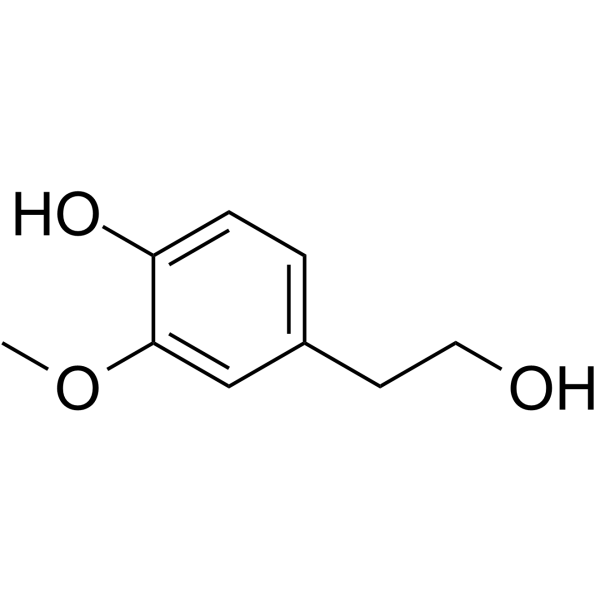
Physicochemical Properties
| Molecular Formula | C9H12O3 |
| Molecular Weight | 168.19 |
| Exact Mass | 168.078 |
| CAS # | 2380-78-1 |
| PubChem CID | 16928 |
| Appearance | White to off-white solid powder |
| Density | 1.2±0.1 g/cm3 |
| Boiling Point | 316.8±27.0 °C at 760 mmHg |
| Melting Point | 40-42 °C(lit.) |
| Flash Point | 145.4±23.7 °C |
| Vapour Pressure | 0.0±0.7 mmHg at 25°C |
| Index of Refraction | 1.559 |
| LogP | 0.33 |
| Hydrogen Bond Donor Count | 2 |
| Hydrogen Bond Acceptor Count | 3 |
| Rotatable Bond Count | 3 |
| Heavy Atom Count | 12 |
| Complexity | 127 |
| Defined Atom Stereocenter Count | 0 |
| InChi Key | XHUBSJRBOQIZNI-UHFFFAOYSA-N |
| InChi Code | InChI=1S/C9H12O3/c1-12-9-6-7(4-5-10)2-3-8(9)11/h2-3,6,10-11H,4-5H2,1H3 |
| Chemical Name | 4-(2-hydroxyethyl)-2-methoxyphenol |
| HS Tariff Code | 2934.99.9001 |
| Storage |
Powder-20°C 3 years 4°C 2 years In solvent -80°C 6 months -20°C 1 month |
| Shipping Condition | Room temperature (This product is stable at ambient temperature for a few days during ordinary shipping and time spent in Customs) |
Biological Activity
| References |
[1]. Protective Activity of Hydroxytyrosol Metabolites on Erythrocyte Oxidative-Induced Hemolysis. J Agric Food Chem. 2013 Jul 10;61(27):6636-42. [2]. Protective Effect of Homovanillyl Alcohol on Cardiovascular Disease and Total Mortality: Virgin Olive Oil, Wine, and Catechol-Methylation. Am J Clin Nutr. 2017 Jun;105(6):1297-1304. |
| Additional Infomation |
(4-Hydroxy-3-methoxyphenyl)ethanol is a member of methoxybenzenes and a member of phenols. Homovanillyl alcohol has been reported in Saussurea medusa, Cyclopia intermedia, and other organisms with data available. Homovanillyl alcohol is a metabolite found in or produced by Saccharomyces cerevisiae. Metabolite of serotonin and norepinephrine. |
Solubility Data
| Solubility (In Vitro) | DMSO: ≥ 100 mg/mL (594.57 mM) |
| Solubility (In Vivo) |
Solubility in Formulation 1: ≥ 2.5 mg/mL (14.86 mM) (saturation unknown) in 10% DMSO + 40% PEG300 + 5% Tween80 + 45% Saline (add these co-solvents sequentially from left to right, and one by one), clear solution. For example, if 1 mL of working solution is to be prepared, you can add 100 μL of 25.0 mg/mL clear DMSO stock solution to 400 μL PEG300 and mix evenly; then add 50 μL Tween-80 to the above solution and mix evenly; then add 450 μL normal saline to adjust the volume to 1 mL. Preparation of saline: Dissolve 0.9 g of sodium chloride in 100 mL ddH₂ O to obtain a clear solution. Solubility in Formulation 2: ≥ 2.5 mg/mL (14.86 mM) (saturation unknown) in 10% DMSO + 90% (20% SBE-β-CD in Saline) (add these co-solvents sequentially from left to right, and one by one), clear solution. For example, if 1 mL of working solution is to be prepared, you can add 100 μL of 25.0 mg/mL clear DMSO stock solution to 900 μL of 20% SBE-β-CD physiological saline solution and mix evenly. Preparation of 20% SBE-β-CD in Saline (4°C,1 week): Dissolve 2 g SBE-β-CD in 10 mL saline to obtain a clear solution. Solubility in Formulation 3: ≥ 2.5 mg/mL (14.86 mM) (saturation unknown) in 10% DMSO + 90% Corn Oil (add these co-solvents sequentially from left to right, and one by one), clear solution. For example, if 1 mL of working solution is to be prepared, you can add 100 μL of 25.0 mg/mL clear DMSO stock solution to 900 μL of corn oil and mix evenly. (Please use freshly prepared in vivo formulations for optimal results.) |
| Preparing Stock Solutions | 1 mg | 5 mg | 10 mg | |
| 1 mM | 5.9457 mL | 29.7283 mL | 59.4566 mL | |
| 5 mM | 1.1891 mL | 5.9457 mL | 11.8913 mL | |
| 10 mM | 0.5946 mL | 2.9728 mL | 5.9457 mL |