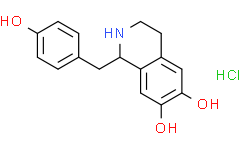
Physicochemical Properties
| Molecular Formula | C16H18CLNO3 |
| Molecular Weight | 307.774 |
| Exact Mass | 307.097 |
| Elemental Analysis | C, 62.44; H, 5.90; Cl, 11.52; N, 4.55; O, 15.59 |
| CAS # | 11041-94-4 |
| Related CAS # | (S)-Higenamine hydrobromide; 105990-27-0; Higenamine; 5843-65-2; (S)-Higenamine; 22672-77-1 |
| PubChem CID | 165901 |
| Appearance | White to off-white solid powder |
| Boiling Point | 522.4ºC at 760 mmHg |
| Flash Point | 209.6ºC |
| Vapour Pressure | 1.56E-11mmHg at 25°C |
| LogP | 3.363 |
| Hydrogen Bond Donor Count | 5 |
| Hydrogen Bond Acceptor Count | 4 |
| Rotatable Bond Count | 2 |
| Heavy Atom Count | 21 |
| Complexity | 317 |
| Defined Atom Stereocenter Count | 0 |
| SMILES | Cl[H].O([H])C1=C(C([H])=C2C([H])([H])C([H])([H])N([H])C([H])(C([H])([H])C3C([H])=C([H])C(=C([H])C=3[H])O[H])C2=C1[H])O[H] |
| InChi Key | SWWQQSDRUYSMAR-UHFFFAOYSA-N |
| InChi Code | InChI=1S/C16H17NO3.ClH/c18-12-3-1-10(2-4-12)7-14-13-9-16(20)15(19)8-11(13)5-6-17-14;/h1-4,8-9,14,17-20H,5-7H2;1H |
| Chemical Name | 1-[(4-hydroxyphenyl)methyl]-1,2,3,4-tetrahydroisoquinoline-6,7-diol;hydrochloride |
| Synonyms | Higenamine HCl; norcoclaurine HCl; (+-)-Demethylcoclaurine hydrochloride; Higenamine hydrochloride |
| HS Tariff Code | 2934.99.9001 |
| Storage |
Powder-20°C 3 years 4°C 2 years In solvent -80°C 6 months -20°C 1 month Note: Please store this product in a sealed and protected environment (e.g. under nitrogen), avoid exposure to moisture and light. |
| Shipping Condition | Room temperature (This product is stable at ambient temperature for a few days during ordinary shipping and time spent in Customs) |
Biological Activity
| Targets | β2-adrenoceptor; α1-adrenoceptor |
| ln Vitro | Higenamine has the ability to agonist β2-adrenoceptors. It is also a weak α2 agonist and a α1 antagonist in addition to being a strong cardiotonic and vasodilator[1]. After 24 hours of incubation, hegemone exhibits a dose-dependent reduction in intracellular dopamine content of 55.2% in PC12 cells at a concentration of 2OM. In PC12 cells, higenamine has an IC50 value of 18.2 μM for inhibiting dopamine biosynthesis. After being exposed to higenamine, dopamine levels decrease and eventually reach a minimal level in 12 to 24 hours[2]. |
| ln Vivo | In tracheal muscle, heigemine can cause relaxation[1]. In model studies of acute thrombosis in mice and arterio-venous shunts (AV-shunts) in rats, hegigenamine exhibits antithrombotic properties. When given orally, higenamine (50 or 100 mg/kg) decreases the weight of thrombus that forms inside the AV-shunt tube in rats and improves recovery rates from the acute thrombotic challenge in mice#3. |
| Cell Assay | RPMI 1640 medium supplemented with 10% heat-inactivated horse serum, 5% fetal calf serum, 100 units/ml penicillin, and 100 μg/ml streptomycin is used to regularly maintain PC12 cells at 37°C. After being treated with higenamine (5-2O μM), the PC12 cells (approximately 1×10⁵ cells/cm2) are incubated for 12 (-48) hours. PBS is used to harvest the cells (approximately 1.5–2 × 10⁵ cells/cm2), and the pellet extract is used to measure the amount of dopamine, as well as TH and AADC activities. |
| Animal Protocol |
Spontaneous osteoporosis SAMP6 mice model 10 mg/kg, 20 mg/kg Intraperitoneal injection (i.p.);Once daily for 60 days |
| References |
[1]. Acta Pharmacol Sin . 2008 Oct;29(10):1187-94. [2]. Planta Med . 1999 Jun;65(5):452-5. [3]. Planta Med . 2001 Oct;67(7):619-22. |
| Additional Infomation | Demethylcoclaurine hydrochloride is a member of isoquinolines. |
Solubility Data
| Solubility (In Vitro) | DMSO: 61~100 mg/mL (198.2~324.9 mM) |
| Solubility (In Vivo) |
Solubility in Formulation 1: ≥ 2.08 mg/mL (6.76 mM) (saturation unknown) in 10% DMSO + 40% PEG300 + 5% Tween80 + 45% Saline (add these co-solvents sequentially from left to right, and one by one), clear solution. For example, if 1 mL of working solution is to be prepared, you can add 100 μL of 20.8 mg/mL clear DMSO stock solution to 400 μL PEG300 and mix evenly; then add 50 μL Tween-80 to the above solution and mix evenly; then add 450 μL normal saline to adjust the volume to 1 mL. Preparation of saline: Dissolve 0.9 g of sodium chloride in 100 mL ddH₂ O to obtain a clear solution. Solubility in Formulation 2: ≥ 2.08 mg/mL (6.76 mM) (saturation unknown) in 10% DMSO + 90% (20% SBE-β-CD in Saline) (add these co-solvents sequentially from left to right, and one by one), clear solution. For example, if 1 mL of working solution is to be prepared, you can add 100 μL of 20.8 mg/mL clear DMSO stock solution to 900 μL of 20% SBE-β-CD physiological saline solution and mix evenly. Preparation of 20% SBE-β-CD in Saline (4°C,1 week): Dissolve 2 g SBE-β-CD in 10 mL saline to obtain a clear solution. Solubility in Formulation 3: 100 mg/mL (324.92 mM) in PBS (add these co-solvents sequentially from left to right, and one by one), clear solution; with ultrasonication. (Please use freshly prepared in vivo formulations for optimal results.) |
| Preparing Stock Solutions | 1 mg | 5 mg | 10 mg | |
| 1 mM | 3.2492 mL | 16.2459 mL | 32.4918 mL | |
| 5 mM | 0.6498 mL | 3.2492 mL | 6.4984 mL | |
| 10 mM | 0.3249 mL | 1.6246 mL | 3.2492 mL |