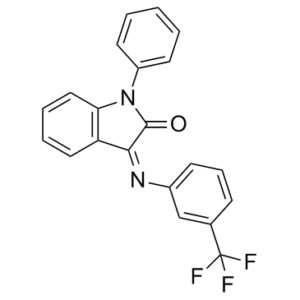
HT-2157 (also known as SNAP 37889) is a selective, high-affinity, and competitive antagonists of galanin-3 receptor (Gal3) that has the potential for the treatment of major depressive disorder. Administering SNAP 37889 or its more soluble analog, SNAP 398299, acutely improved the social interaction of rats. Acute SNAP 37889 has also been demonstrated to decrease guinea pig vocalizations following mother separation, lessen stress-induced hyperthermia in mice, increase punished drinking in rats, and reduce immobility and lengthen swimming times in rats during forced swim tests. Additionally, following a 14-day treatment period, SNAP 37889 prolonged social interaction times and continued to have antidepressant effects in forced swim tests with rats after a 21-day treatment period. In microdialysis studies, SNAP 37889 partially antagonized the galanin-evoked reduction in hippocampal serotonin (5-hydroxytryptamine, 5-HT), as did the 5-HT(1A) receptor antagonist WAY100635.
Physicochemical Properties
| Molecular Formula | C21H13F3N2O | |
| Molecular Weight | 366.34 | |
| Exact Mass | 366.098 | |
| Elemental Analysis | C, 68.85; H, 3.58; F, 15.56; N, 7.65; O, 4.37 | |
| CAS # | 303149-14-6 | |
| Related CAS # |
|
|
| PubChem CID | 1471834 | |
| Appearance | Yellow to orange solid powder | |
| LogP | 5.569 | |
| Hydrogen Bond Donor Count | 0 | |
| Hydrogen Bond Acceptor Count | 5 | |
| Rotatable Bond Count | 2 | |
| Heavy Atom Count | 27 | |
| Complexity | 583 | |
| Defined Atom Stereocenter Count | 0 | |
| SMILES | O=C1N(C2=CC=CC=C2)C3=C(C=CC=C3)/C1=N/C4=CC=CC(C(F)(F)F)=C4 |
|
| InChi Key | TXCGMRVPXUBHAL-UHFFFAOYSA-N | |
| InChi Code | InChI=1S/C21H13F3N2O/c22-21(23,24)14-7-6-8-15(13-14)25-19-17-11-4-5-12-18(17)26(20(19)27)16-9-2-1-3-10-16/h1-13H | |
| Chemical Name | 1-phenyl-3-[3-(trifluoromethyl)phenyl]iminoindol-2-one | |
| Synonyms |
|
|
| HS Tariff Code | 2934.99.9001 | |
| Storage |
Powder-20°C 3 years 4°C 2 years In solvent -80°C 6 months -20°C 1 month Note: Please store this product in a sealed and protected environment (e.g. under nitrogen), avoid exposure to moisture. |
|
| Shipping Condition | Room temperature (This product is stable at ambient temperature for a few days during ordinary shipping and time spent in Customs) |
Biological Activity
| Targets | Galanin-3 receptor | |
| ln Vitro |
|
|
| ln Vivo |
|
|
| Enzyme Assay | The 125I-galanin displacement assay is used to determine the binding affinities for HT-2157 (SNAP 37889) and SNAP 398299 at the human Gal1, Gal2, and Gal3 receptors. Furthermore, is examined for binding in a wide panel of cross-reactivity components, such as ion channels, transporters, enzymes, and G-protein-coupled receptors. The ability of HT-2157 to antagonize functional responses to galanin is examined in modified HEK-293 cells (PEAKrapid cells) transiently cotransfected with the Gal3 receptor and Gαz by measuring the inhibition of adenylyl cyclase activity[1]. | |
| Animal Protocol |
|
|
| References |
[1]. Anxiolytic- and antidepressant-like profiles of the galanin-3 receptor (Gal3) antagonists SNAP 37889 and SNAP 398299. Proc Natl Acad Sci U S A. 2005 Nov 29;102(48):17489-94. [2]. The galanin-3 receptor antagonist, SNAP 37889, reduces operant responding for ethanol in alcohol-preferring rats. Regul Pept. 2011 Jan 17;166(1-3):59-67. |
Solubility Data
| Solubility (In Vitro) |
|
|||
| Solubility (In Vivo) |
Solubility in Formulation 1: ≥ 2.5 mg/mL (6.82 mM) (saturation unknown) in 10% DMSO + 40% PEG300 + 5% Tween80 + 45% Saline (add these co-solvents sequentially from left to right, and one by one), clear solution. For example, if 1 mL of working solution is to be prepared, you can add 100 μL of 25.0 mg/mL clear DMSO stock solution to 400 μL PEG300 and mix evenly; then add 50 μL Tween-80 to the above solution and mix evenly; then add 450 μL normal saline to adjust the volume to 1 mL. Preparation of saline: Dissolve 0.9 g of sodium chloride in 100 mL ddH₂ O to obtain a clear solution. Solubility in Formulation 2: ≥ 2.5 mg/mL (6.82 mM) (saturation unknown) in 10% DMSO + 90% Corn Oil (add these co-solvents sequentially from left to right, and one by one), clear solution. For example, if 1 mL of working solution is to be prepared, you can add 100 μL of 25.0 mg/mL clear DMSO stock solution to 900 μL of corn oil and mix evenly. (Please use freshly prepared in vivo formulations for optimal results.) |
| Preparing Stock Solutions | 1 mg | 5 mg | 10 mg | |
| 1 mM | 2.7297 mL | 13.6485 mL | 27.2970 mL | |
| 5 mM | 0.5459 mL | 2.7297 mL | 5.4594 mL | |
| 10 mM | 0.2730 mL | 1.3649 mL | 2.7297 mL |