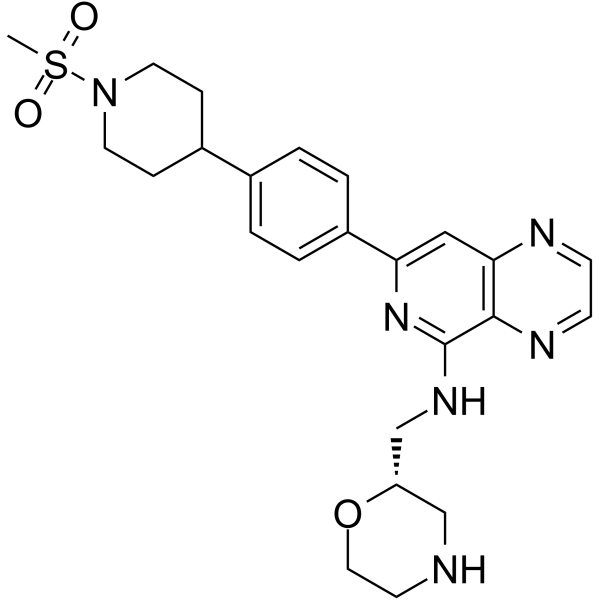
Physicochemical Properties
| Molecular Formula | C24H30N6O3S |
| Molecular Weight | 482.5984 |
| Exact Mass | 482.21 |
| CAS # | 1415792-84-5 |
| Related CAS # | 1415792-84-5;2288850-57-5 (acetate); |
| PubChem CID | 71113742 |
| Appearance | Light yellow to yellow solid powder |
| Density | 1.37±0.1 g/cm3 |
| Boiling Point | 701.3±70.0 °C |
| LogP | 1.2 |
| Hydrogen Bond Donor Count | 2 |
| Hydrogen Bond Acceptor Count | 9 |
| Rotatable Bond Count | 6 |
| Heavy Atom Count | 34 |
| Complexity | 748 |
| Defined Atom Stereocenter Count | 1 |
| SMILES | CS(=O)(=O)N1CCC(CC1)C2=CC=C(C=C2)C3=CC4=NC=CN=C4C(=N3)NC[C@@H]5CNCCO5 |
| InChi Key | NJIAKNWTIVDSDA-FQEVSTJZSA-N |
| InChi Code | InChI=1S/C24H30N6O3S/c1-34(31,32)30-11-6-18(7-12-30)17-2-4-19(5-3-17)21-14-22-23(27-9-8-26-22)24(29-21)28-16-20-15-25-10-13-33-20/h2-5,8-9,14,18,20,25H,6-7,10-13,15-16H2,1H3,(H,28,29)/t20-/m0/s1 |
| Chemical Name | 7-[4-(1-methylsulfonylpiperidin-4-yl)phenyl]-N-[[(2S)-morpholin-2-yl]methyl]pyrido[3,4-b]pyrazin-5-amine |
| HS Tariff Code | 2934.99.9001 |
| Storage |
Powder-20°C 3 years 4°C 2 years In solvent -80°C 6 months -20°C 1 month |
| Shipping Condition | Room temperature (This product is stable at ambient temperature for a few days during ordinary shipping and time spent in Customs) |
Biological Activity
| ln Vitro | SYK, FLT3, KDR, LYN, FGFR2, and AUR A are all inhibited by sovleplenib (HMPL-523) with IC50 values of 0.025, 0.063, 0.390, 0.921, 3.214, and 3.969 μM, respectively [1]. In the human mantle cell line REC-1 and the human plasma cell line ARH-7777, sovleplenib (HMPL-523) inhibits the phosphorylation of Syk downstream protein BLNK, with IC50 values of 0.105 µM and 0.173 µM, respectively[2]. With an IC50 of 0.033 μM, sovleplenib similarly reduces the viability of Ba/F3 Tel-Syk cells[2]. Additionally, REC-1 cell apoptosis is accelerated by sovleplenib [2]. When treating human diffuse large B-cell lymphoma (DLBCL), sovleplenib is used in combination with other medications such as BTK inhibitors, PI3Kδ inhibitors, and Bcl2 family inhibitors to have a synergistic killing effect [2]. |
| ln Vivo | Sovleplenib (HMPL-523) demonstrates anticancer efficacy in vivo. Sovleplenib (100 mg/kg) suppresses tumor growth in the REC-1 subcutaneous xenograft model [1]. Sovleplenib (HMPL-523; 100 mg/kg; daily oral dosing) revealed substantial antitumor efficacy against B-cell lymphoma REC-1 (TGI: 59%) in a Syk-dependent xenograft model [2]. |
| Animal Protocol |
Animal/Disease Models: Balb/c nude mice were subcutaneously (sc) (sc) implanted with REC-1 cells or intravenously (iv) (iv)(iv) injected with BA/F3 cells or BA/F3 TEL-SYK cells [1] Doses: 10 and 100 mg/kg Doses: one time/day; continuous 8-day Experimental Results: 100 mg/kg dose inhibits tumor growth in REC-1 subcutaneousxenograft model. |
| References |
[1]. Preparation of pyridopyrazine derivatives for use as Syk inhibitors. WO2012167733 A1. [2]. HMPL-523, a Novel SYK Inhibitor Showed Anti-Tumor Activities In Vitro and In Vivo. Blood (2016) 128 (22): 3970. |
| Additional Infomation |
Sovleplenib is a novel, investigational, selective small molecule inhibitor for oral administration targeting spleen tyrosine kinase (Syk). It is under investigation in clinical trial NCT03483948 (Phase I Study of Hmpl-523+azacitidine in Elderly Patients With Acute Myeloid Leukemia). Sovleplenib is an orally available inhibitor of spleen tyrosine kinase (Syk), with potential immunomodulating and antineoplastic activities. Upon oral administration of sovleplenib, this agent binds to and inhibits the activity of Syk. This inhibits B-cell receptor (BCR) signaling, which leads to the inhibition of B-cell activation, and prevents tumor cell activation, migration, adhesion and proliferation. Syk, a non-receptor cytoplasmic, BCR-associated tyrosine kinase, is expressed in hematopoietic tissues and is often overexpressed in hematopoietic malignancies; it plays a key role in B-cell receptor signaling. |
Solubility Data
| Solubility (In Vitro) | DMSO : ~25 mg/mL (~51.80 mM) |
| Solubility (In Vivo) |
Solubility in Formulation 1: ≥ 2.08 mg/mL (4.31 mM) (saturation unknown) in 10% DMSO + 40% PEG300 + 5% Tween80 + 45% Saline (add these co-solvents sequentially from left to right, and one by one), clear solution. For example, if 1 mL of working solution is to be prepared, you can add 100 μL of 20.8 mg/mL clear DMSO stock solution to 400 μL PEG300 and mix evenly; then add 50 μL Tween-80 to the above solution and mix evenly; then add 450 μL normal saline to adjust the volume to 1 mL. Preparation of saline: Dissolve 0.9 g of sodium chloride in 100 mL ddH₂ O to obtain a clear solution. Solubility in Formulation 2: ≥ 2.08 mg/mL (4.31 mM) (saturation unknown) in 10% DMSO + 90% (20% SBE-β-CD in Saline) (add these co-solvents sequentially from left to right, and one by one), clear solution. For example, if 1 mL of working solution is to be prepared, you can add 100 μL of 20.8 mg/mL clear DMSO stock solution to 900 μL of 20% SBE-β-CD physiological saline solution and mix evenly. Preparation of 20% SBE-β-CD in Saline (4°C,1 week): Dissolve 2 g SBE-β-CD in 10 mL saline to obtain a clear solution. (Please use freshly prepared in vivo formulations for optimal results.) |
| Preparing Stock Solutions | 1 mg | 5 mg | 10 mg | |
| 1 mM | 2.0721 mL | 10.3605 mL | 20.7211 mL | |
| 5 mM | 0.4144 mL | 2.0721 mL | 4.1442 mL | |
| 10 mM | 0.2072 mL | 1.0361 mL | 2.0721 mL |