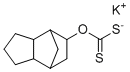
D-609 (D609) is a novel, competitive and potent phospholipase C inhibitor with the potential to be used for the treatment of pancreatic cancer. It inhibits phosphatidyl choline-specific phospholipase C (PC-PLC) with Ki of 6.4 μM.
Physicochemical Properties
| Molecular Formula | C11H15KOS2 |
| Molecular Weight | 266.4583 |
| Exact Mass | 266.02 |
| CAS # | 83373-60-8 |
| Related CAS # | 83373-60-8 (K+); 145764-52-9 (free); |
| PubChem CID | 4234241 |
| Appearance | White to off-white solid powder |
| Density | 1.24 g/cm3 |
| Boiling Point | 303.8ºC at 760 mmHg |
| Flash Point | 137.5ºC |
| LogP | 3.31 |
| Hydrogen Bond Donor Count | 0 |
| Hydrogen Bond Acceptor Count | 3 |
| Rotatable Bond Count | 2 |
| Heavy Atom Count | 15 |
| Complexity | 271 |
| Defined Atom Stereocenter Count | 0 |
| SMILES | [K].S=C(OC1C2C3C(C(C2)C1)CCC3)S |
| InChi Key | IGULCCCBGBDZKQ-UHFFFAOYSA-M |
| InChi Code | InChI=1S/C11H16OS2.K/c13-11(14)12-10-5-6-4-9(10)8-3-1-2-7(6)8;/h6-10H,1-5H2,(H,13,14);/q;+1/p-1 |
| Chemical Name | potassium;8-tricyclo[5.2.1.02,6]decanyloxymethanedithioate |
| Synonyms | D609D-609 D609 |
| HS Tariff Code | 2934.99.9001 |
| Storage |
Powder-20°C 3 years 4°C 2 years In solvent -80°C 6 months -20°C 1 month |
| Shipping Condition | Room temperature (This product is stable at ambient temperature for a few days during ordinary shipping and time spent in Customs) |
Biological Activity
| ln Vitro | D609 at 100 μM for two hours greatly reduces edema in several cell lines [2]. After activating caspase-3 at 200 μM for two hours, D609 (100 μM; two hours) at 50, 100 μM significantly inhibited BrdU in BV-2 astrocytes. It occurs annually and results in a decrease in the number of cells in the S phase and an accumulation of cells in the G1 phase [2]. 100 μM; for two hours, then for two more hours or for twenty-two hours without D609) raises ceramide levels, boosts p21 expression, and causes phosphorylated Rb to drop [2]. |
| ln Vivo | In apoE-/-mice, D609 (2.5, 10 mg/kg/day; i.p.; for 6 weeks) inhibits the progression of preexisting atherosclerotic lesions, changing the event component to a more stable phenotype [3 LPS administered intratracheally (30 mg/kg; i.p.; single dose) 30 minutes prior to LPS (3 mg/kg) prevents LPS-induced pulmonary hypertension in Island Wistar [4]. C57BL/6 WT and apoE−/− 26-week-old mice [3] |
| Cell Assay |
Cell Proliferation Assay[2] Cell Types: RAW 264.7 macrophages, N9 and BV-2 microglia, and DITNC1 astrocytes Tested Concentrations: 100 μM Incubation Duration: 2 hrs (hours) Experimental Results: Dramatically attenuated RAW 264.7 macrophages , N9 and BV-2 microglia, and DITNC1 astrocytes without affecting cell viability. Apoptosis analysis[2] Cell Types: BV-2 Cell Tested Concentrations: 50, 100 and 200 μM Incubation Duration: 2 hrs (hours) Experimental Results: Activation of caspase-3 in a dose- and time-dependent manner. Cell cycle analysis [2] Cell Types: BV-2 Cell Tested Concentrations: 100 μM Incubation Duration: 2 hrs (hours) Experimental Results: Dramatically inhibited the incorporation of BrdU in BV-2 microglia, resulting in G1 phase cell aggregation and S phase cell number reduction phase. Western Blot Analysis[2] Cell Types: BV-2 Cell Tested Concentrations: 100 μM Incubation Duration: 2 hrs (hours) Experimental Results: Increased ceramide levels, upregulation of p21 expression and resulting reduction in phospho-Rb. |
| Animal Protocol |
Animal/Disease Models: 26weeks old apoE−/− and C57BL/6 WT mice[3] Doses: 2.5, 10 mg/kg Route of Administration: IP; per day for 6 weeks Experimental Results:Inhibited the progression of preexisting atherosclerotic lesions in apoE−/− mice and changed the lesion composition into a more stable phenotype. Dramatically diminished the aortic endothelial expression of the vascular cell adhesion molecule-1 and the intercellular adhesion molecule-1. |
| References |
[1]. The antiviral, antitumoural xanthate D609 is a competitive inhibitor of phosphatidylcholine-specific phospholipase C. Drugs Exp Clin Res. 1996;22(6):287-94. [2]. Anti-proliferative effects of tricyclodecan-9-yl-xanthogenate (D609) involve ceramide and cell cycle inhibition.Mol Neurobiol. 2012 Jun;45(3):455-64. Epub 2012 Mar 14. [3]. D609 inhibits progression of preexisting atheroma and promotes lesion stability in apolipoprotein e-/- mice: a role of phosphatidylcholine-specific phospholipase in atherosclerosis. Arterioscler Thromb Vasc Biol. 2010 Mar;30(3):411-8. [4]. Role of acid sphingomyelinase and IL-6 as mediators of endotoxin-induced pulmonary vascular dysfunction. Thorax. 2017 May;72(5):460-471. [5]. D609 inhibits the proliferation of neural progenitor cells.Neuroreport. 2010 Jul 14;21(10):700-3. |
Solubility Data
| Solubility (In Vitro) |
DMSO : ~100 mg/mL (~375.29 mM) H2O : ~2 mg/mL (~7.51 mM) |
| Solubility (In Vivo) |
Solubility in Formulation 1: ≥ 3 mg/mL (11.26 mM) (saturation unknown) in 10% DMSO + 40% PEG300 + 5% Tween80 + 45% Saline (add these co-solvents sequentially from left to right, and one by one), clear solution. For example, if 1 mL of working solution is to be prepared, you can add 100 μL of 30.0 mg/mL clear DMSO stock solution to 400 μL PEG300 and mix evenly; then add 50 μL Tween-80 to the above solution and mix evenly; then add 450 μL normal saline to adjust the volume to 1 mL. Preparation of saline: Dissolve 0.9 g of sodium chloride in 100 mL ddH₂ O to obtain a clear solution. Solubility in Formulation 2: ≥ 3 mg/mL (11.26 mM) (saturation unknown) in 10% DMSO + 90% (20% SBE-β-CD in Saline) (add these co-solvents sequentially from left to right, and one by one), clear solution. For example, if 1 mL of working solution is to be prepared, you can add 100 μL of 30.0 mg/mL clear DMSO stock solution to 900 μL of 20% SBE-β-CD physiological saline solution and mix evenly. Preparation of 20% SBE-β-CD in Saline (4°C,1 week): Dissolve 2 g SBE-β-CD in 10 mL saline to obtain a clear solution. Solubility in Formulation 3: ≥ 3 mg/mL (11.26 mM) (saturation unknown) in 10% DMSO + 90% Corn Oil (add these co-solvents sequentially from left to right, and one by one), clear solution. For example, if 1 mL of working solution is to be prepared, you can add 100 μL of 30.0 mg/mL clear DMSO stock solution to 900 μL of corn oil and mix evenly. Solubility in Formulation 4: 25 mg/mL (93.82 mM) in PBS (add these co-solvents sequentially from left to right, and one by one), clear solution; with ultrasonication (<60°C). (Please use freshly prepared in vivo formulations for optimal results.) |
| Preparing Stock Solutions | 1 mg | 5 mg | 10 mg | |
| 1 mM | 3.7529 mL | 18.7645 mL | 37.5291 mL | |
| 5 mM | 0.7506 mL | 3.7529 mL | 7.5058 mL | |
| 10 mM | 0.3753 mL | 1.8765 mL | 3.7529 mL |