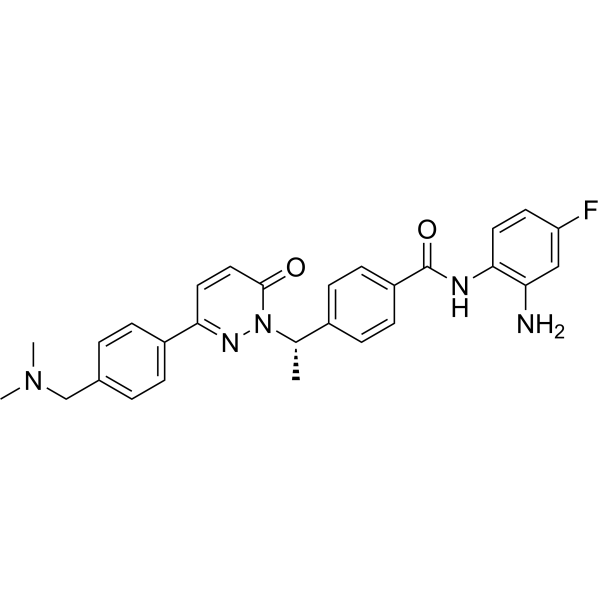
Physicochemical Properties
| Molecular Formula | C28H28FN5O2 |
| Molecular Weight | 485.55 |
| CAS # | 2814571-89-4 |
| Appearance | Typically exists as solid at room temperature |
| HS Tariff Code | 2934.99.9001 |
| Storage |
Powder-20°C 3 years 4°C 2 years In solvent -80°C 6 months -20°C 1 month |
| Shipping Condition | Room temperature (This product is stable at ambient temperature for a few days during ordinary shipping and time spent in Customs) |
Biological Activity
| Targets | HDAC1 56.0 nM (IC50) HDAC2 90.0 nM (IC50) HDAC3 422.2 nM (IC50) |
| ln Vitro | In comparison to MS-275 (HY-12163), HDAC-IN-56 exhibits more effective and specific inhibition against Class I HDACs 1, 2, and 3. HDAC-IN-56 (0.1 μM, 2 h) was stable in five species of hepatocytes and metabolized differently in human, monkey, dog, rat, and mouse hepatocytes[1]. Apoptosis and G1 cell cycle arrest are efficiently induced by HDAC-IN-56 (0.01-1 μM, 72 h)[1]. The intracellular level of acetyl-histone H3 and p21 is increased more by HDAC-IN-56 (0.01-1 μM, 72 h) treatment than by Tucidinostat (HY-109015) or MS-275 (HY-12163), indicating a substantial inhibition of class I histone deacetylase[1]. For SKM-1, HDAC-IN-56's IC50 is 139.0 ± 8.0 nM[1]. In comparison to MS-275 (HY-12163), HDAC-IN-56 exhibits more effective and specific inhibition against Class I HDACs 1, 2, and 3. HDAC-IN-56 (0.1 μM, 2 h) was stable in five species of hepatocytes and metabolized differently in human, monkey, dog, rat, and mouse hepatocytes[1]. Apoptosis and G1 cell cycle arrest are efficiently induced by HDAC-IN-56 (0.01-1 μM, 72 h)[1]. The intracellular level of acetyl-histone H3 and p21 is increased more by HDAC-IN-56 (0.01-1 μM, 72 h) treatment than by Tucidinostat (HY-109015) or MS-275 (HY-12163), indicating a substantial inhibition of class I histone deacetylase[1]. For SKM-1, HDAC-IN-56's IC50 is 139.0 ± 8.0 nM[1]. |
| ln Vivo | Even at the high dose of 80 mg/kg per day, HDAC-IN-56 (10-80 mg/kg/d, po, one month) did not result in appreciable changes in body weight [1]. In ICR mice and SD rats, respectively, HDAC-IN-56 (SD: 10, 20 mg/kg; ICR: 20, 40 mg/kg, po) has favorable pharmacokinetic properties and oral bioavailability. stand at 39.5% and 47.7%[1]. The expected inhibitory impact of HDAC-IN-56 (20–60 mg/kg, po) on the formation of tumors in nude mice MC38 cells is observed. A more pronounced tumor growth suppression effect was observed at the same dose when transplanted into immunocompetent C57BL/6 mice, suggesting that HDAC-IN-56 may somehow activate and engage the immune system to produce a larger anti-tumor impact[1]. |
| Animal Protocol |
Animal/Disease Models: Male SD rats or ICR mice[1] Doses: 10, 20 mg/kg; ICR: 20, 40 mg/kg Route of Administration: Male SD rats or ICR mice (n = 6) were fasted for 12 h before administration and remained fasting for 2 h. SD rats were received 10 and 20 mg/kg via intravenously (iv) injection (iv) and oral administration (po), respectively, and ICR mice were received 20 and 40 mg/kg via intravenously (iv) injection (iv) and oral administration (po), respectively. Experimental Results: Epresented a favorable pharmacokinetic/PK profile with an oral bioavailability of 47.7% in ICR mice and 39.5% in SD rat, respectively Animal/Disease Models: SKM-1 or MC-38 cells xenograft model[1] Doses: 20, 40, 60 mg/kg Route of Administration: po (oral gavage). Experimental Results: Inhibited the tumor growth of MC38 cells in nude mice. demonstrated more significant tumor growth inhibition at the same doses, which implie that the immune system may be engaged and somehow activated HDAC-IN-56 to gain stronger antitumor effect. |
| References |
[1]. Discovery of (S)-N-(2-Amino-4-fluorophenyl)-4-(1-(3-(4-((dimethylamino)methyl)phenyl)-6-oxopyridazin-1(6H)-yl)ethyl) benzamide as Potent Class I Selective HDAC Inhibitor for Oral Anticancer Drug Candidate. J Med Chem. 2023 May 25;66(10):7016-7037. |
Solubility Data
| Solubility (In Vitro) | May dissolve in DMSO (in most cases), if not, try other solvents such as H2O, Ethanol, or DMF with a minute amount of products to avoid loss of samples |
| Solubility (In Vivo) |
Note: Listed below are some common formulations that may be used to formulate products with low water solubility (e.g. < 1 mg/mL), you may test these formulations using a minute amount of products to avoid loss of samples. Injection Formulations (e.g. IP/IV/IM/SC) Injection Formulation 1: DMSO : Tween 80: Saline = 10 : 5 : 85 (i.e. 100 μL DMSO stock solution → 50 μL Tween 80 → 850 μL Saline) *Preparation of saline: Dissolve 0.9 g of sodium chloride in 100 mL ddH ₂ O to obtain a clear solution. Injection Formulation 2: DMSO : PEG300 :Tween 80 : Saline = 10 : 40 : 5 : 45 (i.e. 100 μL DMSO → 400 μLPEG300 → 50 μL Tween 80 → 450 μL Saline) Injection Formulation 3: DMSO : Corn oil = 10 : 90 (i.e. 100 μL DMSO → 900 μL Corn oil) Example: Take the Injection Formulation 3 (DMSO : Corn oil = 10 : 90) as an example, if 1 mL of 2.5 mg/mL working solution is to be prepared, you can take 100 μL 25 mg/mL DMSO stock solution and add to 900 μL corn oil, mix well to obtain a clear or suspension solution (2.5 mg/mL, ready for use in animals). Injection Formulation 4: DMSO : 20% SBE-β-CD in saline = 10 : 90 [i.e. 100 μL DMSO → 900 μL (20% SBE-β-CD in saline)] *Preparation of 20% SBE-β-CD in Saline (4°C,1 week): Dissolve 2 g SBE-β-CD in 10 mL saline to obtain a clear solution. Injection Formulation 5: 2-Hydroxypropyl-β-cyclodextrin : Saline = 50 : 50 (i.e. 500 μL 2-Hydroxypropyl-β-cyclodextrin → 500 μL Saline) Injection Formulation 6: DMSO : PEG300 : castor oil : Saline = 5 : 10 : 20 : 65 (i.e. 50 μL DMSO → 100 μLPEG300 → 200 μL castor oil → 650 μL Saline) Injection Formulation 7: Ethanol : Cremophor : Saline = 10: 10 : 80 (i.e. 100 μL Ethanol → 100 μL Cremophor → 800 μL Saline) Injection Formulation 8: Dissolve in Cremophor/Ethanol (50 : 50), then diluted by Saline Injection Formulation 9: EtOH : Corn oil = 10 : 90 (i.e. 100 μL EtOH → 900 μL Corn oil) Injection Formulation 10: EtOH : PEG300:Tween 80 : Saline = 10 : 40 : 5 : 45 (i.e. 100 μL EtOH → 400 μLPEG300 → 50 μL Tween 80 → 450 μL Saline) Oral Formulations Oral Formulation 1: Suspend in 0.5% CMC Na (carboxymethylcellulose sodium) Oral Formulation 2: Suspend in 0.5% Carboxymethyl cellulose Example: Take the Oral Formulation 1 (Suspend in 0.5% CMC Na) as an example, if 100 mL of 2.5 mg/mL working solution is to be prepared, you can first prepare 0.5% CMC Na solution by measuring 0.5 g CMC Na and dissolve it in 100 mL ddH2O to obtain a clear solution; then add 250 mg of the product to 100 mL 0.5% CMC Na solution, to make the suspension solution (2.5 mg/mL, ready for use in animals). Oral Formulation 3: Dissolved in PEG400 Oral Formulation 4: Suspend in 0.2% Carboxymethyl cellulose Oral Formulation 5: Dissolve in 0.25% Tween 80 and 0.5% Carboxymethyl cellulose Oral Formulation 6: Mixing with food powders Note: Please be aware that the above formulations are for reference only. InvivoChem strongly recommends customers to read literature methods/protocols carefully before determining which formulation you should use for in vivo studies, as different compounds have different solubility properties and have to be formulated differently. (Please use freshly prepared in vivo formulations for optimal results.) |
| Preparing Stock Solutions | 1 mg | 5 mg | 10 mg | |
| 1 mM | 2.0595 mL | 10.2976 mL | 20.5952 mL | |
| 5 mM | 0.4119 mL | 2.0595 mL | 4.1190 mL | |
| 10 mM | 0.2060 mL | 1.0298 mL | 2.0595 mL |