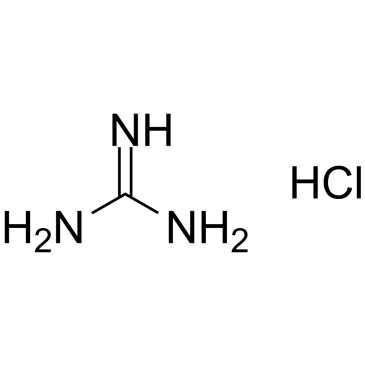
Desription: Guanidine hydrochloride, the crystalline compound of strong alkalinity formed by the oxidation of guanine, is a normal product of protein metabolism and a protein denaturant. Target: Others Guanidine hydrochloride is the most popular protein denaturant. Analysis of unfolding transitions by Guanidine hydrochloride provides several important parameters regarding the mechanism of conformational stability of proteins. Guanidine hydrochloride at low concentrations refolds acid-unfolds apomyoglobin and cytochrome c, stabilizing the molten globule state. Guanidine hydrochloride (> 1 M) causes co-operative unfolding of the molten globule state [1]. Guanidine hydrochloride at millimolar concentrations, is able to causes efficient loss of the normally stable [PSI+] element from yeast cells. 5 mM Guanidine hydrochloride in growth media cures [PSI+] and other prions of yeast. 5 mM Guanidine hydrochloride significantly reduces Hsp104-mediated basal and acquired thermotolerance by 30-fold and 50 fold, respectively. Guanidine hydrochloride also reduces the ability of Hsp104 to restore activity of thermally denatured luciferase [2].
Physicochemical Properties
| Molecular Formula | CH6CLN3 |
| Molecular Weight | 95.5314 |
| Exact Mass | 95.025 |
| CAS # | 50-01-1 |
| Related CAS # | 113-00-8 (Parent) |
| PubChem CID | 5742 |
| Appearance | White to off-white solid powder |
| Density | 1.18 g/mL at 25 °C(lit.) |
| Boiling Point | 132.9ºC at 760 mmHg |
| Melting Point | 180-185 °C(lit.) |
| Index of Refraction | n20/D 1.465 |
| LogP | 1.14 |
| Hydrogen Bond Donor Count | 4 |
| Hydrogen Bond Acceptor Count | 1 |
| Rotatable Bond Count | 0 |
| Heavy Atom Count | 5 |
| Complexity | 26.3 |
| Defined Atom Stereocenter Count | 0 |
| SMILES | Cl[H].N([H])([H])/C(=N/[H])/N([H])[H] |
| InChi Key | PJJJBBJSCAKJQF-UHFFFAOYSA-N |
| InChi Code | InChI=1S/CH5N3.ClH/c2-1(3)4;/h(H5,2,3,4);1H |
| Chemical Name | guanidine;hydrochloride |
| HS Tariff Code | 2934.99.9001 |
| Storage |
Powder-20°C 3 years 4°C 2 years In solvent -80°C 6 months -20°C 1 month Note: Please store this product in a sealed and protected environment, avoid exposure to moisture. |
| Shipping Condition | Room temperature (This product is stable at ambient temperature for a few days during ordinary shipping and time spent in Customs) |
Biological Activity
| ln Vitro | Low doses of guanidine hydrochloride stabilize the molten globule state, which is a compact denatured state with a significant quantity of secondary structure but a highly disordered tertiary structure, by refolding acid-unfolded apomyoglobin and cytochrome c. Melting globule state cooperatively unfolds when exposed to guanidine hydrochloride (> 1 M)[1]. Guanidine hydrochloride has little effect on the disulfide bonds, which maintain a significant degree of ordered structure[2]. At millimolar quantities, guanidine hydrochloride can effectively cause yeast cells to lose the typically stable [PSI+] element. In growth media, 5 mM guanidine hydrochloride cures [PSI+] and other yeast prions. Hsp104-mediated baseline and acquired thermotolerance are markedly reduced by 5 mM guanidine hydrochloride, by 30 and 50 fold, respectively. The capacity of Hsp104 to reinstate the activity of thermally denatured luciferase is likewise diminished by guanidine hydrochloride[3]. |
| ln Vivo | substantial reduction in the death rate of baby mice infected with ten LD50) of coxsackievirus A16 is found when they are treated 58 h after infection with two injections of Guanidine hydrochloride at 145 mg/kg per injection[4]. |
| References |
[1]. Guanidine hydrochloride-induced folding of proteins. J Mol Biol. 1993 May 20;231(2):180-4. [2]. A comparative study on the aggregating effects of guanidine thiocyanate, guanidine hydrochloride and urea on lysozyme aggregation. Biochem Biophys Res Commun. 2014 Aug 8;450(4):1339-44. [3]. Guanidine hydrochloride inhibits Hsp104 activity in vivo: a possible explanation for its effect in curing yeast prions. Curr Microbiol. 2001 Jul;43(1):7-10. [4]. Prevention of death in mice infected with coxsackievirus A16 using guanidine HCl mixed with substituted benzimidazoles. Antiviral Res. 1982 Dec;2(6):339-46. |
| Additional Infomation |
Guanidine Hydrochloride is the hydrochloride salt form of guanidine, a strong basic compound with parasympathomimetic activity. Guanidine hydrochloride enhances the release of acetylcholine following a nerve impulse and potentiates acetylcholine actions on muscarinic and nicotinic receptors. It also appears to slow the rates of depolarization and repolarization of muscle cell membranes. (NCI05) A strong organic base existing primarily as guanidium ions at physiological pH. It is found in the urine as a normal product of protein metabolism. It is also used in laboratory research as a protein denaturant. (From Martindale, the Extra Pharmacopoeia, 30th ed and Merck Index, 12th ed) It is also used in the treatment of myasthenia and as a fluorescent probe in HPLC. |
Solubility Data
| Solubility (In Vitro) |
H2O : ~100 mg/mL (~1046.79 mM) DMSO : ≥ 100 mg/mL (~1046.79 mM) |
| Solubility (In Vivo) |
Solubility in Formulation 1: ≥ 2.08 mg/mL (21.77 mM) (saturation unknown) in 10% DMSO + 40% PEG300 + 5% Tween80 + 45% Saline (add these co-solvents sequentially from left to right, and one by one), clear solution. For example, if 1 mL of working solution is to be prepared, you can add 100 μL of 20.8 mg/mL clear DMSO stock solution to 400 μL PEG300 and mix evenly; then add 50 μL Tween-80 to the above solution and mix evenly; then add 450 μL normal saline to adjust the volume to 1 mL. Preparation of saline: Dissolve 0.9 g of sodium chloride in 100 mL ddH₂ O to obtain a clear solution. Solubility in Formulation 2: ≥ 2.08 mg/mL (21.77 mM) (saturation unknown) in 10% DMSO + 90% (20% SBE-β-CD in Saline) (add these co-solvents sequentially from left to right, and one by one), clear solution. For example, if 1 mL of working solution is to be prepared, you can add 100 μL of 20.8 mg/mL clear DMSO stock solution to 900 μL of 20% SBE-β-CD physiological saline solution and mix evenly. Preparation of 20% SBE-β-CD in Saline (4°C,1 week): Dissolve 2 g SBE-β-CD in 10 mL saline to obtain a clear solution. Solubility in Formulation 3: ≥ 2.08 mg/mL (21.77 mM) (saturation unknown) in 10% DMSO + 90% Corn Oil (add these co-solvents sequentially from left to right, and one by one), clear solution. For example, if 1 mL of working solution is to be prepared, you can add 100 μL of 20.8 mg/mL clear DMSO stock solution to 900 μL of corn oil and mix evenly. Solubility in Formulation 4: 100 mg/mL (1046.79 mM) in PBS (add these co-solvents sequentially from left to right, and one by one), clear solution; with ultrasonication. (Please use freshly prepared in vivo formulations for optimal results.) |
| Preparing Stock Solutions | 1 mg | 5 mg | 10 mg | |
| 1 mM | 10.4679 mL | 52.3396 mL | 104.6792 mL | |
| 5 mM | 2.0936 mL | 10.4679 mL | 20.9358 mL | |
| 10 mM | 1.0468 mL | 5.2340 mL | 10.4679 mL |