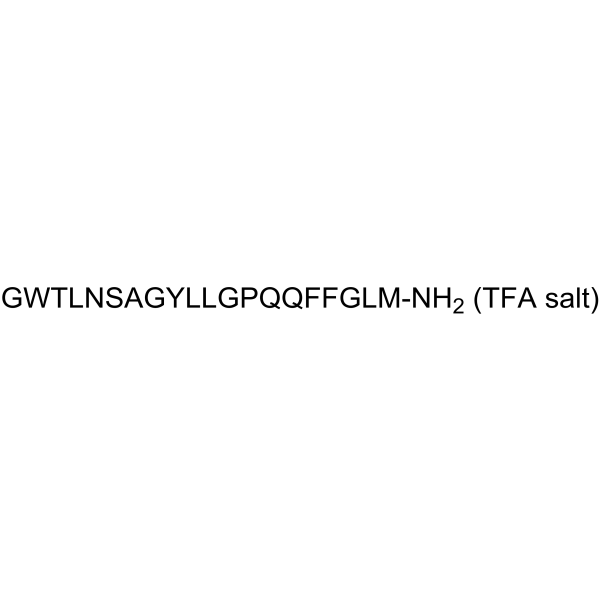
Physicochemical Properties
| Molecular Formula | C106H152F3N25O28S |
| Molecular Weight | 2313.55 |
| Related CAS # | Galantide;138579-66-5 |
| Appearance | White to off-white solid powder |
| HS Tariff Code | 2934.99.9001 |
| Storage |
Powder-20°C 3 years 4°C 2 years In solvent -80°C 6 months -20°C 1 month Note: Please store this product in a sealed and protected environment (e.g. under nitrogen), avoid exposure to moisture and light. |
| Shipping Condition | Room temperature (This product is stable at ambient temperature for a few days during ordinary shipping and time spent in Customs) |
Biological Activity
| ln Vitro | Galantide TFA (0.1-10000 nM) 0.1–10,000 nM) blocks galanin-induced K+ conductance activation with an IC50 value of 4 nM[1]. Galantide TFA (0.1–10,000 nM) has an IC50 value of 16 nM and suppresses voltage-dependent Ba2+ currents in a dose-dependent manner[1]. Regarding voltage-dependent Ba2+ current, the highest inhibition rate of Galantide TFA (0.1–10,000 nM) is almost 40%[1]. |
| ln Vivo | In rats with ovariectomies, galantide TFA (5 nm; intracerebroventricular injection, once) suppresses the release of luteinizing hormone caused by ovarian steroids [2]. In ovariectomized rats, the luteinizing hormone spike caused by estradiol benzoate is lessened by galantide TFA (1 and 5 nm; intravenously delivered in three split doses at 1300, 1400, and 1500 hours) [2]. |
| Animal Protocol |
Animal/Disease Models: Adult female Crl:CD(SD)BR ovarian steroid-primed ovariectomized (OVX) rats[2] Doses: 5 nm Route of Administration: Intracerebroventricularly (icv) injection; 5 nm, 60 min before GAL Experimental Results: Blocked GAL-induced LH release. |
| References |
[1]. Galantide distinguishes putative subtypes of galanin receptors in mudpuppy parasympathetic neurons. Eur J Pharmacol. 1995 Dec 4;287(1):97-100. [2]. Role of galanin in stimulation of pituitary luteinizing hormone secretion as revealed by a specific receptor antagonist, galantide. Endocrinology. 1994 Feb;134(2):529-36. |
Solubility Data
| Solubility (In Vitro) |
DMSO :~100 mg/mL (~43.22 mM) H2O :< 0.1 mg/mL |
| Solubility (In Vivo) |
Solubility in Formulation 1: ≥ 2.5 mg/mL (1.08 mM) (saturation unknown) in 10% DMSO + 40% PEG300 + 5% Tween80 + 45% Saline (add these co-solvents sequentially from left to right, and one by one), clear solution. For example, if 1 mL of working solution is to be prepared, you can add 100 μL of 25.0 mg/mL clear DMSO stock solution to 400 μL PEG300 and mix evenly; then add 50 μL Tween-80 to the above solution and mix evenly; then add 450 μL normal saline to adjust the volume to 1 mL. Preparation of saline: Dissolve 0.9 g of sodium chloride in 100 mL ddH₂ O to obtain a clear solution. Solubility in Formulation 2: ≥ 2.5 mg/mL (1.08 mM) (saturation unknown) in 10% DMSO + 90% Corn Oil (add these co-solvents sequentially from left to right, and one by one), clear solution. For example, if 1 mL of working solution is to be prepared, you can add 100 μL of 25.0 mg/mL clear DMSO stock solution to 900 μL of corn oil and mix evenly. (Please use freshly prepared in vivo formulations for optimal results.) |
| Preparing Stock Solutions | 1 mg | 5 mg | 10 mg | |
| 1 mM | 0.4322 mL | 2.1612 mL | 4.3224 mL | |
| 5 mM | 0.0864 mL | 0.4322 mL | 0.8645 mL | |
| 10 mM | 0.0432 mL | 0.2161 mL | 0.4322 mL |