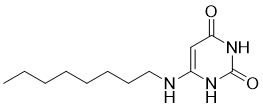
Physicochemical Properties
| Molecular Formula | C12H21N3O2 |
| Molecular Weight | 239.319 |
| Exact Mass | 239.163 |
| Elemental Analysis | C, 60.23; H, 8.85; N, 17.56; O, 13.37 |
| CAS # | 83797-69-7 |
| PubChem CID | 10354234 |
| Appearance | Light yellow to yellow solid powder |
| Density | 1.1±0.1 g/cm3 |
| Index of Refraction | 1.520 |
| LogP | 2.77 |
| Hydrogen Bond Donor Count | 3 |
| Hydrogen Bond Acceptor Count | 3 |
| Rotatable Bond Count | 8 |
| Heavy Atom Count | 17 |
| Complexity | 300 |
| Defined Atom Stereocenter Count | 0 |
| SMILES | O=C1NC(=O)NC(NCCCCCCCC)=C1 |
| InChi Key | PFSWASUQURIOOR-UHFFFAOYSA-N |
| InChi Code | InChI=1S/C12H21N3O2/c1-2-3-4-5-6-7-8-13-10-9-11(16)15-12(17)14-10/h9H,2-8H2,1H3,(H3,13,14,15,16,17) |
| Chemical Name | 6-(octylamino)-1H-pyrimidine-2,4-dione |
| Synonyms | GTPL-5846; GTPL 5846; GTPL5846 |
| HS Tariff Code | 2934.99.9001 |
| Storage |
Powder-20°C 3 years 4°C 2 years In solvent -80°C 6 months -20°C 1 month |
| Shipping Condition | Room temperature (This product is stable at ambient temperature for a few days during ordinary shipping and time spent in Customs) |
Biological Activity
| Targets | hGPR84 ( EC50 = 105 nM ); human GPR84-Gαi fusion protein ( EC50 = 512 nM ) |
| ln Vitro |
Human macrophages and polymorphonuclear leukocytes (PMNs) have high expression levels of the GPR84 gene, and 6-OAU activates GPR84 to promote proinflammatory activity[1].
6-OAU (0.01 nM-0.1 mM; 1 h) with an EC50 value of 105 nM in HEK293 cells activates human GPR84[1]. 6-OAU (0, 6.25, 200 μM; 30 min) incites GPR84-EGFP internalization in a GPR84-dependent manner, accumulates phosphoinositides, and stimulates [35S]GTP binding[1]. 6-OAU (1 nM-1 mM; 1 h) has an EC50 value of 318 nM and causes PMN chemotaxis in a concentration-dependent manner[1]. 6-OAU (0–10 μM; 4 h) stimulates LPS-stimulated PMNs to secrete more IL-8[1]. 6-OAU (0-0.4 μM; 16 h) also increases U937 macrophages' production of TNF-α[1]. 6-OAU (2 μM; 4 h) inhibits MCP-1 protein expression and ERK phosphorylation, and (2 μM; 48 h) inhibits MCP-1 secretion in macrophages[2]. 6-OAU (2 μM; 24 h) decreases ROS generation in RAW264.7 cells infected with B. abortus[2]. 6-OAU (2 μM; 0, 30, and 60 min) suppresses adhesion and anti-Bryella and anti-Salmonella activity in RAW264.7 cells, and (2 μM; 30 min) exhibits anti-infection against both infections[2]. |
| ln Vivo |
6-OAU triggers the production of chemokines and chemotaxis in vivo, which in turn activates GPR84 and causes an inflammatory state[1]. 6-OAU (10 mg/kg; i.v.) increases the level of CXCL1 in the blood in rats[1]. 6-OAU (1 mg/mL; s.c.) draws macrophages and PMNs into the air pouch[1]. 6-OAU (2 μM, 100 mL/mouse; s.c.) decreases bacterial growth in the liver and spleen and increases resistance to Brucella infection[2]. |
| Cell Assay |
Cell Line: B. abortus Concentration: 0, 0.02, 0.2, 2 μM Incubation Time: 0, 2, 24, 48, 72 hours Result: Decreased B. abortus survivability begin at 48 h with a dose of 2 μM. |
| Animal Protocol |
Female Lewis rats(4-week-old) 10 mg/kg Intravenous injection; collecting blood 3 h after injection |
| References |
[1]. Medium-chain fatty acid-sensing receptor, GPR84, is a proinflammatory receptor. J Biol Chem. 2013 Apr 12;288(15):10684-91. [2]. Immune-metabolic receptor GPR84 surrogate and endogenous agonists, 6-OAU and lauric acid, alter Brucella abortus 544 infection in both in vitro and in vivo systems. Microb Pathog. 2021 Sep. 158:105079. |
Solubility Data
| Solubility (In Vitro) | DMSO: 25~35 mg/mL (104.5~146.3 mM) |
| Solubility (In Vivo) |
Note: Listed below are some common formulations that may be used to formulate products with low water solubility (e.g. < 1 mg/mL), you may test these formulations using a minute amount of products to avoid loss of samples. Injection Formulations (e.g. IP/IV/IM/SC) Injection Formulation 1: DMSO : Tween 80: Saline = 10 : 5 : 85 (i.e. 100 μL DMSO stock solution → 50 μL Tween 80 → 850 μL Saline) *Preparation of saline: Dissolve 0.9 g of sodium chloride in 100 mL ddH ₂ O to obtain a clear solution. Injection Formulation 2: DMSO : PEG300 :Tween 80 : Saline = 10 : 40 : 5 : 45 (i.e. 100 μL DMSO → 400 μLPEG300 → 50 μL Tween 80 → 450 μL Saline) Injection Formulation 3: DMSO : Corn oil = 10 : 90 (i.e. 100 μL DMSO → 900 μL Corn oil) Example: Take the Injection Formulation 3 (DMSO : Corn oil = 10 : 90) as an example, if 1 mL of 2.5 mg/mL working solution is to be prepared, you can take 100 μL 25 mg/mL DMSO stock solution and add to 900 μL corn oil, mix well to obtain a clear or suspension solution (2.5 mg/mL, ready for use in animals). Injection Formulation 4: DMSO : 20% SBE-β-CD in saline = 10 : 90 [i.e. 100 μL DMSO → 900 μL (20% SBE-β-CD in saline)] *Preparation of 20% SBE-β-CD in Saline (4°C,1 week): Dissolve 2 g SBE-β-CD in 10 mL saline to obtain a clear solution. Injection Formulation 5: 2-Hydroxypropyl-β-cyclodextrin : Saline = 50 : 50 (i.e. 500 μL 2-Hydroxypropyl-β-cyclodextrin → 500 μL Saline) Injection Formulation 6: DMSO : PEG300 : castor oil : Saline = 5 : 10 : 20 : 65 (i.e. 50 μL DMSO → 100 μLPEG300 → 200 μL castor oil → 650 μL Saline) Injection Formulation 7: Ethanol : Cremophor : Saline = 10: 10 : 80 (i.e. 100 μL Ethanol → 100 μL Cremophor → 800 μL Saline) Injection Formulation 8: Dissolve in Cremophor/Ethanol (50 : 50), then diluted by Saline Injection Formulation 9: EtOH : Corn oil = 10 : 90 (i.e. 100 μL EtOH → 900 μL Corn oil) Injection Formulation 10: EtOH : PEG300:Tween 80 : Saline = 10 : 40 : 5 : 45 (i.e. 100 μL EtOH → 400 μLPEG300 → 50 μL Tween 80 → 450 μL Saline) Oral Formulations Oral Formulation 1: Suspend in 0.5% CMC Na (carboxymethylcellulose sodium) Oral Formulation 2: Suspend in 0.5% Carboxymethyl cellulose Example: Take the Oral Formulation 1 (Suspend in 0.5% CMC Na) as an example, if 100 mL of 2.5 mg/mL working solution is to be prepared, you can first prepare 0.5% CMC Na solution by measuring 0.5 g CMC Na and dissolve it in 100 mL ddH2O to obtain a clear solution; then add 250 mg of the product to 100 mL 0.5% CMC Na solution, to make the suspension solution (2.5 mg/mL, ready for use in animals). Oral Formulation 3: Dissolved in PEG400 Oral Formulation 4: Suspend in 0.2% Carboxymethyl cellulose Oral Formulation 5: Dissolve in 0.25% Tween 80 and 0.5% Carboxymethyl cellulose Oral Formulation 6: Mixing with food powders Note: Please be aware that the above formulations are for reference only. InvivoChem strongly recommends customers to read literature methods/protocols carefully before determining which formulation you should use for in vivo studies, as different compounds have different solubility properties and have to be formulated differently. (Please use freshly prepared in vivo formulations for optimal results.) |
| Preparing Stock Solutions | 1 mg | 5 mg | 10 mg | |
| 1 mM | 4.1785 mL | 20.8925 mL | 41.7851 mL | |
| 5 mM | 0.8357 mL | 4.1785 mL | 8.3570 mL | |
| 10 mM | 0.4179 mL | 2.0893 mL | 4.1785 mL |