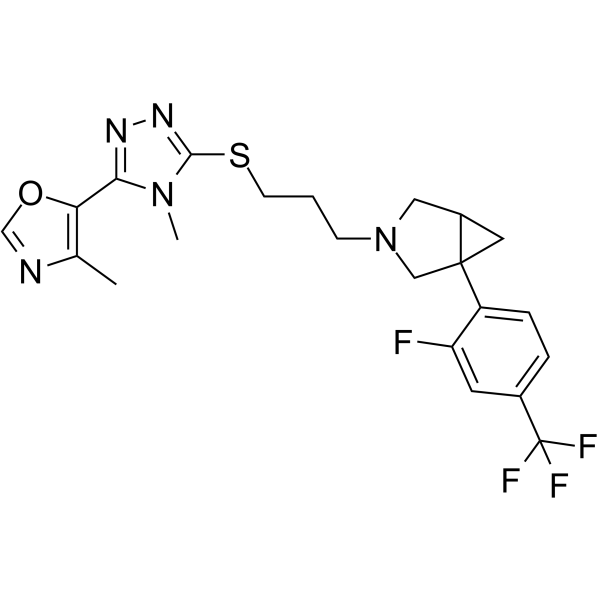
GSK598809 is a novel, potent and selective dopamine D3 Receptor (DRD3) antagonist with a pKi of 8.9. GSK598809 is currently in Phase I trials. GSK-598809 may decrease the rewarding effects of contextual cues associated with drug intake preclinically, which may reduce drug craving in humans. GSK598809 has been proposed as a medication to treat cocaine and other substance use disorders. The US Food and Drug Administration has established guidelines recommending safety studies to investigate potential undesirable pharmacodynamic effects of a substance in relation to exposure in the therapeutic range and above. GSK598809 increased the hemodynamic effect of cocaine in this model. Thus, the increase in blood pressure after intravenous cocaine was greater in animals that had been pretreated with GSK598809 compared with vehicle. This finding suggests that GSK598809 in particular, and perhaps dopamine D3 receptor antagonists as a class, may produce unacceptable cardiovascular risks as medications to treat cocaine use disorder.
Physicochemical Properties
| Exact Mass | 495.172 |
| CAS # | 1310803-30-5 |
| Related CAS # | (-)-GSK598809 hydrochloride;863766-31-8;(-)-GSK598809;863680-46-0 |
| PubChem CID | 71587973 |
| Appearance | Typically exists as solid at room temperature |
| LogP | 5.02 |
| Hydrogen Bond Donor Count | 0 |
| Hydrogen Bond Acceptor Count | 10 |
| Rotatable Bond Count | 7 |
| Heavy Atom Count | 34 |
| Complexity | 749 |
| Defined Atom Stereocenter Count | 2 |
| SMILES | CC1=C(OC=N1)C2=NN=C(N2C)SCCCN3C[C@@]4(C[C@@]4(C3)C5=C(C=C(C=C5)C(F)(F)F)F)C |
| InChi Key | BAFWBNHYBAXTSE-FCHUYYIVSA-N |
| InChi Code | InChI=1S/C23H25F4N5OS/c1-14-18(33-13-28-14)19-29-30-20(31(19)3)34-8-4-7-32-11-21(2)10-22(21,12-32)16-6-5-15(9-17(16)24)23(25,26)27/h5-6,9,13H,4,7-8,10-12H2,1-3H3/t21-,22+/m0/s1 |
| Chemical Name | 5-(5-((3-((1S,5R)-1-(2-Fluoro-4-(trifluoromethyl)phenyl)-5-methyl-3-azabicyclo(3.1.0)hexan-3-yl)propyl)thio)-4-methyl-4H-1,2,4-triazol-3-yl)-4-methyloxazole |
| Synonyms | GSK-598809; GSK598809; GSK 598809; |
| HS Tariff Code | 2934.99.9001 |
| Storage |
Powder-20°C 3 years 4°C 2 years In solvent -80°C 6 months -20°C 1 month |
| Shipping Condition | Room temperature (This product is stable at ambient temperature for a few days during ordinary shipping and time spent in Customs) |
Biological Activity
| ln Vivo | Both GSK598809 and cocaine raise the peak mean arterial blood pressure. In comparison to its vehicle, there are significant differences in the least square means for both cocaine doses. In comparison to its carrier, the least square mean differences for both GSK598809 dosages are substantial. A previous it test on the means of the fitted regression model investigates the experimental topic of interest, which is whether GSK598809 significantly increases cocaine effects on peak mean arterial blood pressure. The pressor effects of 5.6 mg/kg and 1.7 mg/kg cocaine are markedly enhanced by a dosage of 3 mg/kg GSK598809[1]. |
| References | J Pharmacol Exp Ther. 2015 Sep;354(3):484-92.;J Med Chem. 2010 Jan 14;53(1):374-91. |
Solubility Data
| Solubility (In Vitro) | May dissolve in DMSO (in most cases), if not, try other solvents such as H2O, Ethanol, or DMF with a minute amount of products to avoid loss of samples |
| Solubility (In Vivo) |
Note: Listed below are some common formulations that may be used to formulate products with low water solubility (e.g. < 1 mg/mL), you may test these formulations using a minute amount of products to avoid loss of samples. Injection Formulations (e.g. IP/IV/IM/SC) Injection Formulation 1: DMSO : Tween 80: Saline = 10 : 5 : 85 (i.e. 100 μL DMSO stock solution → 50 μL Tween 80 → 850 μL Saline) *Preparation of saline: Dissolve 0.9 g of sodium chloride in 100 mL ddH ₂ O to obtain a clear solution. Injection Formulation 2: DMSO : PEG300 :Tween 80 : Saline = 10 : 40 : 5 : 45 (i.e. 100 μL DMSO → 400 μLPEG300 → 50 μL Tween 80 → 450 μL Saline) Injection Formulation 3: DMSO : Corn oil = 10 : 90 (i.e. 100 μL DMSO → 900 μL Corn oil) Example: Take the Injection Formulation 3 (DMSO : Corn oil = 10 : 90) as an example, if 1 mL of 2.5 mg/mL working solution is to be prepared, you can take 100 μL 25 mg/mL DMSO stock solution and add to 900 μL corn oil, mix well to obtain a clear or suspension solution (2.5 mg/mL, ready for use in animals). Injection Formulation 4: DMSO : 20% SBE-β-CD in saline = 10 : 90 [i.e. 100 μL DMSO → 900 μL (20% SBE-β-CD in saline)] *Preparation of 20% SBE-β-CD in Saline (4°C,1 week): Dissolve 2 g SBE-β-CD in 10 mL saline to obtain a clear solution. Injection Formulation 5: 2-Hydroxypropyl-β-cyclodextrin : Saline = 50 : 50 (i.e. 500 μL 2-Hydroxypropyl-β-cyclodextrin → 500 μL Saline) Injection Formulation 6: DMSO : PEG300 : castor oil : Saline = 5 : 10 : 20 : 65 (i.e. 50 μL DMSO → 100 μLPEG300 → 200 μL castor oil → 650 μL Saline) Injection Formulation 7: Ethanol : Cremophor : Saline = 10: 10 : 80 (i.e. 100 μL Ethanol → 100 μL Cremophor → 800 μL Saline) Injection Formulation 8: Dissolve in Cremophor/Ethanol (50 : 50), then diluted by Saline Injection Formulation 9: EtOH : Corn oil = 10 : 90 (i.e. 100 μL EtOH → 900 μL Corn oil) Injection Formulation 10: EtOH : PEG300:Tween 80 : Saline = 10 : 40 : 5 : 45 (i.e. 100 μL EtOH → 400 μLPEG300 → 50 μL Tween 80 → 450 μL Saline) Oral Formulations Oral Formulation 1: Suspend in 0.5% CMC Na (carboxymethylcellulose sodium) Oral Formulation 2: Suspend in 0.5% Carboxymethyl cellulose Example: Take the Oral Formulation 1 (Suspend in 0.5% CMC Na) as an example, if 100 mL of 2.5 mg/mL working solution is to be prepared, you can first prepare 0.5% CMC Na solution by measuring 0.5 g CMC Na and dissolve it in 100 mL ddH2O to obtain a clear solution; then add 250 mg of the product to 100 mL 0.5% CMC Na solution, to make the suspension solution (2.5 mg/mL, ready for use in animals). Oral Formulation 3: Dissolved in PEG400 Oral Formulation 4: Suspend in 0.2% Carboxymethyl cellulose Oral Formulation 5: Dissolve in 0.25% Tween 80 and 0.5% Carboxymethyl cellulose Oral Formulation 6: Mixing with food powders Note: Please be aware that the above formulations are for reference only. InvivoChem strongly recommends customers to read literature methods/protocols carefully before determining which formulation you should use for in vivo studies, as different compounds have different solubility properties and have to be formulated differently. (Please use freshly prepared in vivo formulations for optimal results.) |