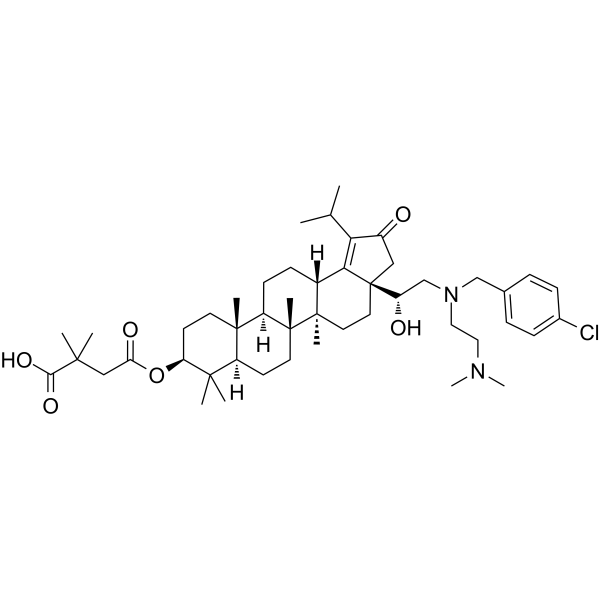
GSK2838232, a betulin derivative, is a novel and potent inhibitor of human immune virus (HIV) maturation that is being developed for the treatment of chronic HIV infection. Human immunodeficiency virus type 1 (HIV-1 ) leads to the contraction of acquired immune deficiency disease (AIDS). The number of cases of HIV continues to rise, and currently over twenty-five million individuals worldwide suffer from the virus. Presently, long-term suppression of viral replication with antiretroviral drugs is the only option for treating HIV-1 infection. Indeed, the U.S. Food and Drug Administration has approved twenty-five drugs over six different inhibitor classes, which have been shown to greatly increase patient survival and quality of life. However, additional therapies are still required because of undesirable drug-drug interactions; drug-food interactions; non-adherence to therapy; and drug resistance due to mutation of the enzyme target.
Physicochemical Properties
| Molecular Formula | C48H73CLN2O6 |
| Molecular Weight | 809.556033849716 |
| Exact Mass | 808.515 |
| CAS # | 1443461-21-9 |
| Related CAS # | 1443460-91-0;1443461-21-9 (GSK2838232-isomer); |
| PubChem CID | 89634981 |
| Appearance | White to off-white solid powder |
| Density | 1.2±0.1 g/cm3 |
| Boiling Point | 817.1±65.0 °C at 760 mmHg |
| Flash Point | 448.0±34.3 °C |
| Vapour Pressure | 0.0±3.1 mmHg at 25°C |
| Index of Refraction | 1.577 |
| LogP | 11.63 |
| Hydrogen Bond Donor Count | 2 |
| Hydrogen Bond Acceptor Count | 8 |
| Rotatable Bond Count | 14 |
| Heavy Atom Count | 57 |
| Complexity | 1570 |
| Defined Atom Stereocenter Count | 9 |
| SMILES | CC(C)C1=C2[C@H]3CC[C@@H]4[C@]5(CC[C@@H](C([C@@H]5CC[C@]4([C@@]3(CC[C@]2(CC1=O)[C@H](CN(CCN(C)C)CC6=CC(=CC=C6)Cl)O)C)C)(C)C)OC(=O)CC(C)(C)C(=O)O)C |
| InChi Key | DSNMRZSQABDJDK-PZFKGGKESA-N |
| InChi Code | InChI=1S/C48H73ClN2O6/c1-30(2)40-34(52)26-48(37(53)29-51(24-23-50(10)11)28-31-13-12-14-32(49)25-31)22-21-46(8)33(41(40)48)15-16-36-45(7)19-18-38(57-39(54)27-43(3,4)42(55)56)44(5,6)35(45)17-20-47(36,46)9/h12-14,25,30,33,35-38,53H,15-24,26-29H2,1-11H3,(H,55,56)/t33-,35+,36-,37+,38+,45+,46-,47-,48+/m1/s1 |
| Chemical Name | 4-(((3aR,5aR,5bR,7aR,9S,11aR,11bR,13aS)-3a-((R)-2-((3-chlorobenzyl)(2-(dimethylamino)ethyl)amino)-1-hydroxyethyl)-1-isopropyl-5a,5b,8,8,11a-pentamethyl-2-oxo-3,3a,4,5,5a,5b,6,7,7a,8,9,10,11,11a,11b,12,13,13a-octadecahydro-2H-cyclopenta[a]chrysen-9-yl)oxy)-2,2-dimethyl-4-oxobutanoic acid. |
| Synonyms | GSK2838232; GSK-2838232; GSK 2838232. |
| HS Tariff Code | 2934.99.9001 |
| Storage |
Powder-20°C 3 years 4°C 2 years In solvent -80°C 6 months -20°C 1 month |
| Shipping Condition | Room temperature (This product is stable at ambient temperature for a few days during ordinary shipping and time spent in Customs) |
Biological Activity
| Targets |
HIV Integrase (HIV IN) (IC50 for recombinant HIV-1 integrase strand transfer reaction: 0.02 μM; EC50 for HIV-1 wild-type strain IIIB: 0.05 μM; EC50 for HIV-1 drug-resistant strain (Y143R): 0.08 μM) [1] |
| ln Vitro |
1. Anti-HIV-1 activity against wild-type and drug-resistant strains: GSK2838232 exhibits potent inhibitory activity against HIV-1 wild-type strains (e.g., IIIB, BaL) and integrase inhibitor-resistant strains (e.g., Y143R, N155H, Q148K). For HIV-1 IIIB, the EC50 value is 0.05 μM; for Y143R mutant strain, EC50 is 0.08 μM; for N155H mutant strain, EC50 is 0.10 μM; and for Q148K mutant strain, EC50 is 0.12 μM. The compound shows no cross-resistance with other anti-HIV drug classes (e.g., nucleoside reverse transcriptase inhibitors, protease inhibitors) [1] 2. Cellular cytotoxicity and therapeutic index: In MT-4 cells (HIV-susceptible human T lymphoblastoid cells) and primary human peripheral blood mononuclear cells (PBMCs), GSK2838232 exhibits low cytotoxicity. The CC50 value is >20 μM in MT-4 cells and >30 μM in PBMCs, resulting in a therapeutic index (TI = CC50/EC50) of >400 for HIV-1 IIIB in MT-4 cells and >600 in PBMCs [1] 3. Inhibition of HIV-1 integration: In a viral integration assay using HeLa cells transfected with HIV-1 proviral DNA and treated with GSK2838232 (0.01–1 μM), the compound dose-dependently inhibits HIV-1 DNA integration into the host genome. At 0.1 μM, integration is reduced by ~85% compared to vehicle control, confirming its mechanism of targeting HIV integrase [1] |
| Enzyme Assay |
1. HIV-1 integrase strand transfer reaction inhibition assay: - Recombinant HIV-1 integrase (wild-type or mutant) was purified and resuspended in reaction buffer containing MgCl₂, dithiothreitol (DTT), and bovine serum albumin (BSA) to maintain enzymatic activity. - Serial concentrations of GSK2838232 (0.001–1 μM) were pre-incubated with the recombinant integrase for 20 minutes at 37°C. - Biotinylated donor DNA substrate and target DNA substrate were added to the reaction mixture to initiate the strand transfer reaction, and the mixture was incubated for 60 minutes at 37°C. - The reaction was terminated by adding EDTA buffer, and the biotinylated DNA products were captured on streptavidin-coated microplate wells. - A fluorescently labeled anti-DNA antibody was added to detect the captured DNA products, and fluorescence intensity (excitation/emission at 485/520 nm) was measured using a microplate reader. - The percentage of enzymatic activity (relative to vehicle control) was plotted against the log concentration of GSK2838232, and the IC50 value was calculated from the dose-response curve [1] |
| Cell Assay |
1. HIV-1 infection inhibition assay in MT-4 cells: - MT-4 cells (human T lymphoblastoid cells susceptible to HIV-1) were seeded in 96-well plates at a density of 2×10⁴ cells/well and cultured in RPMI 1640 medium supplemented with 10% fetal bovine serum. - Serial concentrations of GSK2838232 (0.001–10 μM) were added to the wells, followed by inoculation with HIV-1 IIIB strain at a multiplicity of infection (MOI) of 0.01. - The plates were incubated at 37°C with 5% CO₂ for 5 days. After incubation, the cytopathic effect (CPE) induced by HIV-1 was observed under a light microscope, and cell viability was measured using the MTT colorimetric assay. - The EC50 was defined as the concentration of GSK2838232 inhibiting HIV-1-induced CPE by 50% relative to vehicle control. The CC50 was determined as the concentration reducing cell viability by 50% compared to uninfected, untreated cells [1] 2. HIV-1 p24 antigen quantification assay: - PBMCs were isolated from healthy donors by density gradient centrifugation and activated with phytohemagglutinin (PHA) for 3 days. - Activated PBMCs were seeded in 96-well plates (1×10⁵ cells/well) and treated with GSK2838232 (0.005–5 μM) for 1 hour, then infected with HIV-1 BaL strain (MOI = 0.05). - After 7 days of incubation at 37°C with 5% CO₂, cell supernatants were collected, and p24 antigen levels were quantified using an enzyme-linked immunosorbent assay (ELISA). - The EC50 was calculated as the concentration inhibiting p24 production by 50% relative to vehicle-treated infected cells [1] |
| ADME/Pharmacokinetics |
1. Oral absorption: In CD-1 mice, oral administration of GSK2838232 (10 mg/kg) results in a peak plasma concentration (Cmax) of 1.8 μM at a Tmax of 1.5 hours. The oral bioavailability is 42% based on comparison with intravenous administration data [1] 2. Distribution: The apparent volume of distribution (Vd/F) in mice is 3.2 L/kg, indicating extensive tissue distribution. The compound penetrates into lymphoid tissues (e.g., spleen, lymph nodes) with tissue-to-plasma concentration ratios of 2.5:1 (spleen) and 3.1:1 (lymph nodes) at 2 hours post-dosing [1] 3. Metabolism: GSK2838232 is metabolized primarily in the liver via cytochrome P450 3A4 (CYP3A4) and UDP-glucuronosyltransferase (UGT) 1A9. In human liver microsomes, the in vitro metabolic half-life is 3.8 hours, with two major metabolites (a hydroxylated derivative and a glucuronide conjugate) identified, both inactive against HIV integrase [1] 4. Excretion: In mice, the plasma elimination half-life (t1/2) is 4.5 hours. Within 72 hours of oral administration, 65% of the dose is excreted in feces (30% as unchanged drug, 35% as metabolites) and 28% in urine (primarily as metabolites) [1] 5. Plasma protein binding: In human plasma, the plasma protein binding rate is 89% (determined by equilibrium dialysis) over the concentration range of 0.1–10 μM [1] |
| Toxicity/Toxicokinetics |
1. In vitro cytotoxicity: GSK2838232 shows low cytotoxicity in mammalian cell lines (MT-4, PBMCs, HepG2) with CC50 values >20 μM, resulting in high therapeutic indices (>400) for anti-HIV activity [1] 2. Acute in vivo toxicity: Single oral administration of GSK2838232 at doses up to 500 mg/kg in CD-1 mice and Sprague-Dawley rats causes no mortality or severe clinical signs. Mild transient diarrhea is observed in mice at doses ≥200 mg/kg, resolving within 24 hours [1] 3. Subchronic toxicity: Four-week oral administration of GSK2838232 (10 mg/kg, 30 mg/kg, 100 mg/kg daily) in rats results in no significant changes in body weight, food intake, or laboratory parameters (liver function: ALT, AST; renal function: creatinine, BUN; hematology: hemoglobin, WBC count). Histopathological examination of major organs (liver, kidney, heart, spleen) shows no abnormal lesions [1] 4. Drug-drug interaction potential: GSK2838232 does not inhibit major cytochrome P450 enzymes (CYP1A2, CYP2C9, CYP2C19, CYP2D6, CYP3A4) at therapeutic concentrations (≤1 μM), indicating low potential for drug-drug interactions with other anti-HIV agents [1] |
| References |
[1]. Preparation of betulin derivatives for the treatment of HIV. From PCT Int. Appl. (2013), WO 2013090664 A1 20130620. |
| Additional Infomation |
1. Drug classification and structure: GSK2838232 is a synthetic derivative of betulin (a natural triterpenoid isolated from birch bark), designed as a second-generation HIV integrase strand transfer inhibitor (INSTI) [1] 2. Mechanism of action: GSK2838232 binds to the catalytic site of HIV integrase, inhibiting the strand transfer reaction—the final step of HIV DNA integration into the host cell genome. This blocks viral replication by preventing the establishment of a persistent infection [1] 3. Therapeutic potential: The compound is developed for the treatment of HIV-1 infection, including infections caused by integrase inhibitor-resistant strains. Its potent activity against drug-resistant mutants and favorable pharmacokinetic profile (oral bioavailability, tissue penetration into lymphoid tissues) support its use in combination antiretroviral therapy (cART) [1] 4. Structural optimization: Compared to first-generation INSTIs (e.g., raltegravir), GSK2838232 features structural modifications (e.g., addition of polar substituents on the betulin scaffold) that enhance binding affinity to HIV integrase and improve oral bioavailability [1] 5. Patent background: This compound is disclosed in PCT International Application WO2013090664A1, focusing on the development of betulin derivatives with improved anti-HIV activity and pharmacokinetic properties for clinical application [1] |
Solubility Data
| Solubility (In Vitro) | May dissolve in DMSO (in most cases), if not, try other solvents such as H2O, Ethanol, or DMF with a minute amount of products to avoid loss of samples |
| Solubility (In Vivo) |
Note: Listed below are some common formulations that may be used to formulate products with low water solubility (e.g. < 1 mg/mL), you may test these formulations using a minute amount of products to avoid loss of samples. Injection Formulations (e.g. IP/IV/IM/SC) Injection Formulation 1: DMSO : Tween 80: Saline = 10 : 5 : 85 (i.e. 100 μL DMSO stock solution → 50 μL Tween 80 → 850 μL Saline) *Preparation of saline: Dissolve 0.9 g of sodium chloride in 100 mL ddH ₂ O to obtain a clear solution. Injection Formulation 2: DMSO : PEG300 :Tween 80 : Saline = 10 : 40 : 5 : 45 (i.e. 100 μL DMSO → 400 μLPEG300 → 50 μL Tween 80 → 450 μL Saline) Injection Formulation 3: DMSO : Corn oil = 10 : 90 (i.e. 100 μL DMSO → 900 μL Corn oil) Example: Take the Injection Formulation 3 (DMSO : Corn oil = 10 : 90) as an example, if 1 mL of 2.5 mg/mL working solution is to be prepared, you can take 100 μL 25 mg/mL DMSO stock solution and add to 900 μL corn oil, mix well to obtain a clear or suspension solution (2.5 mg/mL, ready for use in animals). Injection Formulation 4: DMSO : 20% SBE-β-CD in saline = 10 : 90 [i.e. 100 μL DMSO → 900 μL (20% SBE-β-CD in saline)] *Preparation of 20% SBE-β-CD in Saline (4°C,1 week): Dissolve 2 g SBE-β-CD in 10 mL saline to obtain a clear solution. Injection Formulation 5: 2-Hydroxypropyl-β-cyclodextrin : Saline = 50 : 50 (i.e. 500 μL 2-Hydroxypropyl-β-cyclodextrin → 500 μL Saline) Injection Formulation 6: DMSO : PEG300 : castor oil : Saline = 5 : 10 : 20 : 65 (i.e. 50 μL DMSO → 100 μLPEG300 → 200 μL castor oil → 650 μL Saline) Injection Formulation 7: Ethanol : Cremophor : Saline = 10: 10 : 80 (i.e. 100 μL Ethanol → 100 μL Cremophor → 800 μL Saline) Injection Formulation 8: Dissolve in Cremophor/Ethanol (50 : 50), then diluted by Saline Injection Formulation 9: EtOH : Corn oil = 10 : 90 (i.e. 100 μL EtOH → 900 μL Corn oil) Injection Formulation 10: EtOH : PEG300:Tween 80 : Saline = 10 : 40 : 5 : 45 (i.e. 100 μL EtOH → 400 μLPEG300 → 50 μL Tween 80 → 450 μL Saline) Oral Formulations Oral Formulation 1: Suspend in 0.5% CMC Na (carboxymethylcellulose sodium) Oral Formulation 2: Suspend in 0.5% Carboxymethyl cellulose Example: Take the Oral Formulation 1 (Suspend in 0.5% CMC Na) as an example, if 100 mL of 2.5 mg/mL working solution is to be prepared, you can first prepare 0.5% CMC Na solution by measuring 0.5 g CMC Na and dissolve it in 100 mL ddH2O to obtain a clear solution; then add 250 mg of the product to 100 mL 0.5% CMC Na solution, to make the suspension solution (2.5 mg/mL, ready for use in animals). Oral Formulation 3: Dissolved in PEG400 Oral Formulation 4: Suspend in 0.2% Carboxymethyl cellulose Oral Formulation 5: Dissolve in 0.25% Tween 80 and 0.5% Carboxymethyl cellulose Oral Formulation 6: Mixing with food powders Note: Please be aware that the above formulations are for reference only. InvivoChem strongly recommends customers to read literature methods/protocols carefully before determining which formulation you should use for in vivo studies, as different compounds have different solubility properties and have to be formulated differently. (Please use freshly prepared in vivo formulations for optimal results.) |
| Preparing Stock Solutions | 1 mg | 5 mg | 10 mg | |
| 1 mM | 1.2352 mL | 6.1762 mL | 12.3524 mL | |
| 5 mM | 0.2470 mL | 1.2352 mL | 2.4705 mL | |
| 10 mM | 0.1235 mL | 0.6176 mL | 1.2352 mL |