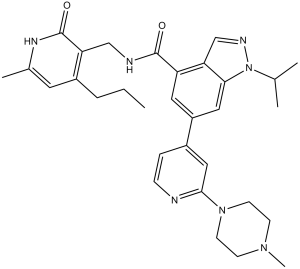
GSK343 is a novel, highly potent and selective inhibitor of H3-lysine 27 (H3K27) methyltransferase EZH2 with antineoplastic activity. It inhibits EZH2 with an IC50 of 4 nM in a cell-free assay, and displays >60 fold selectivity for EZH2 over EZH1, and other histone methyltransferases. GSK343 was found to inhibit cell proliferation in some breast and prostate cancer cells. In LNCaP cells, GSK343 suppressed cell growth with IC50 value of 2.9 μM. In human EOC cells, GSK343 notably inhibited cell invasion and induced cell apoptosis. GSK343 was also found to induce LC3-II accumulation and autophagy in A549, MDA-MB-231 and HepG2 cell.
Physicochemical Properties
| Molecular Formula | C31H39N7O2 | |
| Molecular Weight | 541.69 | |
| Exact Mass | 541.316 | |
| CAS # | 1346704-33-3 | |
| Related CAS # |
|
|
| PubChem CID | 71268957 | |
| Appearance | White to yellow solid powder | |
| Density | 1.3±0.1 g/cm3 | |
| Boiling Point | 797.4±60.0 °C at 760 mmHg | |
| Flash Point | 436.0±32.9 °C | |
| Vapour Pressure | 0.0±2.8 mmHg at 25°C | |
| Index of Refraction | 1.654 | |
| LogP | 3.22 | |
| Hydrogen Bond Donor Count | 2 | |
| Hydrogen Bond Acceptor Count | 6 | |
| Rotatable Bond Count | 8 | |
| Heavy Atom Count | 40 | |
| Complexity | 986 | |
| Defined Atom Stereocenter Count | 0 | |
| InChi Key | ULNXAWLQFZMIHX-UHFFFAOYSA-N | |
| InChi Code | InChI=1S/C31H39N7O2/c1-6-7-23-14-21(4)35-31(40)26(23)18-33-30(39)25-15-24(16-28-27(25)19-34-38(28)20(2)3)22-8-9-32-29(17-22)37-12-10-36(5)11-13-37/h8-9,14-17,19-20H,6-7,10-13,18H2,1-5H3,(H,33,39)(H,35,40) | |
| Chemical Name | 1-isopropyl-N-((6-methyl-2-oxo-4-propyl-1,2-dihydropyridin-3-yl)methyl)-6-(2-(4-methylpiperazin-1-yl)pyridin-4-yl)-1H-indazole-4-carboxamide. | |
| Synonyms | GSK-343; GSK 343; GSK343 | |
| HS Tariff Code | 2934.99.9001 | |
| Storage |
Powder-20°C 3 years 4°C 2 years In solvent -80°C 6 months -20°C 1 month |
|
| Shipping Condition | Room temperature (This product is stable at ambient temperature for a few days during ordinary shipping and time spent in Customs) |
Biological Activity
| ln Vitro | The scaffold line LNCaP was the most susceptible to EZH2 tension among the cell lines in this study, and the growth IC50 value of GSK343 was 2.9 μM >[1]. GSK343 has a positive quenching at position 4 of pyridine, with EZH2 Kiapp=1.2±0.2 nM. GSK343 was discovered to have a half-maximum amplification concentration value of 13 μM in HeLa cells and 15 μM in SiHa cells [2]. | ||
| ln Vivo | Mice treated with GSK343 (5 mg/kg) showed a substantial reduction of tumor growth when compared to the control group. The group treated with GSK343 experienced a significant reduction in both mean tumor volume and weight. The GSK343-treated group showed a significant reduction in tumor growth as early as 20 days after implantation when compared to the control group; this difference has been consistently reported in additional investigations. Additionally, compared to controls, animals treated with GSK343 in xenograft models exhibited significantly higher levels of E-cadherin messenger RNA but significantly lower levels of vimentin messenger RNA [2]. | ||
| Animal Protocol |
|
||
| References |
[1]. Identification of Potent, Selective, Cell-Active Inhibitors of the Histone Lysine Methyltransferase EZH2. ACS Med Chem Lett. 2012 Oct 19;3(12):1091-6. [2]. The polycomb group protein enhancer of zeste 2 is a novel therapeutic target for cervical cancer. Clin Exp Pharmacol Physiol. 2015 May;42(5):458-64. |
||
| Additional Infomation | GSK343 is a member of the class of indazoles that is 1-isopropyl-1H-indazole-4-carboxamide in which the nitrogen of the carboxamide group is substituted by a (6-methyl-2-oxo-4-propyl-1,2-dihydropyridin-3-yl)methyl group and in which the indazole ring is substituted at position 6 by a 2-(4-methylpiperazin-1-yl)pyridin-4-yl group. A highly potent and selective EZH2 inhibitor (IC50 = 4 nM). It has a role as an EC 2.1.1.43 (enhancer of zeste homolog 2) inhibitor, an apoptosis inducer and an antineoplastic agent. It is a N-alkylpiperazine, a secondary carboxamide, an aminopyridine, a pyridone, a N-arylpiperazine and a member of indazoles. |
Solubility Data
| Solubility (In Vitro) |
|
|||
| Solubility (In Vivo) |
Solubility in Formulation 1: ≥ 1.56 mg/mL (2.88 mM) (saturation unknown) in 10% DMSO + 40% PEG300 + 5% Tween80 + 45% Saline (add these co-solvents sequentially from left to right, and one by one), clear solution. For example, if 1 mL of working solution is to be prepared, you can add 100 μL of 15.6 mg/mL clear DMSO stock solution to 400 μL PEG300 and mix evenly; then add 50 μL Tween-80 to the above solution and mix evenly; then add 450 μL normal saline to adjust the volume to 1 mL. Preparation of saline: Dissolve 0.9 g of sodium chloride in 100 mL ddH₂ O to obtain a clear solution. Solubility in Formulation 2: ≥ 1.56 mg/mL (2.88 mM) (saturation unknown) in 10% DMSO + 90% (20% SBE-β-CD in Saline) (add these co-solvents sequentially from left to right, and one by one), clear solution. For example, if 1 mL of working solution is to be prepared, you can add 100 μL of 15.6 mg/mL clear DMSO stock solution to 900 μL of 20% SBE-β-CD physiological saline solution and mix evenly. Preparation of 20% SBE-β-CD in Saline (4°C,1 week): Dissolve 2 g SBE-β-CD in 10 mL saline to obtain a clear solution. Solubility in Formulation 3: ≥ 1.56 mg/mL (2.88 mM) (saturation unknown) in 10% DMSO + 90% Corn Oil (add these co-solvents sequentially from left to right, and one by one), clear solution. For example, if 1 mL of working solution is to be prepared, you can add 100 μL of 15.6 mg/mL clear DMSO stock solution to 900 μL of corn oil and mix evenly. (Please use freshly prepared in vivo formulations for optimal results.) |
| Preparing Stock Solutions | 1 mg | 5 mg | 10 mg | |
| 1 mM | 1.8461 mL | 9.2304 mL | 18.4607 mL | |
| 5 mM | 0.3692 mL | 1.8461 mL | 3.6921 mL | |
| 10 mM | 0.1846 mL | 0.9230 mL | 1.8461 mL |