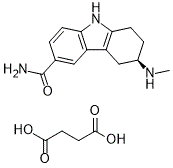
Description: Frovatriptan Succinate (KB-295988; LS-173538; FT-0668872; D04264; Miguard; SB 209509), the succinate salt of frovatriptan, is a synthetic triptan that acts as an agonist of the serotonin (5-HT) receptor. It is also a 5-HT1B/1D receptor agonist. In the extracerebral and intracranial arteries, frovatriptan succinate binds selectively and highly affinity to presynaptic 5-HT 1D and 5-HT 1B receptors. This causes the painfully dilated blood vessels during a migraine attack to vasoconstrict due to an inhibition of serotonin activity. The acute treatment of migraines is indicated by frovatriptan succinate.
Physicochemical Properties
| Molecular Formula | C18H23N3O5 | |
| Molecular Weight | 361.39 | |
| Exact Mass | 361.164 | |
| Elemental Analysis | C, 56.98; H, 6.64; N, 11.08; O, 25.30 | |
| CAS # | 158930-09-7 | |
| Related CAS # | Frovatriptan succinate hydrate; 158930-17-7; Frovatriptan; 158747-02-5; Frovatriptan-d3 succinate | |
| PubChem CID | 152944 | |
| Appearance | Solid powder | |
| Boiling Point | 515.2ºC at 760 mmHg | |
| Flash Point | 265.4ºC | |
| Vapour Pressure | 1.01E-10mmHg at 25°C | |
| LogP | 2.554 | |
| Hydrogen Bond Donor Count | 5 | |
| Hydrogen Bond Acceptor Count | 6 | |
| Rotatable Bond Count | 5 | |
| Heavy Atom Count | 26 | |
| Complexity | 426 | |
| Defined Atom Stereocenter Count | 1 | |
| SMILES | CN[C@@H]1CCC2=C(C3C=C(C(=O)N)C=CC=3N2)C1.OC(CCC(=O)O)=O |
|
| InChi Key | WHTHWNUUXINXHN-SBSPUUFOSA-N | |
| InChi Code | InChI=1S/C14H17N3O.C4H6O4/c1-16-9-3-5-13-11(7-9)10-6-8(14(15)18)2-4-12(10)17-13;5-3(6)1-2-4(7)8/h2,4,6,9,16-17H,3,5,7H2,1H3,(H2,15,18);1-2H2,(H,5,6)(H,7,8)/t9-;/m1./s1 | |
| Chemical Name |
|
|
| Synonyms |
|
|
| HS Tariff Code | 2934.99.9001 | |
| Storage |
Powder-20°C 3 years 4°C 2 years In solvent -80°C 6 months -20°C 1 month |
|
| Shipping Condition | Room temperature (This product is stable at ambient temperature for a few days during ordinary shipping and time spent in Customs) |
Biological Activity
| Targets | 5-HT1B Receptor ( pEC50 = 8.2 ); 5-HT1D Receptor |
| ln Vitro | It is thought that neurogenic inflammation and cerebral vasodilatation are key players in the pathophysiology of migraine. While 5-HT1D activation inhibits neurogenic inflammation, 5-HT1B activation reverses cerebral vasodilatation. While frovatriptan has a moderate affinity for the subtypes of 5-HT1A and 5-HT1F receptors, it has a high affinity for 5-HT1B and 5-HT1D receptors. Frovatriptan exhibits a moderate affinity for the 5-HT7 receptors, a property linked to the relaxation of the coronary arteries in dogs[1]. |
| ln Vivo |
Frovatriptan has an oral bioavailability of 22%–30%, which is unaffected by meals. 60%–70% of the plasma's maximum concentration is reached in an hour, even though it takes two to three hours to reach its maximum. A steady state is achieved in 4-5 days. The binding of plasma proteins is only 15%. The relative terminal long half-life of roughly 26 hours is the most distinctive feature. Since frovatriptan is primarily metabolized by CYP1A2 and excreted by the kidney and liver, mild failure of either organ should not be a treatment-limiting factor[1]. Frovatriptan (0.1, 0.2, and 0.3 mg/kg; a single bolus intraduodenal administration) treatment bolus intraduodenal administration) increases carotid vascular resistance, which lasts for at least five hours in dogs[2]. |
| References |
[1]. Review of frovatriptan in the treatment of migraine. Neuropsychiatr Dis Treat. 2008 Feb;4(1):49-54. [2]. Pharmacology of the selective 5-HT(1B/1D) agonist frovatriptan. Headache. 2002 Apr;42 Suppl 2:S47-53. |
| Additional Infomation |
Frovatriptan Succinate is the succinate salt form of frovatriptan, a synthetic triptan with serotonin (5-HT) receptor agonist activity. Frovatriptan succinate binds selectively and with high affinity to 5-HT 1B and presynaptic 5-HT 1D receptors in the extracerebral and intracranial arteries. This leads to an inhibition of serotonin activity and results in vasoconstriction of the painfully dilated blood vessels during migraine attack. Frovatriptan succinate is indicated for the acute treatment of migraine. (NCI05) See also: Frovatriptan (has active moiety). |
Solubility Data
| Solubility (In Vitro) |
|
|||
| Solubility (In Vivo) |
Note: Listed below are some common formulations that may be used to formulate products with low water solubility (e.g. < 1 mg/mL), you may test these formulations using a minute amount of products to avoid loss of samples. Injection Formulations (e.g. IP/IV/IM/SC) Injection Formulation 1: DMSO : Tween 80: Saline = 10 : 5 : 85 (i.e. 100 μL DMSO stock solution → 50 μL Tween 80 → 850 μL Saline) *Preparation of saline: Dissolve 0.9 g of sodium chloride in 100 mL ddH ₂ O to obtain a clear solution. Injection Formulation 2: DMSO : PEG300 :Tween 80 : Saline = 10 : 40 : 5 : 45 (i.e. 100 μL DMSO → 400 μLPEG300 → 50 μL Tween 80 → 450 μL Saline) Injection Formulation 3: DMSO : Corn oil = 10 : 90 (i.e. 100 μL DMSO → 900 μL Corn oil) Example: Take the Injection Formulation 3 (DMSO : Corn oil = 10 : 90) as an example, if 1 mL of 2.5 mg/mL working solution is to be prepared, you can take 100 μL 25 mg/mL DMSO stock solution and add to 900 μL corn oil, mix well to obtain a clear or suspension solution (2.5 mg/mL, ready for use in animals). Injection Formulation 4: DMSO : 20% SBE-β-CD in saline = 10 : 90 [i.e. 100 μL DMSO → 900 μL (20% SBE-β-CD in saline)] *Preparation of 20% SBE-β-CD in Saline (4°C,1 week): Dissolve 2 g SBE-β-CD in 10 mL saline to obtain a clear solution. Injection Formulation 5: 2-Hydroxypropyl-β-cyclodextrin : Saline = 50 : 50 (i.e. 500 μL 2-Hydroxypropyl-β-cyclodextrin → 500 μL Saline) Injection Formulation 6: DMSO : PEG300 : castor oil : Saline = 5 : 10 : 20 : 65 (i.e. 50 μL DMSO → 100 μLPEG300 → 200 μL castor oil → 650 μL Saline) Injection Formulation 7: Ethanol : Cremophor : Saline = 10: 10 : 80 (i.e. 100 μL Ethanol → 100 μL Cremophor → 800 μL Saline) Injection Formulation 8: Dissolve in Cremophor/Ethanol (50 : 50), then diluted by Saline Injection Formulation 9: EtOH : Corn oil = 10 : 90 (i.e. 100 μL EtOH → 900 μL Corn oil) Injection Formulation 10: EtOH : PEG300:Tween 80 : Saline = 10 : 40 : 5 : 45 (i.e. 100 μL EtOH → 400 μLPEG300 → 50 μL Tween 80 → 450 μL Saline) Oral Formulations Oral Formulation 1: Suspend in 0.5% CMC Na (carboxymethylcellulose sodium) Oral Formulation 2: Suspend in 0.5% Carboxymethyl cellulose Example: Take the Oral Formulation 1 (Suspend in 0.5% CMC Na) as an example, if 100 mL of 2.5 mg/mL working solution is to be prepared, you can first prepare 0.5% CMC Na solution by measuring 0.5 g CMC Na and dissolve it in 100 mL ddH2O to obtain a clear solution; then add 250 mg of the product to 100 mL 0.5% CMC Na solution, to make the suspension solution (2.5 mg/mL, ready for use in animals). Oral Formulation 3: Dissolved in PEG400 Oral Formulation 4: Suspend in 0.2% Carboxymethyl cellulose Oral Formulation 5: Dissolve in 0.25% Tween 80 and 0.5% Carboxymethyl cellulose Oral Formulation 6: Mixing with food powders Note: Please be aware that the above formulations are for reference only. InvivoChem strongly recommends customers to read literature methods/protocols carefully before determining which formulation you should use for in vivo studies, as different compounds have different solubility properties and have to be formulated differently. (Please use freshly prepared in vivo formulations for optimal results.) |
| Preparing Stock Solutions | 1 mg | 5 mg | 10 mg | |
| 1 mM | 2.7671 mL | 13.8355 mL | 27.6709 mL | |
| 5 mM | 0.5534 mL | 2.7671 mL | 5.5342 mL | |
| 10 mM | 0.2767 mL | 1.3835 mL | 2.7671 mL |