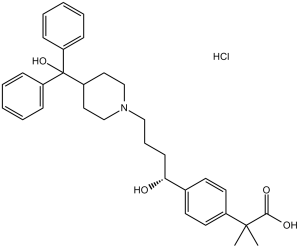
Fexofenadine HCl (formerly MDL-16455A; Allegra; Terfenidine carboxylate; Telfast) is a potent histamine H1 receptor antagonist (antihistamine agent) used in the treatment of allergy symptoms such as hay fever, nasal congestion, and urticaria. Fexofenadine belongs to the second generation of antihistamines because, in contrast to first-generation antihistamines, it is less able to sedate people by crossing the blood-brain barrier.Fexofenadine has an IC50 value of 95.5 nM and demonstrates a strong, concentration-dependent anti-anaphylactic effect. For the 5-HT2A receptors from the rat caudal artery with a pA2 of 5.2, fexofenadine only exhibits a weak competitive antagonist behavior. On the P-gp-mediated secretion of Fexofenadine, verapamil's half-life (IC50) is 8.44 mM.
Physicochemical Properties
| Molecular Formula | C32H40CLNO4 | |
| Molecular Weight | 538.12 | |
| Exact Mass | 537.264 | |
| Elemental Analysis | C, 71.42; H, 7.49; Cl, 6.59; N, 2.60; O, 11.89 | |
| CAS # | 153439-40-8 | |
| Related CAS # | Fexofenadine; 83799-24-0; Fexofenadine-d6; 548783-71-7; Fexofenadine-d10 hydrochloride; 1215821-44-5 | |
| PubChem CID | 63002 | |
| Appearance | White to off-white solid powder | |
| Melting Point | 148-150oC | |
| LogP | 6.25 | |
| Hydrogen Bond Donor Count | 4 | |
| Hydrogen Bond Acceptor Count | 5 | |
| Rotatable Bond Count | 10 | |
| Heavy Atom Count | 38 | |
| Complexity | 678 | |
| Defined Atom Stereocenter Count | 0 | |
| SMILES | Cl[H].O([H])C(C1C([H])=C([H])C([H])=C([H])C=1[H])(C1C([H])=C([H])C([H])=C([H])C=1[H])C1([H])C([H])([H])C([H])([H])N(C([H])([H])C([H])([H])C([H])([H])C([H])(C2C([H])=C([H])C(=C([H])C=2[H])C(C(=O)O[H])(C([H])([H])[H])C([H])([H])[H])O[H])C([H])([H])C1([H])[H] |
|
| InChi Key | RRJFVPUCXDGFJB-UHFFFAOYSA-N | |
| InChi Code | InChI=1S/C32H39NO4.ClH/c1-31(2,30(35)36)25-17-15-24(16-18-25)29(34)14-9-21-33-22-19-28(20-23-33)32(37,26-10-5-3-6-11-26)27-12-7-4-8-13-27;/h3-8,10-13,15-18,28-29,34,37H,9,14,19-23H2,1-2H3,(H,35,36);1H | |
| Chemical Name | 2-[4-[1-hydroxy-4-[4-[hydroxy(diphenyl)methyl]piperidin-1-yl]butyl]phenyl]-2-methylpropanoic acid;hydrochloride | |
| Synonyms |
|
|
| HS Tariff Code | 2934.99.9001 | |
| Storage |
Powder-20°C 3 years 4°C 2 years In solvent -80°C 6 months -20°C 1 month Note: Please store this product in a sealed and protected environment, avoid exposure to moisture. |
|
| Shipping Condition | Room temperature (This product is stable at ambient temperature for a few days during ordinary shipping and time spent in Customs) |
Biological Activity
| Targets | Histamine H1 receptor ( IC50 = 246 nM ) | |
| ln Vitro |
|
|
| ln Vivo |
|
|
| Cell Assay | Fexofenadine hydrochloride (MDL-16455 hydrochloride) (100 µM; 1 hour) efficiently inhibits phosphorylated p38 activation in histamine-induced nasal fibroblasts. | |
| Animal Protocol |
C57BL/6 mice infected with Trichinella spiralis 5, 10 and 20 mg/kg Oral administration; 5, 10 and 20 mg/kg; once daily; 3 weeks |
|
| References |
[1]. Drugs R D . 2005;6(6):371-84. [2]. Pharm Res . 2004 Aug;21(8):1398-404. [3]. Heart Rhythm . 2006 Aug;3(8):948-56. |
|
| Additional Infomation |
Fexofenadine hydrochloride is a diarylmethane. Fexofenadine Hydrochloride is the hydrochloride salt form of fexofenadine, a carboxylated metabolic derivative of terfenadine and second generation, long-lasting selective histamine H1 receptor antagonist, with antihistaminic activity. Upon administration, fexofenadine competitively binds of peripheral H1-receptors in the gastrointestinal (GI) tract, blood vessels, and bronchial smooth muscle. This prevents binding of histamine to peripheral H1-receptors and prevents their activation. This prevents a histamine-mediated allergic reaction. Fexofenadine does not cross the blood-brain-barrier (BBB). See also: Fexofenadine (has active moiety) ... View More ... |
Solubility Data
| Solubility (In Vitro) |
|
|||
| Solubility (In Vivo) |
Solubility in Formulation 1: ≥ 2.5 mg/mL (4.65 mM) (saturation unknown) in 10% DMSO + 40% PEG300 + 5% Tween80 + 45% Saline (add these co-solvents sequentially from left to right, and one by one), clear solution. For example, if 1 mL of working solution is to be prepared, you can add 100 μL of 25.0 mg/mL clear DMSO stock solution to 400 μL PEG300 and mix evenly; then add 50 μL Tween-80 to the above solution and mix evenly; then add 450 μL normal saline to adjust the volume to 1 mL. Preparation of saline: Dissolve 0.9 g of sodium chloride in 100 mL ddH₂ O to obtain a clear solution. Solubility in Formulation 2: ≥ 2.5 mg/mL (4.65 mM) (saturation unknown) in 10% DMSO + 90% Corn Oil (add these co-solvents sequentially from left to right, and one by one), clear solution. For example, if 1 mL of working solution is to be prepared, you can add 100 μL of 25.0 mg/mL clear DMSO stock solution to 900 μL of corn oil and mix evenly. (Please use freshly prepared in vivo formulations for optimal results.) |
| Preparing Stock Solutions | 1 mg | 5 mg | 10 mg | |
| 1 mM | 1.8583 mL | 9.2916 mL | 18.5832 mL | |
| 5 mM | 0.3717 mL | 1.8583 mL | 3.7166 mL | |
| 10 mM | 0.1858 mL | 0.9292 mL | 1.8583 mL |