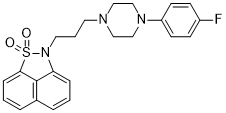
Fananserin (RP-62203; RP62203) is a novel and potent antipsychotic agent acting as a 5-hydroxytryptamine2 (5-HT2) receptor antagonist (Ki = 0.37 nM for the rat 5-HT2A receptor).
Physicochemical Properties
| Molecular Formula | C23H24FN3O2S |
| Molecular Weight | 425.52 |
| Exact Mass | 425.157 |
| Elemental Analysis | C, 64.92; H, 5.69; F, 4.46; N, 9.88; O, 7.52; S, 7.53 |
| CAS # | 127625-29-0 |
| PubChem CID | 60785 |
| Appearance | Solid powder |
| Density | 1.331g/cm3 |
| Boiling Point | 641.1ºC at 760mmHg |
| Flash Point | 341.5ºC |
| Vapour Pressure | 2.48E-16mmHg at 25°C |
| Index of Refraction | 1.659 |
| LogP | 4.848 |
| Hydrogen Bond Donor Count | 0 |
| Hydrogen Bond Acceptor Count | 6 |
| Rotatable Bond Count | 5 |
| Heavy Atom Count | 30 |
| Complexity | 683 |
| Defined Atom Stereocenter Count | 0 |
| SMILES | S1(C2=C([H])C([H])=C([H])C3C([H])=C([H])C([H])=C(C2=3)N1C([H])([H])C([H])([H])C([H])([H])N1C([H])([H])C([H])([H])N(C2C([H])=C([H])C(=C([H])C=2[H])F)C([H])([H])C1([H])[H])(=O)=O |
| InChi Key | VGIGHGMPMUCLIQ-UHFFFAOYSA-N |
| InChi Code | InChI=1S/C23H24FN3O2S/c24-19-8-10-20(11-9-19)26-16-14-25(15-17-26)12-3-13-27-21-6-1-4-18-5-2-7-22(23(18)21)30(27,28)29/h1-2,4-11H,3,12-17H2 |
| Chemical Name | 3-[3-[4-(4-fluorophenyl)piperazin-1-yl]propyl]-2lambda6-thia-3-azatricyclo[6.3.1.04,12]dodeca-1(11),4,6,8(12),9-pentaene 2,2-dioxide |
| Synonyms | RP-62203; RP 62203; 2H-Naphth[1,8-cd]isothiazole, 2-[3-[4-(4-fluorophenyl)-1-piperazinyl]propyl]-, 1,1-dioxide; CHEMBL83894; DTXSID8046743; 38QJ762ET6; Fananserin; RP62203 |
| HS Tariff Code | 2934.99.03.00 |
| Storage |
Powder-20°C 3 years 4°C 2 years In solvent -80°C 6 months -20°C 1 month |
| Shipping Condition | Room temperature (This product is stable at ambient temperature for a few days during ordinary shipping and time spent in Customs) |
Biological Activity
| Targets | 5-HT2 Receptor ( Ki = 0.37 nM ); D4 Receptor ( Ki = 2.93 nM ) |
| ln Vitro | Fananserin has very little affinity for the 5-HT3 receptor and less affinity for the 5-HT1A receptor, making it comparatively selective for the 5-HT2 receptor[1]. Fananserin displaces [3H]spiperone binding to recombinant human dopamine D 4 receptors with a Ki of 2.93 nM[1]. RP 62203 exhibits low to moderate binding affinity towards histamine H1 receptors, dopamine D2 receptors, and α1-adrenoceptors[2]. |
| ln Vivo |
Fananserin displaces [125I]AMIK from 5-HT2 receptors at an IC50 of 0.21 nM in rat frontal cortex[2]. Fananserin demonstrates a moderate affinity for the rat thalamus's alpha 1-adrenoceptors (IC50 = 14 nM) and the guinea-pig cerebellum's histamine H1 receptors (IC50 = 13 nM)[2]. Fananserin (0.5-4 mg/kg; p.o.) lengthens the duration of deep nonrapid eye movement (NREM) sleep at the expense of wakefulness in a dose-dependent manner[3]. |
| Enzyme Assay | The dopamine D4 receptor is a potential target for novel antipsychotic drugs. Most available compounds with affinity for the dopamine D4 receptor also bind to dopamine D2 receptors. This report describe the affinity of the 5-HT2A receptor antagonist RP 62203 (fananserin) for the human dopamine D4 receptor. Fananserin displaces [3H]spiperone binding to recombinant human dopamine D4 receptors with a Ki of 2.93 nM. This compares with an affinity (Ki) of 0.37 nM for the rat 5-HT2A receptor and of 726 mM for the rat dopamine D2 receptor. [3H]Fananserin can be used to label the recombinant dopamine D4 receptor expressed in Chinese hamster ovary cells with a KD of 0.725 nM. Fananserin is, thus, the first compound to be reported that distinguishes between dopamine D4 and D2 receptors[1]. |
| Cell Assay | In this study, quantitative autoradiography was used to determine the selectivity of RP 62203, a novel naphtosultam derivative, for 5-HT2 receptors in vitro and ex vivo, using [125I]7-amino-8-iodo-ketanserin ([125I]AMIK) and [3H]mesulergine as radioligands. The density of [125I]AMIK or [3H]mesulergine binding sites was determined by quantitative image analysis. In in vitro experiments, RP 62203 displaced [125I]AMIK from 5-HT2 receptors with an IC50 of 0.21 nM in rat frontal cortex. Its affinity for 5-HT1C receptors was 100-fold lower (IC50 25 nM versus [3H]mesulergine in rat choroid plexus). RP 62203 showed moderate affinity for alpha 1-adrenoceptors in the rat thalamus (IC50 14 nM) and for histamine H1 receptors in the guinea-pig cerebellum (IC50 13 nM). The tetrabenazine sites were not affected by RP 62203 at a concentration of 30 nM. In ex vivo experiments, RP 62203 was about 4 times more potent than ritanserin in displacing [125I]AMIK from 5-HT2 receptors (ED50 0.58 mg/kg p.o.). A dose of 10 mg/kg of RP 62203 did not displace [3H]mesulergine from 5-HT1C receptors or [125I]AMIK from alpha 1-adrenoceptors and tetrabenazine sites in the rat brain and from histamine H1 receptors in the guinea-pig brain. These results demonstrate that RP 62203 specifically recognizes 5-HT2 receptors in rodent brain[2]. |
| Animal Protocol |
Adult male Sprague Dawley rats (250-300 g) 0.5 mg/kg, 1 mg/kg,2 mg/kg, 4 mg/kg Oral administration RP 62203, a naphtosultam derivative, is an antagonist at the 5-hydroxytryptamine2 (HT2) receptor. The sleep pattern of rats treated orally with RP 62203 was studied at doses ranging from 0.5 to 4 mg/kg. Following RP 62203 administration, the duration of deep nonrapid eye movement (NREM) sleep was found to increase at the expense of wakefulness in a dose-dependent manner from 0.5 mg/kg. The 5-HT2 receptor agonist DOI and the 5-HT1a receptor agonist 8 OH-DPAT induced a dose-related increase in wakefulness; treatment with RP 62203 reversed the enhancement of wakefulness produced by DOI but not that produced by 8 OH-DPAT. These data provide further evidence for the involvement of 5-HT2 receptors in the regulation of NREM sleep in rats. RP 62203 could therefore be of clinical interest in the management of sleep disorders, particularly those developing within a psychiatric context.[3] |
| References |
[1]. The naphtosultam derivative RP 62203 (fananserin) has high affinity for the dopamine D4 receptor. Eur J Pharmacol. 1996 Oct 24;314(1-2):229-33. [2]. Autoradiographic studies of RP 62203, a potent 5-HT2 receptor antagonist. In vitro and ex vivo selectivity profile. Eur J Pharmacol. 1993 Mar 16;233(1):29-35. [3]. RP 62203, a 5-hydroxytryptamine2 antagonist, enhances deep NREM sleep in rats. Sleep. 1992 Apr;15(2):119-24. |
| Additional Infomation | LSM-2183 is a sulfonic acid derivative and a member of naphthalenes. |
Solubility Data
| Solubility (In Vitro) | DMSO: ~100 mg/mL (~235.0 mM) |
| Solubility (In Vivo) |
Solubility in Formulation 1: 2.5 mg/mL (5.88 mM) in 10% DMSO + 90% (20% SBE-β-CD in Saline) (add these co-solvents sequentially from left to right, and one by one), suspension solution; with sonication. For example, if 1 mL of working solution is to be prepared, you can add 100 μL of 25.0 mg/mL clear DMSO stock solution to 900 μL of 20% SBE-β-CD physiological saline solution and mix evenly. Preparation of 20% SBE-β-CD in Saline (4°C,1 week): Dissolve 2 g SBE-β-CD in 10 mL saline to obtain a clear solution. Solubility in Formulation 2: ≥ 2.5 mg/mL (5.88 mM) (saturation unknown) in 10% DMSO + 90% Corn Oil (add these co-solvents sequentially from left to right, and one by one), clear solution. For example, if 1 mL of working solution is to be prepared, you can add 100 μL of 25.0 mg/mL clear DMSO stock solution to 900 μL of corn oil and mix evenly. (Please use freshly prepared in vivo formulations for optimal results.) |
| Preparing Stock Solutions | 1 mg | 5 mg | 10 mg | |
| 1 mM | 2.3501 mL | 11.7503 mL | 23.5007 mL | |
| 5 mM | 0.4700 mL | 2.3501 mL | 4.7001 mL | |
| 10 mM | 0.2350 mL | 1.1750 mL | 2.3501 mL |