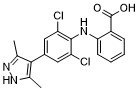
FTO inhibitor 1 (first disclosed in WO 2018157842) is a novel and potent FTO (fat-mass- and obesity-associated protein) inhibitor with the potential to be used for treatment of leukemia. FTO is overexpressed in certain subtypes of AMLs and promotes leukemogenesis.
Physicochemical Properties
| Molecular Formula | C18H15CL2N3O2 |
| Molecular Weight | 376.2366 |
| Exact Mass | 375.05 |
| Elemental Analysis | C, 57.46; H, 4.02; Cl, 18.84; N, 11.17; O, 8.50 |
| CAS # | 2243736-37-8 |
| PubChem CID | 148456336 |
| Appearance | White to off-white solid powder |
| LogP | 5.5 |
| Hydrogen Bond Donor Count | 3 |
| Hydrogen Bond Acceptor Count | 4 |
| Rotatable Bond Count | 4 |
| Heavy Atom Count | 25 |
| Complexity | 469 |
| Defined Atom Stereocenter Count | 0 |
| InChi Key | MCENODSHXUWMEL-UHFFFAOYSA-N |
| InChi Code | InChI=1S/C18H15Cl2N3O2/c1-9-16(10(2)23-22-9)11-7-13(19)17(14(20)8-11)21-15-6-4-3-5-12(15)18(24)25/h3-8,21H,1-2H3,(H,22,23)(H,24,25) |
| Chemical Name | 2-[2,6-dichloro-4-(3,5-dimethyl-1H-pyrazol-4-yl)anilino]benzoic acid |
| Synonyms | MUN36378; MUN-36378; MUN 36378; |
| HS Tariff Code | 2934.99.9001 |
| Storage |
Powder-20°C 3 years 4°C 2 years In solvent -80°C 6 months -20°C 1 month |
| Shipping Condition | Room temperature (This product is stable at ambient temperature for a few days during ordinary shipping and time spent in Customs) |
Biological Activity
| Targets |
FTO (Fat mass and obesity-associated protein, m⁶A demethylase) (IC50: 3.1 μM for human FTO enzyme activity) [1] |
| ln Vitro |
Inhibition of FTO m⁶A demethylase activity FTO inhibitor 1 (0.5–50 μM) dose-dependently inhibited recombinant human FTO enzyme activity. At 3.1 μM (IC50), it reduced the demethylation of m⁶A-containing RNA substrate by 50%. At 20 μM, the inhibition rate reached 83%, as measured by a fluorescence-based assay detecting the release of formaldehyde (a byproduct of m⁶A demethylation) [1] - Elevation of intracellular m⁶A RNA methylation levels In HepG2 human hepatocytes and 3T3-L1 preadipocytes treated with FTO inhibitor 1 (5–30 μM) for 24 hours, intracellular m⁶A RNA methylation levels were increased by 1.8–2.7-fold (5–30 μM) compared to vehicle, as quantified by dot blot assay with m⁶A-specific antibody [1] - Suppression of preadipocyte differentiation In 3T3-L1 preadipocytes, FTO inhibitor 1 (10–30 μM) inhibited adipogenic differentiation by 45–68% (oil red O staining) after 10 days of induction. qPCR analysis showed downregulated mRNA expression of adipogenic markers (PPARγ, C/EBPα, FABP4) by 42–63% at 20 μM [1] |
| Enzyme Assay |
FTO m⁶A demethylase activity assay Recombinant human FTO protein (catalytic domain) was incubated with FTO inhibitor 1 (0.1–100 μM) in reaction buffer containing m⁶A-modified RNA substrate and cofactors. The mixture was incubated at 37°C for 90 minutes, and the reaction was terminated by adding a formaldehyde detection reagent. Fluorescence intensity (proportional to formaldehyde concentration, reflecting demethylation activity) was measured, and IC50 values were calculated from dose-response curves of inhibition rate [1] - Selectivity assay against ALKBH5 The inhibitor (10 μM) was tested for inhibition of recombinant ALKBH5 (another m⁶A demethylase) using the same fluorescence-based assay. It showed <15% inhibition of ALKBH5 activity, indicating moderate selectivity for FTO over ALKBH5 [1] |
| Cell Assay |
Intracellular m⁶A RNA methylation assay HepG2 and 3T3-L1 cells were seeded in 6-well plates (2×10⁵ cells/well) and cultured overnight. FTO inhibitor 1 (5–30 μM) was added, and cells were incubated for 24 hours. Total RNA was extracted, denatured, and spotted onto a nitrocellulose membrane. The membrane was probed with m⁶A-specific antibody, and signal intensity was quantified by densitometry to measure m⁶A levels [1] - 3T3-L1 preadipocyte differentiation assay 3T3-L1 cells were seeded in 96-well plates (5×10³ cells/well) and cultured to confluence. Adipogenic induction medium was added along with FTO inhibitor 1 (10–30 μM), and the medium was refreshed every 2 days for 10 days. Cells were stained with oil red O, and the absorbance of extracted dye was measured to quantify lipid accumulation (adipocyte differentiation marker) [1] - Adipogenic gene expression assay 3T3-L1 cells treated with 20 μM FTO inhibitor 1 during adipogenic induction were harvested on day 7. Total RNA was isolated, and qPCR was performed to detect mRNA expression of PPARγ, C/EBPα, and FABP4, with GAPDH as the internal control [1] |
| References |
[1]. Preparation of 2-substituted-benzene matrix compounds as FTO inhibitors.China,WO2018157843.2018-09-07. |
| Additional Infomation |
Mechanism of action FTO inhibitor 1 is a 2-substituted-benzene matrix compound that binds to the catalytic domain of FTO, a key m⁶A demethylase. It inhibits FTO-mediated demethylation of m⁶A-modified RNA, leading to elevated intracellular m⁶A levels. This modulates the expression of adipogenic and metabolic genes, suppressing preadipocyte differentiation and potentially regulating energy metabolism [1] - Therapeutic potential It has potential applications in the treatment of metabolic disorders such as obesity and type 2 diabetes mellitus, by targeting FTO-mediated m⁶A demethylation to regulate adipogenesis and glucose/lipid metabolism. It may also have utility in cancer therapy, as FTO overexpression is associated with tumor progression in certain malignancies [1] - Structural feature The compound features a 2-substituted benzene core structure, which is critical for binding to the FTO active site and mediating inhibitory activity. It exhibits moderate selectivity for FTO over the closely related m⁶A demethylase ALKBH5 [1] |
Solubility Data
| Solubility (In Vitro) | May dissolve in DMSO (in most cases), if not, try other solvents such as H2O, Ethanol, or DMF with a minute amount of products to avoid loss of samples |
| Solubility (In Vivo) |
Note: Listed below are some common formulations that may be used to formulate products with low water solubility (e.g. < 1 mg/mL), you may test these formulations using a minute amount of products to avoid loss of samples. Injection Formulations (e.g. IP/IV/IM/SC) Injection Formulation 1: DMSO : Tween 80: Saline = 10 : 5 : 85 (i.e. 100 μL DMSO stock solution → 50 μL Tween 80 → 850 μL Saline) *Preparation of saline: Dissolve 0.9 g of sodium chloride in 100 mL ddH ₂ O to obtain a clear solution. Injection Formulation 2: DMSO : PEG300 :Tween 80 : Saline = 10 : 40 : 5 : 45 (i.e. 100 μL DMSO → 400 μLPEG300 → 50 μL Tween 80 → 450 μL Saline) Injection Formulation 3: DMSO : Corn oil = 10 : 90 (i.e. 100 μL DMSO → 900 μL Corn oil) Example: Take the Injection Formulation 3 (DMSO : Corn oil = 10 : 90) as an example, if 1 mL of 2.5 mg/mL working solution is to be prepared, you can take 100 μL 25 mg/mL DMSO stock solution and add to 900 μL corn oil, mix well to obtain a clear or suspension solution (2.5 mg/mL, ready for use in animals). Injection Formulation 4: DMSO : 20% SBE-β-CD in saline = 10 : 90 [i.e. 100 μL DMSO → 900 μL (20% SBE-β-CD in saline)] *Preparation of 20% SBE-β-CD in Saline (4°C,1 week): Dissolve 2 g SBE-β-CD in 10 mL saline to obtain a clear solution. Injection Formulation 5: 2-Hydroxypropyl-β-cyclodextrin : Saline = 50 : 50 (i.e. 500 μL 2-Hydroxypropyl-β-cyclodextrin → 500 μL Saline) Injection Formulation 6: DMSO : PEG300 : castor oil : Saline = 5 : 10 : 20 : 65 (i.e. 50 μL DMSO → 100 μLPEG300 → 200 μL castor oil → 650 μL Saline) Injection Formulation 7: Ethanol : Cremophor : Saline = 10: 10 : 80 (i.e. 100 μL Ethanol → 100 μL Cremophor → 800 μL Saline) Injection Formulation 8: Dissolve in Cremophor/Ethanol (50 : 50), then diluted by Saline Injection Formulation 9: EtOH : Corn oil = 10 : 90 (i.e. 100 μL EtOH → 900 μL Corn oil) Injection Formulation 10: EtOH : PEG300:Tween 80 : Saline = 10 : 40 : 5 : 45 (i.e. 100 μL EtOH → 400 μLPEG300 → 50 μL Tween 80 → 450 μL Saline) Oral Formulations Oral Formulation 1: Suspend in 0.5% CMC Na (carboxymethylcellulose sodium) Oral Formulation 2: Suspend in 0.5% Carboxymethyl cellulose Example: Take the Oral Formulation 1 (Suspend in 0.5% CMC Na) as an example, if 100 mL of 2.5 mg/mL working solution is to be prepared, you can first prepare 0.5% CMC Na solution by measuring 0.5 g CMC Na and dissolve it in 100 mL ddH2O to obtain a clear solution; then add 250 mg of the product to 100 mL 0.5% CMC Na solution, to make the suspension solution (2.5 mg/mL, ready for use in animals). Oral Formulation 3: Dissolved in PEG400 Oral Formulation 4: Suspend in 0.2% Carboxymethyl cellulose Oral Formulation 5: Dissolve in 0.25% Tween 80 and 0.5% Carboxymethyl cellulose Oral Formulation 6: Mixing with food powders Note: Please be aware that the above formulations are for reference only. InvivoChem strongly recommends customers to read literature methods/protocols carefully before determining which formulation you should use for in vivo studies, as different compounds have different solubility properties and have to be formulated differently. (Please use freshly prepared in vivo formulations for optimal results.) |
| Preparing Stock Solutions | 1 mg | 5 mg | 10 mg | |
| 1 mM | 2.6579 mL | 13.2894 mL | 26.5788 mL | |
| 5 mM | 0.5316 mL | 2.6579 mL | 5.3158 mL | |
| 10 mM | 0.2658 mL | 1.3289 mL | 2.6579 mL |