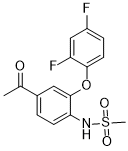
FK3311 is a cyclooxygenase-2 (COX-2) inhibitor. FK3311 has protective effects on hepatic ischemia-reperfusion injury stemming from the marked inhibition of TxA2. Ischemia-reperfusion injury is induced by activation of the arachidonic acid cascade following the induction of cyclooxygenase-2.
Physicochemical Properties
| Molecular Formula | C15H13F2NO4S |
| Molecular Weight | 341.3288 |
| Exact Mass | 341.053 |
| CAS # | 116686-15-8 |
| Related CAS # | 116686-15-8 |
| PubChem CID | 164009 |
| Appearance | Light yellow to yellow solid powder |
| Density | 1.4±0.1 g/cm3 |
| Boiling Point | 431.3±55.0 °C at 760 mmHg |
| Flash Point | 214.6±31.5 °C |
| Vapour Pressure | 0.0±1.0 mmHg at 25°C |
| Index of Refraction | 1.579 |
| LogP | 3.22 |
| Hydrogen Bond Donor Count | 1 |
| Hydrogen Bond Acceptor Count | 7 |
| Rotatable Bond Count | 5 |
| Heavy Atom Count | 23 |
| Complexity | 522 |
| Defined Atom Stereocenter Count | 0 |
| InChi Key | DIIYLGZNZGPXRR-UHFFFAOYSA-N |
| InChi Code | InChI=1S/C15H13F2NO4S/c1-9(19)10-3-5-13(18-23(2,20)21)15(7-10)22-14-6-4-11(16)8-12(14)17/h3-8,18H,1-2H3 |
| Chemical Name | N-(4-acetyl-2-(2,4-difluorophenoxy)phenyl)methanesulfonamide |
| Synonyms | FK-3311 FK 3311 FK3311. |
| HS Tariff Code | 2934.99.9001 |
| Storage |
Powder-20°C 3 years 4°C 2 years In solvent -80°C 6 months -20°C 1 month |
| Shipping Condition | Room temperature (This product is stable at ambient temperature for a few days during ordinary shipping and time spent in Customs) |
Biological Activity
| ln Vitro | Arachidonic acid is converted by the intracellular enzyme cyclooxygenase (COX) into prostaglandin (PG)G2 and PGH2 [1]. The PGE2 test yielded no results for the racemic mixture or the (R)- and (S)-isomers of the two metabolites. The COX-2 inhibitor V, FK 3311, has an IC50 value of 1.6 uM, whereas compounds 2 and 5 have IC50 values greater than 100 uM. The inhibition of adjuvant-induced arthritis was used to measure anti-inflammatory activity, while the acetic acid-induced writhing assay was used to measure analgesic activity. Racemic (2) and its optical isomer demonstrated comparable efficacy to FK-3311 (76% inhibition) in an adjuvant arthritis assay following oral administration of 10 mg/kg, however racemic (5) showed very poor activity and (R)-(S)-(5) was not evaluated. At an oral dose of 100 mg/kg, FK-3311 and racemic(2) demonstrated 81% and 62% inhibition, respectively, in terms of analgesia. Two compounds, (2) and its racemic (R)- and (S)-isomers 5) showed 46% suppression of writhing syndrome. Less active compounds are (R)- and (S)-(5), which exhibit 16% and 20% inhibition, respectively [1]. |
| ln Vivo | The FK group's L-PVR, CO, PaO(2), and WDR greatly outperformed the control group's. The histological tissue edema in the FK group was considerably lower in PMN infiltration and was milder than in the control group. While the 6-keto-PGF(1α) level was not considerably decreased, the serum TxB(2) level in the FK group was much lower than that in the control group. The FK group's two-day survival rate was noticeably higher than the control group's [2]. Thirty minutes after reperfusion, the FK high-dose group showed a significantly lower serum GOT level and a much greater survival rate than the other two groups. The GPT levels and hepatic tissue flow in the FK high-dose group were much higher than those in the control group four hours after reperfusion. Serum TxB(2) levels were much lower in the FK high-dose group at 30 minutes and 4 hours following reperfusion as compared to the control group [3]. |
| References |
[1]. Nakamura K, Ochi T, Matsuo M. [Stereoselective synthesis and pharmacological properties of metabolites of new antiinflammatory agent. 4'-Acetyl-2'-(2,4-difluorophenoxy)methanesulfonanilide (FK3311)]. Yakugaku Zasshi. 1995 Nov;115(11):928-36. [2]. Sunose Y, Takeyoshi I, Tsutsumi H, Effects of FK3311 on pulmonary ischemia-reperfusion injury in a canine model. J Surg Res. 2001 Feb;95(2):167-73. [3]. Oshima K, Yabata Y, Yoshinari D, The effects of cyclooxygenase (COX)-2 inhibition on ischemia-reperfusion injury in liver transplantation. J Invest Surg. 2009 Jul-Aug;22(4):239-45. |
Solubility Data
| Solubility (In Vitro) | DMSO : ≥ 100 mg/mL (~292.97 mM) |
| Solubility (In Vivo) |
Solubility in Formulation 1: ≥ 2.5 mg/mL (7.32 mM) (saturation unknown) in 10% DMSO + 40% PEG300 + 5% Tween80 + 45% Saline (add these co-solvents sequentially from left to right, and one by one), clear solution. For example, if 1 mL of working solution is to be prepared, you can add 100 μL of 25.0 mg/mL clear DMSO stock solution to 400 μL PEG300 and mix evenly; then add 50 μL Tween-80 to the above solution and mix evenly; then add 450 μL normal saline to adjust the volume to 1 mL. Preparation of saline: Dissolve 0.9 g of sodium chloride in 100 mL ddH₂ O to obtain a clear solution. Solubility in Formulation 2: ≥ 2.5 mg/mL (7.32 mM) (saturation unknown) in 10% DMSO + 90% Corn Oil (add these co-solvents sequentially from left to right, and one by one), clear solution. For example, if 1 mL of working solution is to be prepared, you can add 100 μL of 25.0 mg/mL clear DMSO stock solution to 900 μL of corn oil and mix evenly. (Please use freshly prepared in vivo formulations for optimal results.) |
| Preparing Stock Solutions | 1 mg | 5 mg | 10 mg | |
| 1 mM | 2.9297 mL | 14.6486 mL | 29.2972 mL | |
| 5 mM | 0.5859 mL | 2.9297 mL | 5.8594 mL | |
| 10 mM | 0.2930 mL | 1.4649 mL | 2.9297 mL |