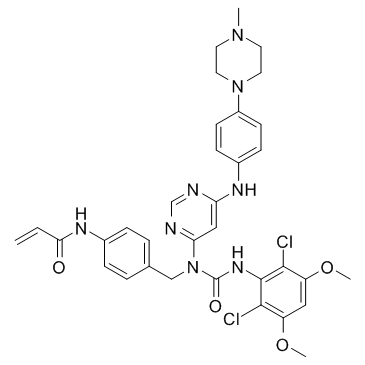
FIIN-3 is a novel, potent, selective, irreversible and the next-generation covalent FGFR inhibitor with an IC50 of 13.1, 21, 31.4, and 35.3 nM for FGFR1, FGFR2, FGFR3 and FGFR4, respectively. FIIN-3 is the first inhibitor that can potently inhibit the proliferation of cells dependent upon the gatekeeper mutants of FGFR1 or FGFR2, which confer resistance to first-generation clinical FGFR inhibitors such as NVP-BGJ398 and AZD4547. FIIN-3 has the unprecedented ability to inhibit both the EGF receptor (EGFR) and FGFR covalently by targeting two distinct cysteine residues. FIIN-3 bound with FGFR4 V550L and EGFR L858R.
Physicochemical Properties
| Molecular Formula | C34H36CL2N8O4 |
| Molecular Weight | 691.606844902039 |
| Exact Mass | 690.223 |
| CAS # | 1637735-84-2 |
| PubChem CID | 73707531 |
| Appearance | White to off-white solid powder |
| Density | 1.4±0.1 g/cm3 |
| Boiling Point | 909.4±65.0 °C at 760 mmHg |
| Flash Point | 503.8±34.3 °C |
| Vapour Pressure | 0.0±0.3 mmHg at 25°C |
| Index of Refraction | 1.683 |
| LogP | 5.65 |
| Hydrogen Bond Donor Count | 3 |
| Hydrogen Bond Acceptor Count | 9 |
| Rotatable Bond Count | 11 |
| Heavy Atom Count | 48 |
| Complexity | 1020 |
| Defined Atom Stereocenter Count | 0 |
| InChi Key | SFLKJNSBBVSPFE-UHFFFAOYSA-N |
| InChi Code | InChI=1S/C34H36Cl2N8O4/c1-5-30(45)40-24-8-6-22(7-9-24)20-44(34(46)41-33-31(35)26(47-3)18-27(48-4)32(33)36)29-19-28(37-21-38-29)39-23-10-12-25(13-11-23)43-16-14-42(2)15-17-43/h5-13,18-19,21H,1,14-17,20H2,2-4H3,(H,40,45)(H,41,46)(H,37,38,39) |
| Chemical Name | N-(4-((3-(2,6-dichloro-3,5-dimethoxyphenyl)-1-(6-((4-(4-methylpiperazin-1-yl)phenyl)amino)pyrimidin-4-yl)ureido)methyl)phenyl)acrylamide |
| Synonyms | FIIN3; FIIN 3; FIIN-3. |
| HS Tariff Code | 2934.99.9001 |
| Storage |
Powder-20°C 3 years 4°C 2 years In solvent -80°C 6 months -20°C 1 month |
| Shipping Condition | Room temperature (This product is stable at ambient temperature for a few days during ordinary shipping and time spent in Customs) |
Biological Activity
| ln Vitro | FIIN-3 exhibits strong inhibition of both gatekeeper mutants of FGFR2 (EC50 = 64 nM) and WT FGFR (EC50 = 1 to 41 nM). Also, EGFR is significantly inhibited by FIIN-3, with an EC50 of 43 nM. The gatekeeper mutant V564F was effectively inhibited by FIIN-3, while the gatewaykeeper-plus-1 mutant E565K was also successfully targeted by FIIN-3. Furthermore, Ba transformed with EGFR vIII fusion protein (containing the WT EGFR kinase domain) /F3 cells demonstrate antiproliferative activity (EC50 of 135 nM). FIIN-3 exhibited moderate action against the EGFR mutant L858R/T790M mutant, with an EC50 of 231 nM, and greater activity against the EGFR mutant L858R (EC50 of 17 nM). Even at dosages as low as 3 nM, FIIN-3 totally blocked FGFR2 autophosphorylation on Tyr656/657 in WT FGFR2 Ba/F3 cells. FIIN-3 has the ability to partially inhibit FGFR2 mutant V564M autophosphorylation in FGFR2 V564M Ba/F3 cells, and to completely inhibit it at 300 nM [1]. |
| References |
[1]. Development of covalent inhibitors that can overcome resistance to first-generation FGFR kinase inhibitors. Proc Natl Acad Sci U S A, 2014 Nov 11, 111(45):E4869-77. |
| Additional Infomation | N-[4-[[[(2,6-dichloro-3,5-dimethoxyanilino)-oxomethyl]-[6-[4-(4-methyl-1-piperazinyl)anilino]-4-pyrimidinyl]amino]methyl]phenyl]-2-propenamide is a member of piperazines. |
Solubility Data
| Solubility (In Vitro) | DMSO : ~10 mg/mL (~14.46 mM) |
| Solubility (In Vivo) |
Solubility in Formulation 1: ≥ 2.5 mg/mL (3.61 mM) (saturation unknown) in 10% DMSO + 40% PEG300 + 5% Tween80 + 45% Saline (add these co-solvents sequentially from left to right, and one by one), clear solution. For example, if 1 mL of working solution is to be prepared, you can add 100 μL of 25.0 mg/mL clear DMSO stock solution to 400 μL PEG300 and mix evenly; then add 50 μL Tween-80 to the above solution and mix evenly; then add 450 μL normal saline to adjust the volume to 1 mL. Preparation of saline: Dissolve 0.9 g of sodium chloride in 100 mL ddH₂ O to obtain a clear solution. Solubility in Formulation 2: 2.5 mg/mL (3.61 mM) in 10% DMSO + 90% (20% SBE-β-CD in Saline) (add these co-solvents sequentially from left to right, and one by one), suspension solution; with ultrasonication. For example, if 1 mL of working solution is to be prepared, you can add 100 μL of 25.0 mg/mL clear DMSO stock solution to 900 μL of 20% SBE-β-CD physiological saline solution and mix evenly. Preparation of 20% SBE-β-CD in Saline (4°C,1 week): Dissolve 2 g SBE-β-CD in 10 mL saline to obtain a clear solution. Solubility in Formulation 3: ≥ 2.5 mg/mL (3.61 mM) (saturation unknown) in 10% DMSO + 90% Corn Oil (add these co-solvents sequentially from left to right, and one by one), clear solution. For example, if 1 mL of working solution is to be prepared, you can add 100 μL of 25.0 mg/mL clear DMSO stock solution to 900 μL of corn oil and mix evenly. (Please use freshly prepared in vivo formulations for optimal results.) |
| Preparing Stock Solutions | 1 mg | 5 mg | 10 mg | |
| 1 mM | 1.4459 mL | 7.2295 mL | 14.4590 mL | |
| 5 mM | 0.2892 mL | 1.4459 mL | 2.8918 mL | |
| 10 mM | 0.1446 mL | 0.7230 mL | 1.4459 mL |