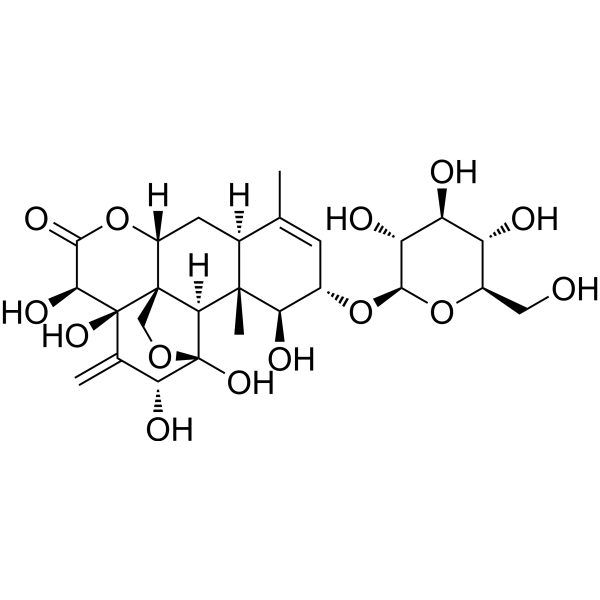
Physicochemical Properties
| Molecular Formula | C26H36O14 |
| Molecular Weight | 572.556 |
| CAS # | 126260-97-7 |
| PubChem CID | 101637225 |
| Appearance | Typically exists as solid at room temperature |
| Hydrogen Bond Donor Count | 9 |
| Hydrogen Bond Acceptor Count | 14 |
| Rotatable Bond Count | 3 |
| Heavy Atom Count | 40 |
| Complexity | 1140 |
| Defined Atom Stereocenter Count | 16 |
| SMILES | C123C([H])([H])OC4(O[H])C(O[H])([H])C(=C([H])[H])C1(O[H])C(O[H])([H])C(=O)OC2(C(C1(C(C34[H])(C([H])([H])[H])C(O[H])([H])C(OC2(C(O[H])([H])C(O[H])([H])C(O[H])([H])C(C(O[H])([H])[H])([H])O2)[H])([H])C([H])=C1C([H])([H])[H])[H])([H])[H])[H] |
| Synonyms | Eurycomanol-2-O-beta-D-glucopyranoside; 126260-97-7; Picras-3-en-16-one, 11,20-epoxy-2-(beta-D-glucopyranosyloxy)-1,11,12,14,15-pentahydroxy-, (1beta,2alpha,11beta,12alpha,15beta)- |
| HS Tariff Code | 2934.99.9001 |
| Storage |
Powder-20°C 3 years 4°C 2 years In solvent -80°C 6 months -20°C 1 month |
| Shipping Condition | Room temperature (This product is stable at ambient temperature for a few days during ordinary shipping and time spent in Customs) |
Biological Activity
| Targets | Natural Monosaccharides; Anti-malarial[1] |
| ln Vitro | An extensive comparative study on the electrospray ionization (ESI) and atmospheric pressure chemical ionization (APCI) mass spectrometry using automated flow injection analysis (FIA), was performed on eurycomanone (1), 13α(21)-epoxyeurycomanone (2), eurycomanol (3), eurycomanol-2-O-β-d-glucopyranoside (4), and 13,21-dihydroeurycomanone (5), the bioactive markers isolated from Eurycoma longifolia. The effects of eluent mixture (methanol or acetonitrile in water) and acidic modifiers (acetic acid, formic acid and trifluoroacetic acid) on the ionization efficiency of the markers were also investigated. The ESI in the positive ion mode with methanol containing 0.1% (v/v) acetic acid was selected for the subsequent optimization of nebulizer pressure, dry gas flow, dry gas temperature and capillary voltage to improve the sensitivity of the total ion chromatogram (TIC). Fragmentation of the analytes was further investigated by varying the capillary exit offset voltage and fragmentation amplitude in positive mode of ESI. The detection limits (LODs) were determined in isolation mode (selected ion monitoring, SIM). Their limits of detection (LODs) ranged between 0.03 and 0.1μgmL(-1) while the intra-day and inter-day precisions were less than 5.72% and 4.82%, respectively. The method was next applied for the simultaneous analysis of the markers to standardize various batches of manufactured extracts of E. longifolia for potential use as antimalarial products. Multiple Reaction Monitoring (MRM) mode was used for the quantification of analytes which gave protonated molecular ion, [M+H](+). For those without pseudo-molecular ions, SIM mode was used to quantify the analytes. The batches contained 5.65-9.95% of eurycomanone (1), 5.21-19.75% of eurycomanol (3) and 7.59-19.95% of eurycomanol-2-O-β-d-glucopyranoside (4) as major quassinoids whereas, 13α(21)-epoxyeurycomanone (2), and 13,21-dihydroeurycomanone (5) were much lower in concentrations of 0.78-3.90% and 0.47-1.76%, respectively[1]. |
| References |
[1]. Developing a validated liquid chromatography-mass spectrometric method for the simultaneous analysis of five bioactive quassinoid markers for the standardization of manufactured batches of Eurycoma longifolia Jack extract as antimalarial medicaments. J Chromatogr A. 2011 Apr 8;1218(14):1861-77. |
| Additional Infomation | Eurycomanol 2-O-beta-D-glucopyranoside has been reported in Eurycoma longifolia with data available. |
Solubility Data
| Solubility (In Vitro) | May dissolve in DMSO (in most cases), if not, try other solvents such as H2O, Ethanol, or DMF with a minute amount of products to avoid loss of samples |
| Solubility (In Vivo) |
Note: Listed below are some common formulations that may be used to formulate products with low water solubility (e.g. < 1 mg/mL), you may test these formulations using a minute amount of products to avoid loss of samples. Injection Formulations (e.g. IP/IV/IM/SC) Injection Formulation 1: DMSO : Tween 80: Saline = 10 : 5 : 85 (i.e. 100 μL DMSO stock solution → 50 μL Tween 80 → 850 μL Saline) *Preparation of saline: Dissolve 0.9 g of sodium chloride in 100 mL ddH ₂ O to obtain a clear solution. Injection Formulation 2: DMSO : PEG300 :Tween 80 : Saline = 10 : 40 : 5 : 45 (i.e. 100 μL DMSO → 400 μLPEG300 → 50 μL Tween 80 → 450 μL Saline) Injection Formulation 3: DMSO : Corn oil = 10 : 90 (i.e. 100 μL DMSO → 900 μL Corn oil) Example: Take the Injection Formulation 3 (DMSO : Corn oil = 10 : 90) as an example, if 1 mL of 2.5 mg/mL working solution is to be prepared, you can take 100 μL 25 mg/mL DMSO stock solution and add to 900 μL corn oil, mix well to obtain a clear or suspension solution (2.5 mg/mL, ready for use in animals). Injection Formulation 4: DMSO : 20% SBE-β-CD in saline = 10 : 90 [i.e. 100 μL DMSO → 900 μL (20% SBE-β-CD in saline)] *Preparation of 20% SBE-β-CD in Saline (4°C,1 week): Dissolve 2 g SBE-β-CD in 10 mL saline to obtain a clear solution. Injection Formulation 5: 2-Hydroxypropyl-β-cyclodextrin : Saline = 50 : 50 (i.e. 500 μL 2-Hydroxypropyl-β-cyclodextrin → 500 μL Saline) Injection Formulation 6: DMSO : PEG300 : castor oil : Saline = 5 : 10 : 20 : 65 (i.e. 50 μL DMSO → 100 μLPEG300 → 200 μL castor oil → 650 μL Saline) Injection Formulation 7: Ethanol : Cremophor : Saline = 10: 10 : 80 (i.e. 100 μL Ethanol → 100 μL Cremophor → 800 μL Saline) Injection Formulation 8: Dissolve in Cremophor/Ethanol (50 : 50), then diluted by Saline Injection Formulation 9: EtOH : Corn oil = 10 : 90 (i.e. 100 μL EtOH → 900 μL Corn oil) Injection Formulation 10: EtOH : PEG300:Tween 80 : Saline = 10 : 40 : 5 : 45 (i.e. 100 μL EtOH → 400 μLPEG300 → 50 μL Tween 80 → 450 μL Saline) Oral Formulations Oral Formulation 1: Suspend in 0.5% CMC Na (carboxymethylcellulose sodium) Oral Formulation 2: Suspend in 0.5% Carboxymethyl cellulose Example: Take the Oral Formulation 1 (Suspend in 0.5% CMC Na) as an example, if 100 mL of 2.5 mg/mL working solution is to be prepared, you can first prepare 0.5% CMC Na solution by measuring 0.5 g CMC Na and dissolve it in 100 mL ddH2O to obtain a clear solution; then add 250 mg of the product to 100 mL 0.5% CMC Na solution, to make the suspension solution (2.5 mg/mL, ready for use in animals). Oral Formulation 3: Dissolved in PEG400 Oral Formulation 4: Suspend in 0.2% Carboxymethyl cellulose Oral Formulation 5: Dissolve in 0.25% Tween 80 and 0.5% Carboxymethyl cellulose Oral Formulation 6: Mixing with food powders Note: Please be aware that the above formulations are for reference only. InvivoChem strongly recommends customers to read literature methods/protocols carefully before determining which formulation you should use for in vivo studies, as different compounds have different solubility properties and have to be formulated differently. (Please use freshly prepared in vivo formulations for optimal results.) |
| Preparing Stock Solutions | 1 mg | 5 mg | 10 mg | |
| 1 mM | 1.7465 mL | 8.7327 mL | 17.4654 mL | |
| 5 mM | 0.3493 mL | 1.7465 mL | 3.4931 mL | |
| 10 mM | 0.1747 mL | 0.8733 mL | 1.7465 mL |