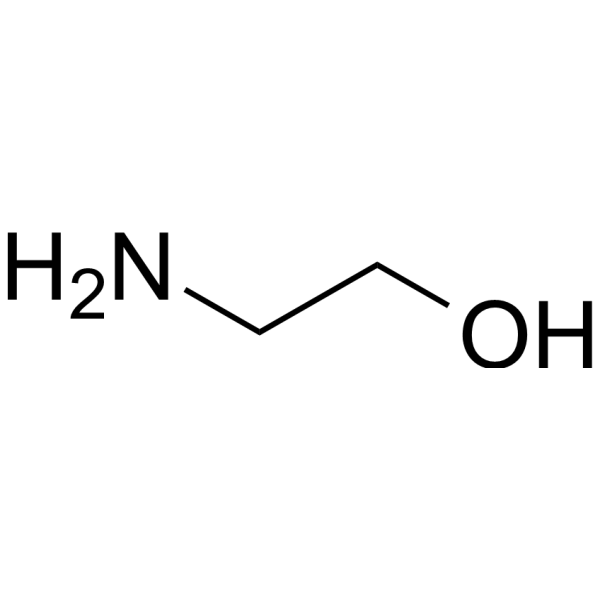
Physicochemical Properties
| Molecular Formula | C2H7NO |
| Molecular Weight | 61.08 |
| Exact Mass | 61.052 |
| CAS # | 141-43-5 |
| Related CAS # | 26778-51-8 |
| PubChem CID | 700 |
| Appearance | Colorless, viscous liquid or solid (below 51 °F) |
| Density | 1.0±0.1 g/cm3 |
| Boiling Point | 170.9±0.0 °C at 760 mmHg |
| Melting Point | 10-11 °C(lit.) |
| Flash Point | 93.3±0.0 °C |
| Vapour Pressure | 0.5±0.7 mmHg at 25°C |
| Index of Refraction | 1.435 |
| LogP | -1.31 |
| Hydrogen Bond Donor Count | 2 |
| Hydrogen Bond Acceptor Count | 2 |
| Rotatable Bond Count | 1 |
| Heavy Atom Count | 4 |
| Complexity | 10 |
| Defined Atom Stereocenter Count | 0 |
| InChi Key | HZAXFHJVJLSVMW-UHFFFAOYSA-N |
| InChi Code | InChI=1S/C2H7NO/c3-1-2-4/h4H,1-3H2 |
| Chemical Name | 2-aminoethanol |
| Synonyms | ETA |
| HS Tariff Code | 2934.99.9001 |
| Storage |
Powder-20°C 3 years 4°C 2 years In solvent -80°C 6 months -20°C 1 month |
| Shipping Condition | Room temperature (This product is stable at ambient temperature for a few days during ordinary shipping and time spent in Customs) |
Biological Activity
| Targets | Human Endogenous Metabolite |
| ADME/Pharmacokinetics |
Absorption, Distribution and Excretion The principal route of exposure is through skin, with some exposure occurring by inhalation of vapor and aerosols. Monoethanolamine (MEA), diethanolamine (DEA), and triethanolamine (TEA) in water penetrate rat skin at the rate of 2.9 x 10(-3), 4.36 x 10(-3) and 18 x 10(-3) cm/hr, respectively. MEA, DEA, and TEA are water-soluble ammonia derivatives, with pHs of 9-11 in water and pHa values of 9.3, 8.8, and 7.7, respectively. The excretion rate in men was found to vary between 4.8 and 22.9 mg/day with a mean of 0.162 mg/kg /body weight/. 11 women were observed to excrete larger amounts, varying between 7.7 and 34.9 mg/day with a mean excretion rate of 0.492 mg/kg/day. The excretion rates in animals were approximately, for cats, 0.47 mg/kg/day; for rats, 1.46 mg/kg/day; and for rabbits, 1.0 mg/kg/day. From 6-47% of monoethanolamine administered to rats can be recovered in the urine. Persistence of low levels of radioactivity in dog whole blood was obtained after admin of (14)C-labeled ethanolamine. Excretion of radioactivity as % of dose in dog urine was 11. After 24 hr total blood radioactivity as % of dose was 1.69. /Ethanolamine/ is a normal urine constituent in man, excreted at a rate of 5-23 mg/day ... 40 percent of an administered dose is deaminated and excreted as urea. For more Absorption, Distribution and Excretion (Complete) data for 2-AMINOETHANOL (10 total), please visit the HSDB record page. Metabolism / Metabolites Ethanolamine can be used as a source of carbon and nitrogen by phylogenetically diverse bacteria. Ethanolamine-ammonia lyase, the enzyme that breaks ethanolamine into acetaldehyde and ammonia, is encoded by the gene tandem eutBC. Despite extensive studies of ethanolamine utilization in Salmonella enterica serovar Typhimurium, much remains to be learned about EutBC structure and catalytic mechanism, about the evolutionary origin of ethanolamine utilization, and about regulatory links between the metabolism of ethanolamine itself and the ethanolamine-ammonia lyase cofactor adenosylcobalamin. We used computational analysis of sequences, structures, genome contexts, and phylogenies of ethanolamine-ammonia lyases to address these questions and to evaluate recent data-mining studies that have suggested an association between bacterial food poisoning and the diol utilization pathways. We found that EutBC evolution included recruitment of a TIM barrel and a Rossmann fold domain and their fusion to N-terminal alpha-helical domains to give EutB and EutC, respectively. This fusion was followed by recruitment and occasional loss of auxiliary ethanolamine utilization genes in Firmicutes and by several horizontal transfers, most notably from the firmicute stem to the Enterobacteriaceae and from Alphaproteobacteria to Actinobacteria. We identified a conserved DNA motif that likely represents the EutR-binding site and is shared by the ethanolamine and cobalamin operons in several enterobacterial species, suggesting a mechanism for coupling the biosyntheses of apoenzyme and cofactor in these species. Finally, we found that the food poisoning phenotype is associated with the structural components of metabolosome more strongly than with ethanolamine utilization genes or with paralogous propanediol utilization genes per se. Forty percent of (15)N-labeled ethanolamine appears as urea within 24 hr when it is given to rabbits, suggesting that it is deaminated. In rat liver homogenates, ethanolamine undergoes demethylation yielding formaldehyde. Ethanolamine is a normal intermediate in the metabolism of some animal species, having a part in the formation of phospholipids and choline. The distribution and metabolism of topical (14)C ethanolamine was studied in vivo, using athymic nude mice, human skin grafted onto athymic nude mice, and in vitro, using excised pig skin. Ethanolamine was the only radioactive phospholipid base detected in the human skin grafts, in the mouse skin, and in the pig skin. Ethanolamine that penetrated human skin grafts or mouse skin was extensively metabolized in the animal. The liver is a major site for metabolism of ethanolamine, containing over 24% of the applied radioactive dose. The kidneys, lungs, brain, and the heart contained 2.53, 0.55, 0.27, and 0.15% of the dose, respectively. Hepatic, human skin graft, and mouse skin proteins were also highly radioactive. Over 18% of the topical radioactive dose oxidized to (14)CO2 and 4.6% was excreted in the urine over 24 hr. Urea, glycine, serine, choline, and uric acid were the urinary metabolites of ethanolamine. For more Metabolism/Metabolites (Complete) data for 2-AMINOETHANOL (10 total), please visit the HSDB record page. Biological Half-Life The half-life of the persistent low level of radioactivity in the blood /of dogs administered 14C-ethanolamine/ was 19 days. Labeled MEA was administered to dogs. ... After 24 hr ... the half-life was 19 days. |
| Toxicity/Toxicokinetics |
Toxicity Summary IDENTIFICATION AND USE: 2-Aminoethanol is a colorless, viscous liquid or solid (below 51 °F). It is not registered for current pesticide use in the U.S., but approved pesticide uses may change periodically and so federal, state and local authorities must be consulted for currently approved uses. The dual function groups, amino and hydroxyl, make it useful in cutting fluids and as intermediates in the production of surfactants, soaps, salts, corrosion control inhibitors, and in pharmaceutical and miscellaneous applications. 2-Aminoethanol and other amines appear to be potentially useful components of topical formulations used to decontaminate and protect the skin against chemical warfare agents. As a pharmaceutical adjuvant, it is used as a solvent for fats and oils, and in combination with fatty acids forms soaps in the formulations of various types of emulsion such as lotions and creams. It is used in hydraulic fracturing. HUMAN EXPOSURE AND TOXICITY: A concentration of 5.9% is irritating to human skin. Symptoms associated with CNS depression in humans include increased blood pressure, diuresis, salivation, and pupillary dilation. Large doses produce sedation, coma, and death following depression of blood pressure and cardiac collapse. 2-Aminoethanol inhalation by humans has been reported to cause immediate allergic responses of dyspnea and asthma and clinical symptoms of acute liver damage and chronic hepatitis. ANIMAL STUDIES: Undiluted liquid causes redness and swelling when applied to the skin of the rabbit. Administration of 2-aminoethanol by the intravenous route in dogs produced increased blood pressure, diuresis, salivation, and pupillary dilation. Rats, mice, rabbits, and guinea pigs exposed to vapor or mist at high concentrations (up to 1250 ppm) developed pulmonary, hepatic, and renal lesions. In a 90-day subacute oral toxicity study of 2-aminoethanol in rats that a maximum daily dose of 0.32 g/kg resulted in no effect; 0.64 g/kg/day resulted in altered liver or kidney wt; and at 1.28 g/kg death occurred. It is considered to be liver toxin. No treatment-related effects were noted in dogs administered as much as 22 mg/kg/d of 2-aminoethanol for 2 yr. In developmental studies in rabbits maternal toxicity was seen at the two higher dose levels (25, 75 mg/kg body weight) as skin irritation and at the highest dose level as reduced weight gain. There was no treatment related effect on the incidence of any fetal variation or malformation or on the number of malformed fetuses. 2-Aminoethanol has been demonstrated to be non-mutagenic in the Ames Salmonella typhimurium assay, with and without S9 metabolic activation, using TA 1535, TA 1537, TA 1538, TA 98, and TA 100; and also negative in the Escherichia coli assay, Saccharomyces gene conversion assay, and rat liver chromosome assay. ECOTOXICITY STUDIES: Aquatic toxicity tests were conducted using zebra fish fry (Brachydanio rerio) and the unicellular algae Isochrysis galbana (a flagellate) and Chaetoceros gracilis (a diatom). Inhibition of cell division, chlorophyll content, and (14)CO2 uptake in the algae were sensitive end points. 2-Aminoethanol had an LC50 /in the zebra fish fry/ higher than 5,000 mg/L. Toxicity Data LC50 (mice) > 2,420mg/m3/2H Interactions ... Here we investigated hair dye-induced dermatitis and hair loss using in vivo mouse model to uncover the causative ingredients. Commercially available hair dye products or combination of the ingredients of hair dye product were applied topically for 3 days on the dorsum of the female C57BL/6 mice and, dermatitis and hair loss were examined. The mice treated with hair dye products exhibited unequivocal signs of hair loss and dermatitis. To find out causative ingredients, combinations of the representative components of hair dye including reducing agents, the mixture of dye and monoethanolamine (MEA), ammonia, and hydrogen peroxide (H(2)O(2)) were applied and thereafter, hair loss and dermatitis were evaluated. All the groups treated with the combinations containing H(2)O(2) and neutralized dye mixture manifested hair loss and dermatitis. Subsequent experiments revealed that H(2)O(2) and MEA synergistically induced hair loss and dermatitis. Histological examination showed that oxidative stress may be the mechanism underlying hair-dye induced dermatitis. Consistently, H(2)O(2) and MEA synergistically induced oxidative stress and cytotoxicity in human keratinocytes. These results suggest that H(2)O(2) and MEA may be the key causative ingredients for hair dye-associated dermatitis and hair loss. Non-Human Toxicity Values LD50 Guinea pig oral 620 mg/kg body weight LD50 Rats oral 10.2 g/kg LD50 Rat oral 3.32 g/kg LD50 Rat oral 2,050 mg/kg For more Non-Human Toxicity Values (Complete) data for 2-AMINOETHANOL (12 total), please visit the HSDB record page. |
| Additional Infomation |
Ethanolamine appears as a clear colorless liquid with an odor resembling that of ammonia. Flash point 185 °F. May attack copper, brass, and rubber. Corrosive to tissue. Moderately toxic. Produces toxic oxides of nitrogen during combustion. Ethanolamine is a member of the class of ethanolamines that is ethane with an amino substituent at C-1 and a hydroxy substituent at C-2, making it both a primary amine and a primary alcohol. It has a role as a human metabolite, an Escherichia coli metabolite and a mouse metabolite. It is a primary amine, a primary alcohol and a member of ethanolamines. It is a conjugate base of an ethanolaminium(1+). A viscous, hygroscopic amino alcohol with an ammoniacal odor. It is widely distributed in biological tissue and is a component of lecithin. It is used as a surfactant, fluorimetric reagent, and to remove CO2 and H2S from natural gas and other gases. Ethanolamine is a metabolite found in or produced by Escherichia coli (strain K12, MG1655). Ethanolamine is a Sclerosing Agent. The mechanism of action of ethanolamine is as a Sclerosing Activity. The physiologic effect of ethanolamine is by means of Vascular Sclerosing Activity. Ethanolamine has been reported in Microchloropsis, Glycine max, and other organisms with data available. Monoethanolamine is a first generation monoethanolamine with antihistaminic property. Ethanolamine competes with free histamine for binding at the histamine (H)-1 receptor thereby acting as an inverse agonist that combines with and stabilizes the inactive form of the H1-receptor thereby shifting the equilibrium toward the inactive state. This leads to a reduction of the negative symptoms brought on by H1-receptor binding. Ethanolamine is a viscous, hygroscopic amino alcohol with an ammoniacal odor. It is widely distributed in biological tissue and is a component of lecithin. It is used as a surfactant, fluorometric reagent, and to remove CO2 and H2S from natural gas and other gases. Ethanolamine is a metabolite found in or produced by Saccharomyces cerevisiae. A viscous, hygroscopic amino alcohol with an ammoniacal odor. It is widely distributed in biological tissue and is a component of lecithin. It is used as a surfactant, fluorimetric reagent, and to remove CO2 and H2S from natural gas and other gases. See also: Ethanolamine Oleate (has salt form); Ethanolamine Hydrochloride (has salt form); Ciclopirox Olamine (part of). |
Solubility Data
| Solubility (In Vitro) | DMSO : 100 mg/mL (1637.20 mM; with sonication) |
| Solubility (In Vivo) |
Note: Listed below are some common formulations that may be used to formulate products with low water solubility (e.g. < 1 mg/mL), you may test these formulations using a minute amount of products to avoid loss of samples. Injection Formulations (e.g. IP/IV/IM/SC) Injection Formulation 1: DMSO : Tween 80: Saline = 10 : 5 : 85 (i.e. 100 μL DMSO stock solution → 50 μL Tween 80 → 850 μL Saline) *Preparation of saline: Dissolve 0.9 g of sodium chloride in 100 mL ddH ₂ O to obtain a clear solution. Injection Formulation 2: DMSO : PEG300 :Tween 80 : Saline = 10 : 40 : 5 : 45 (i.e. 100 μL DMSO → 400 μLPEG300 → 50 μL Tween 80 → 450 μL Saline) Injection Formulation 3: DMSO : Corn oil = 10 : 90 (i.e. 100 μL DMSO → 900 μL Corn oil) Example: Take the Injection Formulation 3 (DMSO : Corn oil = 10 : 90) as an example, if 1 mL of 2.5 mg/mL working solution is to be prepared, you can take 100 μL 25 mg/mL DMSO stock solution and add to 900 μL corn oil, mix well to obtain a clear or suspension solution (2.5 mg/mL, ready for use in animals). Injection Formulation 4: DMSO : 20% SBE-β-CD in saline = 10 : 90 [i.e. 100 μL DMSO → 900 μL (20% SBE-β-CD in saline)] *Preparation of 20% SBE-β-CD in Saline (4°C,1 week): Dissolve 2 g SBE-β-CD in 10 mL saline to obtain a clear solution. Injection Formulation 5: 2-Hydroxypropyl-β-cyclodextrin : Saline = 50 : 50 (i.e. 500 μL 2-Hydroxypropyl-β-cyclodextrin → 500 μL Saline) Injection Formulation 6: DMSO : PEG300 : castor oil : Saline = 5 : 10 : 20 : 65 (i.e. 50 μL DMSO → 100 μLPEG300 → 200 μL castor oil → 650 μL Saline) Injection Formulation 7: Ethanol : Cremophor : Saline = 10: 10 : 80 (i.e. 100 μL Ethanol → 100 μL Cremophor → 800 μL Saline) Injection Formulation 8: Dissolve in Cremophor/Ethanol (50 : 50), then diluted by Saline Injection Formulation 9: EtOH : Corn oil = 10 : 90 (i.e. 100 μL EtOH → 900 μL Corn oil) Injection Formulation 10: EtOH : PEG300:Tween 80 : Saline = 10 : 40 : 5 : 45 (i.e. 100 μL EtOH → 400 μLPEG300 → 50 μL Tween 80 → 450 μL Saline) Oral Formulations Oral Formulation 1: Suspend in 0.5% CMC Na (carboxymethylcellulose sodium) Oral Formulation 2: Suspend in 0.5% Carboxymethyl cellulose Example: Take the Oral Formulation 1 (Suspend in 0.5% CMC Na) as an example, if 100 mL of 2.5 mg/mL working solution is to be prepared, you can first prepare 0.5% CMC Na solution by measuring 0.5 g CMC Na and dissolve it in 100 mL ddH2O to obtain a clear solution; then add 250 mg of the product to 100 mL 0.5% CMC Na solution, to make the suspension solution (2.5 mg/mL, ready for use in animals). Oral Formulation 3: Dissolved in PEG400 Oral Formulation 4: Suspend in 0.2% Carboxymethyl cellulose Oral Formulation 5: Dissolve in 0.25% Tween 80 and 0.5% Carboxymethyl cellulose Oral Formulation 6: Mixing with food powders Note: Please be aware that the above formulations are for reference only. InvivoChem strongly recommends customers to read literature methods/protocols carefully before determining which formulation you should use for in vivo studies, as different compounds have different solubility properties and have to be formulated differently. (Please use freshly prepared in vivo formulations for optimal results.) |
| Preparing Stock Solutions | 1 mg | 5 mg | 10 mg | |
| 1 mM | 16.3720 mL | 81.8599 mL | 163.7197 mL | |
| 5 mM | 3.2744 mL | 16.3720 mL | 32.7439 mL | |
| 10 mM | 1.6372 mL | 8.1860 mL | 16.3720 mL |