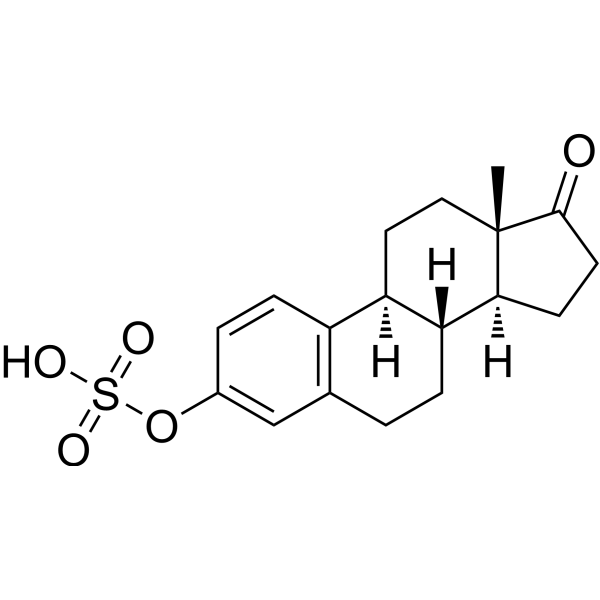
Physicochemical Properties
| Molecular Formula | C18H22O5S |
| Molecular Weight | 350.43 |
| Exact Mass | 349.111 |
| CAS # | 481-97-0 |
| Related CAS # | Estrone sulfate potassium;1240-04-6;Estrone sulfate sodium;438-67-5 |
| PubChem CID | 3001028 |
| Appearance | Typically exists as solid at room temperature |
| Melting Point | 254.5 °C |
| LogP | 4.031 |
| Hydrogen Bond Donor Count | 1 |
| Hydrogen Bond Acceptor Count | 5 |
| Rotatable Bond Count | 2 |
| Heavy Atom Count | 24 |
| Complexity | 624 |
| Defined Atom Stereocenter Count | 4 |
| SMILES | OS(OC1C=CC2[C@@H]3CC[C@]4(C(CC[C@@H]4[C@H]3CCC=2C=1)=O)C)(=O)=O |
| InChi Key | JKKFKPJIXZFSSB-CBZIJGRNSA-N |
| InChi Code | InChI=1S/C18H22O5S/c1-18-9-8-14-13-5-3-12(23-24(20,21)22)10-11(13)2-4-15(14)16(18)6-7-17(18)19/h3,5,10,14-16H,2,4,6-9H2,1H3,(H,20,21,22)/t14-,15-,16+,18+/m1/s1 |
| Chemical Name | [(8R,9S,13S,14S)-13-methyl-17-oxo-7,8,9,11,12,14,15,16-octahydro-6H-cyclopenta[a]phenanthren-3-yl] hydrogen sulfate |
| HS Tariff Code | 2934.99.9001 |
| Storage |
Powder-20°C 3 years 4°C 2 years In solvent -80°C 6 months -20°C 1 month |
| Shipping Condition | Room temperature (This product is stable at ambient temperature for a few days during ordinary shipping and time spent in Customs) |
Biological Activity
| Targets | Human Endogenous Metabolite |
| ln Vitro | Endogenous metabolites are those that the Kyoto Encyclopedia of Genes and Genomes has identified as products or substrates of the approximately 1900 metabolic enzymes that are encoded in human genome. Numerous of these metabolites have been shown to have harmful effects, as evidenced by the body of literature [1]. |
| ADME/Pharmacokinetics |
Absorption, Distribution and Excretion Estropipate is well absorbed through the skin and gastrointestinal tract. When applied for a local action, absorption is usually sufficient to cause systemic effects. Estradiol, estrone and estriol are excreted in the urine along with glucuronide and sulfate conjugates Metabolism / Metabolites Exogenous estrogens are metabolized in the same manner as endogenous estrogens. Circulating estrogens exist in a dynamic equilibrium of metabolic interconversions. These transformations take place mainly in the liver. Estradiol is converted reversibly to estrone, and both can be converted to estriol, which is the major urinary metabolite. Estrogens also undergo enterohepatic recirculation via sulfate and glucuronide conjugation in the liver, biliary secretion of conjugates into the intestine, and hydrolysis in the gut followed by reabsorption. In postmenopausal women, a significant proportion of the circulating estrogens exist as sulfate conjugates, especially estrone sulfate, which serves as a circulating reservoir for the formation of more active estrogens. |
| References |
[1]. Endogenous toxic metabolites and implications in cancer therapy. Oncogene. 2020 Aug;39(35):5709-5720. [2]. Abnormal androgen and oestrogen metabolism in men with steroid sulphatase deficiency and recessive X-linked ichthyosis. Clin Endocrinol (Oxf). 1985 Oct;23(4):385-93. [3]. Obese men have elevated plasma levels of estrone sulfate. Int J Obes. 1990 Jun;14(6):483-6. |
| Additional Infomation |
Estrone 3-sulfate is a steroid sulfate that is the 3-sulfate of estrone. It has a role as a human metabolite and a mouse metabolite. It is a 17-oxo steroid and a steroid sulfate. It is functionally related to an estrone. It is a conjugate acid of an estrone 3-sulfate(1-). It derives from a hydride of an estrane. Estrone sulfate (as estropipate) is a form of estrogen. It has several uses such as: alleviate symptoms of menopause as hormone replacement therapy, treatment some types of infertility, treatment of some conditions leading to underdevelopment of female sexual characteristics, treatment of vaginal atrophy, treatment of some types of breast cancer (particularly in men and postmenopausal women), treatment of prostate cancer and prevention of osteoporosis. Estrone sulfate has been reported in Homo sapiens and Phaseolus vulgaris with data available. Estrone Sulfate is an aqueous substance that is the sulfate salt form of estrone. (NCI) Drug Indication Estropipate is used for the treatment of moderate to severe vasomotor symptoms associated with the monopause, and moderate to severe symptoms of vulval and vaginal atrophy associated with the menopause. It is also used to treat hypoestrogenism due to hypogonadism, castration or primary ovarian failure, and prevent postmenopausal osteoporosis. Mechanism of Action Estradiol enters target cells freely (e.g., female organs, breasts, hypothalamus, pituitary) and interacts with a target cell receptor. When the estrogen receptor has bound its ligand it can enter the nucleus of the target cell, and regulate gene transcription which leads to formation of messenger RNA. The mRNA interacts with ribosomes to produce specific proteins that express the effect of estradiol upon the target cell. Estrogens increase the hepatic synthesis of sex hormone binding globulin (SHBG), thyroid-binding globulin (TBG), and other serum proteins and suppress follicle-stimulating hormone (FSH) from the anterior pituitary. Pharmacodynamics Estropipate is an estrogenic substance. It acts as naturally produced estrogen does. Estrogens act through binding to nuclear receptors in estrogen-responsive tissues. Circulating estrogens modulate the pituitary secretion of the gonadotropins, luteinizing hormone (LH) and follicle stimulating hormone (FSH), through a negative feedback mechanism. Estrogens act to reduce the elevated levels of these hormones seen in postmenopausal women. |
Solubility Data
| Solubility (In Vitro) | May dissolve in DMSO (in most cases), if not, try other solvents such as H2O, Ethanol, or DMF with a minute amount of products to avoid loss of samples |
| Solubility (In Vivo) |
Note: Listed below are some common formulations that may be used to formulate products with low water solubility (e.g. < 1 mg/mL), you may test these formulations using a minute amount of products to avoid loss of samples. Injection Formulations (e.g. IP/IV/IM/SC) Injection Formulation 1: DMSO : Tween 80: Saline = 10 : 5 : 85 (i.e. 100 μL DMSO stock solution → 50 μL Tween 80 → 850 μL Saline) *Preparation of saline: Dissolve 0.9 g of sodium chloride in 100 mL ddH ₂ O to obtain a clear solution. Injection Formulation 2: DMSO : PEG300 :Tween 80 : Saline = 10 : 40 : 5 : 45 (i.e. 100 μL DMSO → 400 μLPEG300 → 50 μL Tween 80 → 450 μL Saline) Injection Formulation 3: DMSO : Corn oil = 10 : 90 (i.e. 100 μL DMSO → 900 μL Corn oil) Example: Take the Injection Formulation 3 (DMSO : Corn oil = 10 : 90) as an example, if 1 mL of 2.5 mg/mL working solution is to be prepared, you can take 100 μL 25 mg/mL DMSO stock solution and add to 900 μL corn oil, mix well to obtain a clear or suspension solution (2.5 mg/mL, ready for use in animals). Injection Formulation 4: DMSO : 20% SBE-β-CD in saline = 10 : 90 [i.e. 100 μL DMSO → 900 μL (20% SBE-β-CD in saline)] *Preparation of 20% SBE-β-CD in Saline (4°C,1 week): Dissolve 2 g SBE-β-CD in 10 mL saline to obtain a clear solution. Injection Formulation 5: 2-Hydroxypropyl-β-cyclodextrin : Saline = 50 : 50 (i.e. 500 μL 2-Hydroxypropyl-β-cyclodextrin → 500 μL Saline) Injection Formulation 6: DMSO : PEG300 : castor oil : Saline = 5 : 10 : 20 : 65 (i.e. 50 μL DMSO → 100 μLPEG300 → 200 μL castor oil → 650 μL Saline) Injection Formulation 7: Ethanol : Cremophor : Saline = 10: 10 : 80 (i.e. 100 μL Ethanol → 100 μL Cremophor → 800 μL Saline) Injection Formulation 8: Dissolve in Cremophor/Ethanol (50 : 50), then diluted by Saline Injection Formulation 9: EtOH : Corn oil = 10 : 90 (i.e. 100 μL EtOH → 900 μL Corn oil) Injection Formulation 10: EtOH : PEG300:Tween 80 : Saline = 10 : 40 : 5 : 45 (i.e. 100 μL EtOH → 400 μLPEG300 → 50 μL Tween 80 → 450 μL Saline) Oral Formulations Oral Formulation 1: Suspend in 0.5% CMC Na (carboxymethylcellulose sodium) Oral Formulation 2: Suspend in 0.5% Carboxymethyl cellulose Example: Take the Oral Formulation 1 (Suspend in 0.5% CMC Na) as an example, if 100 mL of 2.5 mg/mL working solution is to be prepared, you can first prepare 0.5% CMC Na solution by measuring 0.5 g CMC Na and dissolve it in 100 mL ddH2O to obtain a clear solution; then add 250 mg of the product to 100 mL 0.5% CMC Na solution, to make the suspension solution (2.5 mg/mL, ready for use in animals). Oral Formulation 3: Dissolved in PEG400 Oral Formulation 4: Suspend in 0.2% Carboxymethyl cellulose Oral Formulation 5: Dissolve in 0.25% Tween 80 and 0.5% Carboxymethyl cellulose Oral Formulation 6: Mixing with food powders Note: Please be aware that the above formulations are for reference only. InvivoChem strongly recommends customers to read literature methods/protocols carefully before determining which formulation you should use for in vivo studies, as different compounds have different solubility properties and have to be formulated differently. (Please use freshly prepared in vivo formulations for optimal results.) |
| Preparing Stock Solutions | 1 mg | 5 mg | 10 mg | |
| 1 mM | 2.8536 mL | 14.2682 mL | 28.5364 mL | |
| 5 mM | 0.5707 mL | 2.8536 mL | 5.7073 mL | |
| 10 mM | 0.2854 mL | 1.4268 mL | 2.8536 mL |