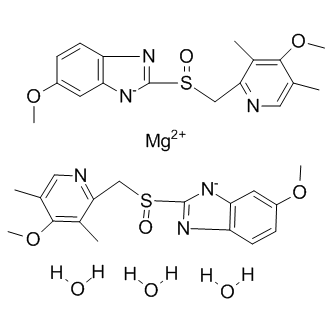
Esomeprazole Magnesium trihydrate (S-Omeprazole magnesium trihydrate) is a proton pump inhibitor (PPI) that is used to reduce gastric acid secretion. Esomeprazole Magnesium is the magnesium salt of esomeprazole, the S-isomer of omeprazole. In the acidic compartment of parietal cells, esomeprazole is protonated and converted into the active achiral sulphenamide; the active sulphenamide forms one or more covalent disulfide bonds with the proton pump hydrogen-potassium adenosine triphosphatase (H+/K+ ATPase), thereby inhibiting its activity and the parietal cell secretion of H+ ions into the gastric lumen.
Physicochemical Properties
| Molecular Formula | C₃₄H₄₂MGN₆O₉S₂ |
| Molecular Weight | 767.17 |
| Exact Mass | 766.23 |
| CAS # | 217087-09-7 |
| Related CAS # | Esomeprazole;119141-88-7;Esomeprazole sodium;161796-78-7;Esomeprazole magnesium;161973-10-0;Esomeprazole magnesium salt;1198768-91-0;Esomeprazole potassium salt;161796-84-5;Esomeprazole hemistrontium;914613-86-8 |
| PubChem CID | 130565 |
| Appearance | White to off-white solid powder |
| Boiling Point | 600ºC at 760 mmHg |
| Melting Point | 184-189ºC (dec.) |
| Flash Point | 316.7ºC |
| Vapour Pressure | 2.35E-14mmHg at 25°C |
| LogP | 6.909 |
| Hydrogen Bond Donor Count | 3 |
| Hydrogen Bond Acceptor Count | 17 |
| Rotatable Bond Count | 10 |
| Heavy Atom Count | 52 |
| Complexity | 453 |
| Defined Atom Stereocenter Count | 0 |
| InChi Key | VEVZQDGATGBLIC-UHFFFAOYSA-N |
| InChi Code | InChI=1S/2C17H18N3O3S.Mg.3H2O/c2*1-10-8-18-15(11(2)16(10)23-4)9-24(21)17-19-13-6-5-12(22-3)7-14(13)20-17;;;;/h2*5-8H,9H2,1-4H3;;3*1H2/q2*-1;+2;;; |
| Chemical Name | magnesium;5-methoxy-2-[(4-methoxy-3,5-dimethylpyridin-2-yl)methylsulfinyl]benzimidazol-1-ide;trihydrate |
| HS Tariff Code | 2934.99.9001 |
| Storage |
Powder-20°C 3 years 4°C 2 years In solvent -80°C 6 months -20°C 1 month Note: (1). Please store this product in a sealed and protected environment (e.g. under nitrogen), avoid exposure to moisture and light.(2). This product is not stable in solution, please use freshly prepared working solution for optimal results. |
| Shipping Condition | Room temperature (This product is stable at ambient temperature for a few days during ordinary shipping and time spent in Customs) |
Biological Activity
| Targets |
Esomeprazole Magnesium trihydrate targets gastric H+/K+-ATPase [1] |
| ln Vitro |
From esomeprazole strontium tetrahydrate (EST), esomeprazole magnesium trihydrate is produced. The S-enantiomer of omeprazole, esomeprazole magnesium trihydrate, which is a salt-exchanged form of the drug, is present in EST [2]. Esomeprazole Magnesium trihydrate loaded in pH-sensitive hydrogels showed pH-dependent release behavior in vitro: at pH 1.2 (simulated gastric fluid), cumulative release was <10% within 2 hours; at pH 7.4 (simulated intestinal fluid), cumulative release reached 89% within 8 hours [2] In gastric microsomal preparations, Esomeprazole Magnesium trihydrate (1 μM–10 μM) inhibited H+/K+-ATPase activity, reducing ATP hydrolysis by 75% at 10 μM [1] |
| ln Vivo |
Esomeprazole magnesium (0.5–50 mg/kg; oral gavage; daily; 10 days; A/J mice) enhances copper/zinc superoxide dismutase activity and the overall antioxidant capacity of the stomach [1]. In ICR mice, oral administration of Esomeprazole Magnesium trihydrate (10 mg/kg, 20 mg/kg, 40 mg/kg) once daily for 7 days dose-dependently increased gut total antioxidant capacity (TAC): 40 mg/kg dose elevated TAC by 62% compared to the control group, with no significant change in gastric acid secretion-related parameters [1] In Sprague-Dawley rats, oral administration of Esomeprazole Magnesium trihydrate loaded in pH-sensitive hydrogels exhibited a relative bioavailability of 128% compared to the commercial formulation, with a Cmax of 1.8 μg/mL and Tmax of 3.5 hours [2] |
| Enzyme Assay |
H+/K+-ATPase activity assay: Gastric mucosal tissues were homogenized to prepare microsomal fractions containing H+/K+-ATPase. The microsomes were incubated with Esomeprazole Magnesium trihydrate (1 μM–10 μM) in assay buffer containing ATP and Mg²⁺ at 37°C for 60 minutes. The amount of inorganic phosphate (Pi) released from ATP hydrolysis was quantified by a colorimetric method, and inhibition rates were calculated relative to the control group [1] |
| Animal Protocol |
Animal/Disease Models: A/J mice [1] Doses: 0.5 mg/kg, 5 mg/kg, 50 mg/kg Route of Administration: po (oral gavage); daily; 10 days Experimental Results: Gastric total antioxidant capacity and copper / Increased zinc superoxide dismutase activity. Gut antioxidant capacity mouse model: ICR mice (6–8 weeks old) were randomized into control and Esomeprazole Magnesium trihydrate treatment groups (10 mg/kg, 20 mg/kg, 40 mg/kg, p.o., n=8/group). The compound was dissolved in normal saline and administered once daily for 7 days. Mice were sacrificed on day 8, and small intestine tissues were collected to measure total antioxidant capacity (TAC) by spectrophotometric assay [1] In vivo drug release rat model: Sprague-Dawley rats (200–250 g) were randomized into two groups (n=6/group): one group received Esomeprazole Magnesium trihydrate loaded in pH-sensitive hydrogels, and the other received the commercial formulation (equivalent to 20 mg/kg esomeprazole). Blood samples were collected at 0.5, 1, 2, 3, 4, 6, 8, 12 hours post-administration, and plasma drug concentrations were determined by HPLC to calculate pharmacokinetic parameters [2] |
| ADME/Pharmacokinetics |
In Sprague-Dawley rats, oral administration of Esomeprazole Magnesium trihydrate (20 mg/kg) via pH-sensitive hydrogels showed a Cmax of 1.8 μg/mL, Tmax of 3.5 hours, elimination half-life (t1/2) of 2.8 hours, and relative bioavailability of 128% compared to the commercial formulation [2] Esomeprazole Magnesium trihydrate exhibited pH-dependent absorption in vivo, with enhanced absorption in the intestinal tract due to protection from gastric acid by the pH-sensitive formulation [2] |
| References |
[1]. Effect of the H, K-ATPase inhibitor, esomeprazole magnesium, on gut total antioxidant capacity in mice. J Nutr Biochem. 2004 Sep;15(9):522-6. [2]. Preparation and characterization of pH-sensitive methyl methacrylate-g-starch/hydroxypropylated starch hydrogels: in vitro and in vivo study on release of esomeprazole magnesium. Drug Deliv Transl Res. 2015 Jun;5(3):243-56. [3]. 2013 Annual Meeting. Abstract Supplement. [4]. Advances in the discovery of exosome inhibitors in cancer. J Enzyme Inhib Med Chem. 2020 Dec;35(1):1322-1330. |
| Additional Infomation |
See also: Esomeprazole Magnesium (annotation moved to). Esomeprazole Magnesium trihydrate is a proton pump inhibitor (PPI) that specifically inhibits gastric H+/K+-ATPase, the final step in gastric acid secretion [1,2] In addition to its acid-suppressive effect, it enhances gut total antioxidant capacity in mice, suggesting potential antioxidant activity in the gastrointestinal tract [1] It is formulated as pH-sensitive preparations to improve stability in gastric acid and enhance oral bioavailability, as the compound is acid-labile [2] The compound is clinically indicated for the treatment of gastroesophageal reflux disease (GERD), peptic ulcers, and other acid-related disorders [1,2] |
Solubility Data
| Solubility (In Vitro) | DMSO : ~50 mg/mL (~65.17 mM) |
| Solubility (In Vivo) |
Solubility in Formulation 1: ≥ 5 mg/mL (6.52 mM) (saturation unknown) in 10% DMSO + 40% PEG300 + 5% Tween80 + 45% Saline (add these co-solvents sequentially from left to right, and one by one), clear solution. For example, if 1 mL of working solution is to be prepared, you can add 100 μL of 50.0 mg/mL clear DMSO stock solution to 400 μL PEG300 and mix evenly; then add 50 μL Tween-80 to the above solution and mix evenly; then add 450 μL normal saline to adjust the volume to 1 mL. Preparation of saline: Dissolve 0.9 g of sodium chloride in 100 mL ddH₂ O to obtain a clear solution. Solubility in Formulation 2: ≥ 5 mg/mL (6.52 mM) (saturation unknown) in 10% DMSO + 90% (20% SBE-β-CD in Saline) (add these co-solvents sequentially from left to right, and one by one), clear solution. For example, if 1 mL of working solution is to be prepared, you can add 100 μL of 50.0 mg/mL clear DMSO stock solution to 900 μL of 20% SBE-β-CD physiological saline solution and mix evenly. Preparation of 20% SBE-β-CD in Saline (4°C,1 week): Dissolve 2 g SBE-β-CD in 10 mL saline to obtain a clear solution. Solubility in Formulation 3: ≥ 5 mg/mL (6.52 mM) (saturation unknown) in 10% DMSO + 90% Corn Oil (add these co-solvents sequentially from left to right, and one by one), clear solution. For example, if 1 mL of working solution is to be prepared, you can add 100 μL of 50.0 mg/mL clear DMSO stock solution to 900 μL of corn oil and mix evenly. (Please use freshly prepared in vivo formulations for optimal results.) |
| Preparing Stock Solutions | 1 mg | 5 mg | 10 mg | |
| 1 mM | 1.3035 mL | 6.5175 mL | 13.0349 mL | |
| 5 mM | 0.2607 mL | 1.3035 mL | 2.6070 mL | |
| 10 mM | 0.1303 mL | 0.6517 mL | 1.3035 mL |