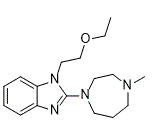
Emedastine is a novel, potent, high affinity, selective, second generation H1-receptor antagonist with pre-clinically well-documented anti-allergic effects. Emedastine's affinity for H1-receptors is 1.3 ±0.1 nM, while its affinity for H2- and H3-receptors is significantly lower, with K1 values of 49,067 ± 11,113 nM and 12,430 ± 1,282 nM, respectively. Since emedastine exhibits pharmacodynamic qualities similar to those of cetirizine, it is a suitable substitute drug with H1-receptor antagonist qualities that is also safe. To support the possible advantages of cetirizine over emedastine following a single dose, more extensive research may be required.
Physicochemical Properties
| Molecular Formula | C17H26N4O | |
| Molecular Weight | 302.41 | |
| Exact Mass | 302.21 | |
| CAS # | 87233-61-2 | |
| Related CAS # | Emedastine-13C,d3 fumarate; Emedastine difumarate; 87233-62-3 | |
| PubChem CID | 3219 | |
| Appearance | Yellow to brown oil | |
| Density | 1.2±0.1 g/cm3 | |
| Boiling Point | 446.6±55.0 °C at 760 mmHg | |
| Melting Point | 148-151ºC | |
| Flash Point | 223.9±31.5 °C | |
| Vapour Pressure | 0.0±1.1 mmHg at 25°C | |
| Index of Refraction | 1.595 | |
| LogP | 3.02 | |
| Hydrogen Bond Donor Count | 0 | |
| Hydrogen Bond Acceptor Count | 4 | |
| Rotatable Bond Count | 5 | |
| Heavy Atom Count | 22 | |
| Complexity | 341 | |
| Defined Atom Stereocenter Count | 0 | |
| SMILES | N1=C(N2CCCN(C)CC2)N(CCOCC)C2C1=CC=CC=2 |
|
| InChi Key | KBUZBQVCBVDWKX-UHFFFAOYSA-N | |
| InChi Code | InChI=1S/C17H26N4O/c1-3-22-14-13-21-16-8-5-4-7-15(16)18-17(21)20-10-6-9-19(2)11-12-20/h4-5,7-8H,3,6,9-14H2,1-2H3 | |
| Chemical Name |
|
|
| Synonyms |
|
|
| HS Tariff Code | 2934.99.9001 | |
| Storage |
Powder-20°C 3 years 4°C 2 years In solvent -80°C 6 months -20°C 1 month |
|
| Shipping Condition | Room temperature (This product is stable at ambient temperature for a few days during ordinary shipping and time spent in Customs) |
Biological Activity
| Targets | H1 Receptor ( Ki = 1.3 nM ); H2 Receptor ( Ki = 49067 nM ); H3 Receptor ( Ki = 12430 nM ) | |
| ln Vitro |
|
|
| ln Vivo |
|
|
| Enzyme Assay | Emedastine was significantly weaker at H2- (K1 = 49,067 +/- 11,113 nM) and H3- (Ki = 12,430 +/- 1,282 nM) receptors, but showed the highest affinity for H1-receptors (dissociation constant, Ki = 1.3 +/- 0.1 nM). The results showed that emedastine is a highly selective H1-receptor antagonist, with ratios of 37744, 9562, and 4 for H2:H1, H3:H1, and H2:H3 receptor affinities, respectively. Emedastine's H1-selectivity was significantly higher than pyrilamine's (H2:H1, H3:H1, and H2:H3 ratios of 11887, 12709, and 1, respectively). The antihistamines ketotifen (858, 1752, 0.5), levocabastine (420, 82, 5), pheniramine (430, 312, 1), chlorpheniramine (5700, 2216, 3), and antazoline (1163, 1110, 1) also demonstrated a notable lack of H1 selectivity in comparison to emedastine. Mededastine's ability to counteract histamine-induced phosphoinositide turnover in human trabecular meshwork cells was found to be potent (IC50 = 1.44 +/- 0.3 nM), which was in good agreement with its affinity for binding the H1 receptor site. These findings show that the most selective histamine antagonist for the H1-histamine receptor is emedastine, a histamine antagonist with high affinity and potency. | |
| Animal Protocol |
Male ICR mice 5-6 weeks of age 0.03, 0.1, 0.3 mg/kg Orally; 30 min before pruritogen injection |
|
| ADME/Pharmacokinetics |
Absorption, Distribution and Excretion Ophthalmic use of emedastine usually does not produce measurable plasma concentrations. Following oral administration, approximately 44% of the total dose can be recovered in the urine over the 24-hour period, with only 3.6% of the dose excreted as unchanged form. Two primary metabolites, 5- and 6-hydroxyemedastine, are excreted in the urine as both free and conjugated forms. Metabolism / Metabolites Two primary metabolites, 5-hydroxyemedastine and 6-hydroxyemedastine, are excreted in the urine as both free and conjugated forms. Minor metabolites include the 5'-oxoanalogs of 5-hydroxyemedastine and 6-hydroxy-emedastine and the N-oxide. Biological Half-Life The elimination half-life in the plasma is 3-4 hours following oral administration. |
|
| Toxicity/Toxicokinetics |
Effects During Pregnancy and Lactation ◉ Summary of Use during Lactation Emedastine is an antihistamine that is not approved for marketing in the United States by the U.S. Food and Drug Administration, but is available in other countries. Preliminary data indicate that oral administration of 2 mg daily produces low levels in milk and does not affect the breastfed infant. When used as an eye drop, emedastine would not be expected to cause any adverse effects in breastfed infants. To substantially diminish the amount of drug that reaches the breastmilk after using eye drops, place pressure over the tear duct by the corner of the eye for 1 minute or more, then remove the excess solution with an absorbent tissue. ◉ Effects in Breastfed Infants A woman was prescribed emedastine difumarate 2 mg once daily and pranlukast hydrate 112.5 mg twice daily during pregnancy and postpartum. Her infant was breastfed and no adverse effects were noted. ◉ Effects on Lactation and Breastmilk Relevant published information was not found as of the revision date. |
|
| References |
[1]. Emedastine: a potent, high affinity histamine H1-receptor-selective antagonist for ocular use: receptor binding and second messenger studies. J Ocul Pharmacol. 1994 Winter;10(4):653-64. [2]. Emedastine difumarate: a review of its potential ameliorating effect for tissue remodeling in allergic diseases. Expert Opin Pharmacother. 2009 Aug;10(11):1859-67. [3]. Involvement of blockade of leukotriene B(4) action in anti-pruritic effects of emedastine in mice. Eur J Pharmacol. 2000 Oct 6;406(1):149-52. |
|
| Additional Infomation |
Emedastine is 1-Methyl-1,4-diazepane in which the hydrogen attached to the nitrogen at position 4 is substituted by a 1-(2-ethoxyethyl)-1H-benzimidazol-2-yl group. A relatively selective histamine H1 antagonist, it is used as the difumatate salt for allergic rhinitis, urticaria, and pruritic skin disorders, and in eyedrops for the symptomatic relief of allergic conjuntivitis. It has a role as a H1-receptor antagonist, an anti-allergic agent and an antipruritic drug. Emedastine is an antihistamine used in eye drops to treat allergic conjunctivitis. Emedastine is a Histamine-1 Receptor Inhibitor. The mechanism of action of emedastine is as a Histamine H1 Receptor Antagonist. Emedastine is a second generation, selective histamine H1 receptor antagonist with anti-allergic activity. Emedastine reversibly and competitively blocks histamine by binding to H1 receptors, thus blocking its downstream activity. As a result this agent interferes with mediator release from mast cells either by inhibiting calcium ion influx across mast cell/basophil plasma membrane or by inhibiting intracellular calcium ion release within the cells. In addition, emedastine may also inhibit the late-phase allergic reaction mediated through leukotrienes or prostaglandins, or by producing an anti-platelet activating factor effect. Upon ocular administration, emedastine causes a dose-dependent inhibition of histamine-stimulated vascular permeability in the conjunctiva. Emedastine does not affect adrenergic, dopamine, or serotonin receptors. Drug Indication For the temporary relief of the signs and symptoms of allergic conjunctivitis. FDA Label Symptomatic treatment of seasonal allergic conjunctivitis. Mechanism of Action Emedastine is a relatively selective, histamine H1 antagonist. In vitro examinations of emedastine's affinity for histamine receptors demonstrate relative selectivity for the H1 histamine receptor. In vivo studies have shown concentration-dependent inhibition of histamine-stimulated vascular permeability in the conjunctiva following topical ocular administration. Emedastine appears exert negligible effects on adrenergic, dopaminergic and serotonin receptors. Pharmacodynamics Emedastine is a relatively selective H1-receptor antagonist. |
Solubility Data
| Solubility (In Vitro) |
|
|||
| Solubility (In Vivo) |
Solubility in Formulation 1: ≥ 2.08 mg/mL (6.88 mM) (saturation unknown) in 10% DMSO + 40% PEG300 + 5% Tween80 + 45% Saline (add these co-solvents sequentially from left to right, and one by one), clear solution. For example, if 1 mL of working solution is to be prepared, you can add 100 μL of 20.8 mg/mL clear DMSO stock solution to 400 μL PEG300 and mix evenly; then add 50 μL Tween-80 to the above solution and mix evenly; then add 450 μL normal saline to adjust the volume to 1 mL. Preparation of saline: Dissolve 0.9 g of sodium chloride in 100 mL ddH₂ O to obtain a clear solution. Solubility in Formulation 2: ≥ 2.08 mg/mL (6.88 mM) (saturation unknown) in 10% DMSO + 90% (20% SBE-β-CD in Saline) (add these co-solvents sequentially from left to right, and one by one), clear solution. For example, if 1 mL of working solution is to be prepared, you can add 100 μL of 20.8 mg/mL clear DMSO stock solution to 900 μL of 20% SBE-β-CD physiological saline solution and mix evenly. Preparation of 20% SBE-β-CD in Saline (4°C,1 week): Dissolve 2 g SBE-β-CD in 10 mL saline to obtain a clear solution. Solubility in Formulation 3: ≥ 2.08 mg/mL (6.88 mM) (saturation unknown) in 10% DMSO + 90% Corn Oil (add these co-solvents sequentially from left to right, and one by one), clear solution. For example, if 1 mL of working solution is to be prepared, you can add 100 μL of 20.8 mg/mL clear DMSO stock solution to 900 μL of corn oil and mix evenly. (Please use freshly prepared in vivo formulations for optimal results.) |
| Preparing Stock Solutions | 1 mg | 5 mg | 10 mg | |
| 1 mM | 3.3068 mL | 16.5338 mL | 33.0677 mL | |
| 5 mM | 0.6614 mL | 3.3068 mL | 6.6135 mL | |
| 10 mM | 0.3307 mL | 1.6534 mL | 3.3068 mL |