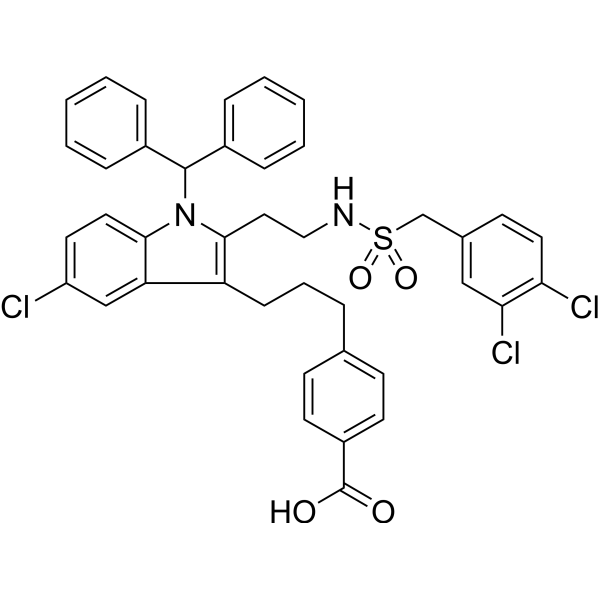
Physicochemical Properties
| Molecular Formula | C40H35CL3N2O4S |
| Molecular Weight | 746.14 |
| Exact Mass | 744.138 |
| CAS # | 381683-94-9 |
| PubChem CID | 9853499 |
| Appearance | Typically exists as solid at room temperature |
| LogP | 11.246 |
| Hydrogen Bond Donor Count | 2 |
| Hydrogen Bond Acceptor Count | 5 |
| Rotatable Bond Count | 14 |
| Heavy Atom Count | 50 |
| Complexity | 1150 |
| Defined Atom Stereocenter Count | 0 |
| SMILES | C1=CC=C(C=C1)C(C2=CC=CC=C2)N3C4=C(C=C(C=C4)Cl)C(=C3CCNS(=O)(=O)CC5=CC(=C(C=C5)Cl)Cl)CCCC6=CC=C(C=C6)C(=O)O |
| InChi Key | HIZOPJQOPKRKFM-UHFFFAOYSA-N |
| InChi Code | InChI=1S/C40H35Cl3N2O4S/c41-32-19-21-37-34(25-32)33(13-7-8-27-14-17-31(18-15-27)40(46)47)38(22-23-44-50(48,49)26-28-16-20-35(42)36(43)24-28)45(37)39(29-9-3-1-4-10-29)30-11-5-2-6-12-30/h1-6,9-12,14-21,24-25,39,44H,7-8,13,22-23,26H2,(H,46,47) |
| Chemical Name | 4-[3-[1-benzhydryl-5-chloro-2-[2-[(3,4-dichlorophenyl)methylsulfonylamino]ethyl]indol-3-yl]propyl]benzoic acid |
| Synonyms | PLA 902; PLA-902; Efipladib |
| HS Tariff Code | 2934.99.9001 |
| Storage |
Powder-20°C 3 years 4°C 2 years In solvent -80°C 6 months -20°C 1 month |
| Shipping Condition | Room temperature (This product is stable at ambient temperature for a few days during ordinary shipping and time spent in Customs) |
Biological Activity
| ln Vitro | In PC3 and LNCaP cells, efipladib (10–25 μM; 24-72 h) raises the levels of PGE2 and COX-1 [3]. |
| ln Vivo | The collagen-induced arthritis (CIA) model's severity is reversed when effipladib (100 mg/kg; po; BID for 31 days) is administered [1]. One hour after instructions are given, Efipladib (100 mg/kg; po; Once) is not able to pass across the blood-brain barrier and reach the central compartment [2]. Efipladib (IT; 5 μL; 100 nM) diminishes waveforms. |
| Cell Assay |
Western Blot Analysis[3] Cell Types: PC3 and LNCaP cells Tested Concentrations: 10, 15, 20 and 25 μM Incubation Duration: 72 hrs (hours) Experimental Results: cPLA2α activity was Dramatically diminished. COX-1 protein levels increase. COX-2 protein levels are increased in PC3 cells. |
| Animal Protocol |
Animal/Disease Models: Male SD (SD (Sprague-Dawley)) rat[2] Doses: 100 nM, dissolved in 5 μL 100% DMSO/rat Route of Administration: intrathecal administration Experimental Results: PGE2 levels in cerebrospinal fluid (CSF) diminished by 45-60%, However, no effect on nociceptive responses was found. |
| References |
[1]. Indole Cytosolic Phospholipase A2 α Inhibitors: Discovery and in Vitro and in Vivo Characterization of 4-{3-[5-Chloro-2-(2-{[(3, 4-dichlorobenzyl) sulfonyl] amino} ethyl)-1-(diphenylmethyl)-1 H-indol-3-yl] propyl} benzoic Acid, Efipladib. Journal of medicinal chemistry, 2008, 51(12): 3388-3413. [2]. The cPLA2α inhibitor efipladib decreases nociceptive responses without affecting PGE2 levels in the cerebral spinal fluid. Neuropharmacology. 2011 Mar;60(4):633-41. [3]. Decrease in expression or activity of cytosolic phospholipase A2alpha increases cyclooxygenase-1 action: A cross-talk between key enzymes in arachidonic acid pathway in prostate cancer cells. Biochim Biophys Acta. 2010 Jul;1801(7):731-7. |
Solubility Data
| Solubility (In Vitro) | May dissolve in DMSO (in most cases), if not, try other solvents such as H2O, Ethanol, or DMF with a minute amount of products to avoid loss of samples |
| Solubility (In Vivo) |
Note: Listed below are some common formulations that may be used to formulate products with low water solubility (e.g. < 1 mg/mL), you may test these formulations using a minute amount of products to avoid loss of samples. Injection Formulations (e.g. IP/IV/IM/SC) Injection Formulation 1: DMSO : Tween 80: Saline = 10 : 5 : 85 (i.e. 100 μL DMSO stock solution → 50 μL Tween 80 → 850 μL Saline) *Preparation of saline: Dissolve 0.9 g of sodium chloride in 100 mL ddH ₂ O to obtain a clear solution. Injection Formulation 2: DMSO : PEG300 :Tween 80 : Saline = 10 : 40 : 5 : 45 (i.e. 100 μL DMSO → 400 μLPEG300 → 50 μL Tween 80 → 450 μL Saline) Injection Formulation 3: DMSO : Corn oil = 10 : 90 (i.e. 100 μL DMSO → 900 μL Corn oil) Example: Take the Injection Formulation 3 (DMSO : Corn oil = 10 : 90) as an example, if 1 mL of 2.5 mg/mL working solution is to be prepared, you can take 100 μL 25 mg/mL DMSO stock solution and add to 900 μL corn oil, mix well to obtain a clear or suspension solution (2.5 mg/mL, ready for use in animals). Injection Formulation 4: DMSO : 20% SBE-β-CD in saline = 10 : 90 [i.e. 100 μL DMSO → 900 μL (20% SBE-β-CD in saline)] *Preparation of 20% SBE-β-CD in Saline (4°C,1 week): Dissolve 2 g SBE-β-CD in 10 mL saline to obtain a clear solution. Injection Formulation 5: 2-Hydroxypropyl-β-cyclodextrin : Saline = 50 : 50 (i.e. 500 μL 2-Hydroxypropyl-β-cyclodextrin → 500 μL Saline) Injection Formulation 6: DMSO : PEG300 : castor oil : Saline = 5 : 10 : 20 : 65 (i.e. 50 μL DMSO → 100 μLPEG300 → 200 μL castor oil → 650 μL Saline) Injection Formulation 7: Ethanol : Cremophor : Saline = 10: 10 : 80 (i.e. 100 μL Ethanol → 100 μL Cremophor → 800 μL Saline) Injection Formulation 8: Dissolve in Cremophor/Ethanol (50 : 50), then diluted by Saline Injection Formulation 9: EtOH : Corn oil = 10 : 90 (i.e. 100 μL EtOH → 900 μL Corn oil) Injection Formulation 10: EtOH : PEG300:Tween 80 : Saline = 10 : 40 : 5 : 45 (i.e. 100 μL EtOH → 400 μLPEG300 → 50 μL Tween 80 → 450 μL Saline) Oral Formulations Oral Formulation 1: Suspend in 0.5% CMC Na (carboxymethylcellulose sodium) Oral Formulation 2: Suspend in 0.5% Carboxymethyl cellulose Example: Take the Oral Formulation 1 (Suspend in 0.5% CMC Na) as an example, if 100 mL of 2.5 mg/mL working solution is to be prepared, you can first prepare 0.5% CMC Na solution by measuring 0.5 g CMC Na and dissolve it in 100 mL ddH2O to obtain a clear solution; then add 250 mg of the product to 100 mL 0.5% CMC Na solution, to make the suspension solution (2.5 mg/mL, ready for use in animals). Oral Formulation 3: Dissolved in PEG400 Oral Formulation 4: Suspend in 0.2% Carboxymethyl cellulose Oral Formulation 5: Dissolve in 0.25% Tween 80 and 0.5% Carboxymethyl cellulose Oral Formulation 6: Mixing with food powders Note: Please be aware that the above formulations are for reference only. InvivoChem strongly recommends customers to read literature methods/protocols carefully before determining which formulation you should use for in vivo studies, as different compounds have different solubility properties and have to be formulated differently. (Please use freshly prepared in vivo formulations for optimal results.) |
| Preparing Stock Solutions | 1 mg | 5 mg | 10 mg | |
| 1 mM | 1.3402 mL | 6.7012 mL | 13.4023 mL | |
| 5 mM | 0.2680 mL | 1.3402 mL | 2.6805 mL | |
| 10 mM | 0.1340 mL | 0.6701 mL | 1.3402 mL |