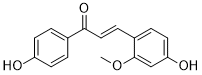
Echinatin, a chalcone derivative named retrochalcone, is a naturally occuring product isolated from the licorice and is a chalcone derivative called retrochalcone. It displays antioxidant properties and anti-inflammatory activities.
Physicochemical Properties
| Molecular Formula | C16H14O4 |
| Molecular Weight | 270.2800 |
| Exact Mass | 270.089 |
| CAS # | 34221-41-5 |
| PubChem CID | 6442675 |
| Appearance | Light yellow to yellow solid powder |
| Density | 1.3±0.1 g/cm3 |
| Boiling Point | 509.8±50.0 °C at 760 mmHg |
| Melting Point | 210ºC (dec.) |
| Flash Point | 193.3±23.6 °C |
| Vapour Pressure | 0.0±1.4 mmHg at 25°C |
| Index of Refraction | 1.658 |
| LogP | 3.23 |
| Hydrogen Bond Donor Count | 2 |
| Hydrogen Bond Acceptor Count | 4 |
| Rotatable Bond Count | 4 |
| Heavy Atom Count | 20 |
| Complexity | 344 |
| Defined Atom Stereocenter Count | 0 |
| SMILES | COC1=C(C=CC(=C1)O)/C=C/C(=O)C2=CC=C(C=C2)O |
| InChi Key | QJKMIJNRNRLQSS-WEVVVXLNSA-N |
| InChi Code | InChI=1S/C16H14O4/c1-20-16-10-14(18)8-4-12(16)5-9-15(19)11-2-6-13(17)7-3-11/h2-10,17-18H,1H3/b9-5+ |
| Chemical Name | (E)-3-(4-hydroxy-2-methoxyphenyl)-1-(4-hydroxyphenyl)prop-2-en-1-one |
| Synonyms | Retrochalcone; |
| HS Tariff Code | 2934.99.9001 |
| Storage |
Powder-20°C 3 years 4°C 2 years In solvent -80°C 6 months -20°C 1 month Note: This product requires protection from light (avoid light exposure) during transportation and storage. |
| Shipping Condition | Room temperature (This product is stable at ambient temperature for a few days during ordinary shipping and time spent in Customs) |
Biological Activity
| ln Vitro | In LPS-challenged BMDM, echinatin (0–40 μM, 60 minutes) binds to HSP90 and inhibits ATPase activity, hence suppressing cyclin-induced activation of the NLRP3 regulatory body [2]. In ESCC (KYSE30 and KYSE270 cells), echinatin (0–40 μM, 1–5 days) decreases cell proliferation, migration, and shortening while inducing cell sealing and autophagy [4]. |
| ln Vivo | Echinatin (20–80 mg/kg, i.p.) is cardioprotective; Echinatin (20 and 50 mg/kg, ischemia) inhibits tumor growth in KYSE270-derived tumor xenografts and inhibits AKT/mTOR buffering [4]. Echinatin (20 and 40 mg/kg, intraperitoneally) inhibits LPS-induced probe septic shock by inhibiting NLRP3 inflammasome activation [2]. |
| Cell Assay |
Western Blot Analysis[1] Cell Types: LPS-primed BMDMs Tested Concentrations: 0- 40 μM Incubation Duration: 60 minutes Experimental Results: diminished production of cleaved caspase-1 and IL-1β. Immunofluorescence [4] Cell Types: KYSE30 and KYSE270 Cell Tested Concentrations: 40 μM Incubation Duration: 2 days Experimental Results: Induced cellular LC3 puncta accumulation. |
| Animal Protocol |
Animal/Disease Models: LPS-induced septic shock in mice [1] Doses: 20 and 40 mg/kg Route of Administration: intraperitoneal (ip) injection Experimental Results: Inhibited LPS-induced IL-1β and TNF-α production. diminished proportion and number of neutrophils in peritoneal lavage cells in mice. |
| References |
[1]. Antioxidant Mechanisms of Echinatin and Licochalcone A. Molecules. 2018 Dec 20;24(1). [2]. Echinatin effectively protects against NLRP3 inflammasome-driven diseases by targeting HSP90. JCI Insight. 2021 Jan 25;6(2):e134601. [3]. Cardioprotective Effect of Echinatin Against Ischemia/Reperfusion Injury: Involvement of Hippo/Yes-Associated Protein Signaling. Front Pharmacol. 2021 Jan 11;11:593225. [4]. Echinatin suppresses esophageal cancer tumor growth and invasion through inducing AKT/mTOR-dependent autophagy and apoptosis. Cell Death Dis. 2020 Jul 13;11(7):524. |
| Additional Infomation |
Echinatin has been reported in Glycyrrhiza pallidiflora, Glycyrrhiza uralensis, and other organisms with data available. See also: Loureirin C (annotation moved to). |
Solubility Data
| Solubility (In Vitro) | DMSO : ~125 mg/mL (~462.48 mM) |
| Solubility (In Vivo) |
Solubility in Formulation 1: ≥ 2.17 mg/mL (8.03 mM) (saturation unknown) in 10% DMSO + 40% PEG300 + 5% Tween80 + 45% Saline (add these co-solvents sequentially from left to right, and one by one), clear solution. For example, if 1 mL of working solution is to be prepared, you can add 100 μL of 21.7 mg/mL clear DMSO stock solution to 400 μL PEG300 and mix evenly; then add 50 μL Tween-80 to the above solution and mix evenly; then add 450 μL normal saline to adjust the volume to 1 mL. Preparation of saline: Dissolve 0.9 g of sodium chloride in 100 mL ddH₂ O to obtain a clear solution. Solubility in Formulation 2: ≥ 2.08 mg/mL (7.70 mM) (saturation unknown) in 10% DMSO + 90% (20% SBE-β-CD in Saline) (add these co-solvents sequentially from left to right, and one by one), clear solution. For example, if 1 mL of working solution is to be prepared, you can add 100 μL of 20.8 mg/mL clear DMSO stock solution to 900 μL of 20% SBE-β-CD physiological saline solution and mix evenly. Preparation of 20% SBE-β-CD in Saline (4°C,1 week): Dissolve 2 g SBE-β-CD in 10 mL saline to obtain a clear solution. (Please use freshly prepared in vivo formulations for optimal results.) |
| Preparing Stock Solutions | 1 mg | 5 mg | 10 mg | |
| 1 mM | 3.6999 mL | 18.4993 mL | 36.9987 mL | |
| 5 mM | 0.7400 mL | 3.6999 mL | 7.3997 mL | |
| 10 mM | 0.3700 mL | 1.8499 mL | 3.6999 mL |