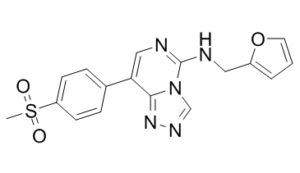
EED226 (EED-226) is a first-in-class, selective, orally bioavailable and allosteric inhibitor of embryonic ectoderm development (EED) with potential anticancer activity. It directly binds to the H3K27me3 binding pocket of EED and induces a conformational change upon binding EED, which leads to loss of PRC2 activity. EED226 shows similar activity to SAM-competitive inhibitors in blocking H3K27 methylation of PRC2 target genes and inducing regression of human lymphoma xenograft tumors. Interestingly, EED226 also effectively inhibits PRC2 containing a mutant EZH2 protein resistant to SAM-competitive inhibitors. Together, EED226 inhibits PRC2 activity via an allosteric mechanism and offers an opportunity for treatment of PRC2-dependent cancers. Overexpression and somatic heterozygous mutations of EZH2, the catalytic subunit of polycomb repressive complex 2 (PRC2), are associated with several tumor types. EZH2 inhibitor, EPZ-6438 (tazemetostat), demonstrated clinical efficacy in patients with acceptable safety profile as monotherapy. EED, another subunit of PRC2 complex, is essential for its histone methyltransferase activity through direct binding to trimethylated lysine 27 on histone 3 (H3K27Me3). EED226 directly binds to the H3K27me3 binding pocket of EED. EED226 induces a conformational change upon binding EED, leading to loss of PRC2 activity.
Physicochemical Properties
| Molecular Formula | C17H15N5O3S | |
| Molecular Weight | 369.3977 | |
| Exact Mass | 369.089 | |
| CAS # | 2083627-02-3 | |
| Related CAS # |
|
|
| PubChem CID | 123132228 | |
| Appearance | White to off-white solid powder | |
| LogP | 2.3 | |
| Hydrogen Bond Donor Count | 1 | |
| Hydrogen Bond Acceptor Count | 7 | |
| Rotatable Bond Count | 5 | |
| Heavy Atom Count | 26 | |
| Complexity | 575 | |
| Defined Atom Stereocenter Count | 0 | |
| SMILES | S(C([H])([H])[H])(C1C([H])=C([H])C(=C([H])C=1[H])C1=C([H])N=C(N([H])C([H])([H])C2=C([H])C([H])=C([H])O2)N2C([H])=NN=C21)(=O)=O |
|
| InChi Key | DYIRSNMPIZZNBK-UHFFFAOYSA-N | |
| InChi Code | InChI=1S/C17H15N5O3S/c1-26(23,24)14-6-4-12(5-7-14)15-10-19-17(22-11-20-21-16(15)22)18-9-13-3-2-8-25-13/h2-8,10-11H,9H2,1H3,(H,18,19) | |
| Chemical Name | N-(furan-2-ylmethyl)-8-(4-methylsulfonylphenyl)-[1,2,4]triazolo[4,3-c]pyrimidin-5-amine | |
| Synonyms |
|
|
| HS Tariff Code | 2934.99.9001 | |
| Storage |
Powder-20°C 3 years 4°C 2 years In solvent -80°C 6 months -20°C 1 month |
|
| Shipping Condition | Room temperature (This product is stable at ambient temperature for a few days during ordinary shipping and time spent in Customs) |
Biological Activity
| ln Vitro | EED226 has been tested against a variety of epigenetic and non-epigenetic targets. It is a very strong and selective inhibitor of EZH2 and EZH1. In cells with the heterozygous Y641N mutation, it selectively kills cells and efficiently lowers the global H3K27Me3 mark in cells. In Caco-2 cells, EED226 has a moderate permeability with an efflux rate of 7.6 and an A-B value of 3.0x10⁻⁶ cm/s[2]. When mononucleosomes are used as substrates, EED226 inhibits PRC2 with an IC50 of 53.5 nM and the addition of stimulatory H3K27me3 at 1× Kact (1.0 μM) in an in vitro enzymatic assay [3]. | ||
| ln Vivo | The preclinical DLBCL model EZH2MUT exhibits robust and sustained tumor regression in response to EED226. When given at a dose of 300 mg/kg bid for 14 days, EED226 was well tolerated in CD-1 mice and did not cause any noteworthy side effects. Its oral bioavailability is about 100%, and its body clearance is extremely low. EED226 exhibits a moderate plasma protein binding (PPB), a reasonable terminal t1/2 (2.2 h), and a low volume of distribution (0.8 L/kg) [2]. | ||
| Animal Protocol |
|
||
| References |
[1]. Discovery and Molecular Basis of a Diverse Set of Polycomb Repressive Complex 2 Inhibitors Recognition by EED. PLoS One. 2017 Jan 10;12(1):e0169855. [2]. Discovery of First-in-Class, Potent, and Orally Bioavailable Embryonic Ectoderm Development (EED) Inhibitor with Robust Anticancer Efficacy. J Med Chem. 2017 Mar 23;60(6):2215-2226. [3]. An allosteric PRC2 inhibitor targeting the H3K27me3 binding pocket of EED. Nat Chem Biol. 2017 Apr;13(4):381-388. |
Solubility Data
| Solubility (In Vitro) |
|
|||
| Solubility (In Vivo) |
Solubility in Formulation 1: ≥ 2.5 mg/mL (6.77 mM) (saturation unknown) in 10% DMSO + 40% PEG300 + 5% Tween80 + 45% Saline (add these co-solvents sequentially from left to right, and one by one), clear solution. For example, if 1 mL of working solution is to be prepared, you can add 100 μL of 25.0 mg/mL clear DMSO stock solution to 400 μL PEG300 and mix evenly; then add 50 μL Tween-80 to the above solution and mix evenly; then add 450 μL normal saline to adjust the volume to 1 mL. Preparation of saline: Dissolve 0.9 g of sodium chloride in 100 mL ddH₂ O to obtain a clear solution. Solubility in Formulation 2: ≥ 2.5 mg/mL (6.77 mM) (saturation unknown) in 10% DMSO + 90% (20% SBE-β-CD in Saline) (add these co-solvents sequentially from left to right, and one by one), suspension solution. For example, if 1 mL of working solution is to be prepared, you can add 100 μL of 25.0 mg/mL clear DMSO stock solution to 900 μL of 20% SBE-β-CD physiological saline solution and mix evenly. Preparation of 20% SBE-β-CD in Saline (4°C,1 week): Dissolve 2 g SBE-β-CD in 10 mL saline to obtain a clear solution. Solubility in Formulation 3: ≥ 2.5 mg/mL (6.77 mM) (saturation unknown) in 10% DMSO + 90% Corn Oil (add these co-solvents sequentially from left to right, and one by one), clear solution. For example, if 1 mL of working solution is to be prepared, you can add 100 μL of 25.0 mg/mL clear DMSO stock solution to 900 μL of corn oil and mix evenly. Solubility in Formulation 4: 10 mg/mL (27.07 mM) in 0.5%HPMC 1%Tween80 (add these co-solvents sequentially from left to right, and one by one), Suspened solution; with ultrasonication. (Please use freshly prepared in vivo formulations for optimal results.) |
| Preparing Stock Solutions | 1 mg | 5 mg | 10 mg | |
| 1 mM | 2.7071 mL | 13.5355 mL | 27.0709 mL | |
| 5 mM | 0.5414 mL | 2.7071 mL | 5.4142 mL | |
| 10 mM | 0.2707 mL | 1.3535 mL | 2.7071 mL |