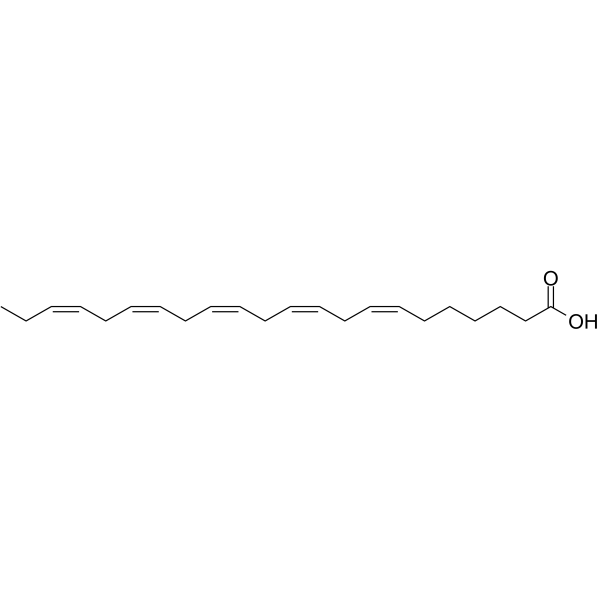
Physicochemical Properties
| Molecular Formula | C22H34O2 |
| Molecular Weight | 330.50416 |
| Exact Mass | 330.255 |
| CAS # | 24880-45-3 |
| PubChem CID | 5497182 |
| Appearance | Colorless to light yellow liquid |
| Density | 0.9±0.1 g/cm3 |
| Boiling Point | 442.2±24.0 °C at 760 mmHg |
| Flash Point | 338.9±18.0 °C |
| Vapour Pressure | 0.0±2.3 mmHg at 25°C |
| Index of Refraction | 1.509 |
| LogP | 7.26 |
| Hydrogen Bond Donor Count | 1 |
| Hydrogen Bond Acceptor Count | 2 |
| Rotatable Bond Count | 15 |
| Heavy Atom Count | 24 |
| Complexity | 425 |
| Defined Atom Stereocenter Count | 0 |
| SMILES | CC/C=C\C/C=C\C/C=C\C/C=C\C/C=C\CCCCCC(O)=O |
| InChi Key | YUFFSWGQGVEMMI-JLNKQSITSA-N |
| InChi Code | InChI=1S/C22H34O2/c1-2-3-4-5-6-7-8-9-10-11-12-13-14-15-16-17-18-19-20-21-22(23)24/h3-4,6-7,9-10,12-13,15-16H,2,5,8,11,14,17-21H2,1H3,(H,23,24)/b4-3-,7-6-,10-9-,13-12-,16-15- |
| Chemical Name | (7Z,10Z,13Z,16Z,19Z)-docosa-7,10,13,16,19-pentaenoic acid |
| HS Tariff Code | 2934.99.9001 |
| Storage |
Powder-20°C 3 years 4°C 2 years In solvent -80°C 6 months -20°C 1 month |
| Shipping Condition | Room temperature (This product is stable at ambient temperature for a few days during ordinary shipping and time spent in Customs) |
Biological Activity
| ADME/Pharmacokinetics |
Docosapentaenoic acid 22n-3 (DPA n-3) is a long-chain omega-3 polyunsaturated fatty acid (PUFA) that can be endogenously synthesized in humans from alpha-linolenic acid (ALA, 18:3n-3) via sequential desaturation and elongation. It is also obtained exogenously from dietary sources, with the highest concentrations found in marine oils (e.g., fish oil, seal oil) [1] In human tissues, Docosapentaenoic acid 22n-3 (DPA n-3) distributes primarily to cell membranes, particularly in the liver, brain, and adipose tissue. It is incorporated into phospholipids, triglycerides, and cholesterol esters, contributing to membrane fluidity and structure [1] |
| References |
[1]. Essential fatty acids in perspective. Hum Nutr Clin Nutr. 1984 Jul;38(4):245-60. |
| Additional Infomation |
(7Z,10Z,13Z,16Z,19Z)-docosapentaenoic acid is the all-cis-isomer of a C22 polyunsaturated fatty acid having five double bonds in the 7-, 10-, 13-, 16- and 19-positions. It has a role as a human metabolite and an algal metabolite. It is a docosapentaenoic acid and an omega-3 fatty acid. It is a conjugate acid of a (7Z,10Z,13Z,16Z,19Z)-docosapentaenoate. Docosapentaenoic acid has been reported in Homo sapiens and Caenorhabditis elegans with data available. Clupanodonic Acid is a polyunsaturated very long-chain fatty acid with a 22-carbon backbone and 5 double bonds, originating from the 3rd, 6th, 9th, 12th and 15th positions from the methyl end, with all double bonds in the cis- configuration. Docosapentaenoic Acid is a polyunsaturated very long-chain fatty acid with a 22-carbon backbone and exactly 5 double bonds. There are 3 recognized isomers of docosapentaenoic acid, and double-bonds for this fatty acid can be originating from either the (3rd, 6th, 9th, 12th, and 15th), the (3rd, 7th, 10th, 14th, and 18th), or the (6th, 9th, 12th, 15th, and 18th) positions from the methyl end. Docosapentaenoic acid 22n-3 (DPA n-3) is classified as an essential omega-3 fatty acid, defined by its chemical structure: 22 carbon atoms with 5 cis double bonds, with the first double bond located at the 3rd carbon from the methyl end of the fatty acid chain [1] It is metabolically related to other key omega-3 PUFAs (eicosapentaenoic acid, EPA; docosahexaenoic acid, DHA), serving as both a precursor for DHA synthesis and an independent component of cell membranes. Its synthesis from ALA is regulated by desaturase enzymes (delta-6, delta-5 desaturases) and elongases [1] As an essential fatty acid, Docosapentaenoic acid 22n-3 (DPA n-3) is required for normal human physiology, including membrane structure maintenance, lipid metabolism, and modulation of inflammatory responses. It cannot be de novo synthesized by humans due to the lack of enzymes to introduce double bonds beyond the 9th carbon from the carboxyl end, necessitating dietary intake or endogenous synthesis from ALA [1] |
Solubility Data
| Solubility (In Vitro) | DMSO : ~50 mg/mL (~151.29 mM) |
| Solubility (In Vivo) |
Solubility in Formulation 1: 2.5 mg/mL (7.56 mM) in 10% DMSO + 40% PEG300 + 5% Tween80 + 45% Saline (add these co-solvents sequentially from left to right, and one by one), suspension solution; with sonication. For example, if 1 mL of working solution is to be prepared, you can add 100 μL of 25.0 mg/mL clear DMSO stock solution to 400 μL PEG300 and mix evenly; then add 50 μL Tween-80 to the above solution and mix evenly; then add 450 μL normal saline to adjust the volume to 1 mL. Preparation of saline: Dissolve 0.9 g of sodium chloride in 100 mL ddH₂ O to obtain a clear solution. Solubility in Formulation 2: 2.5 mg/mL (7.56 mM) in 10% DMSO + 90% (20% SBE-β-CD in Saline) (add these co-solvents sequentially from left to right, and one by one), suspension solution; with ultrasonication. For example, if 1 mL of working solution is to be prepared, you can add 100 μL of 25.0 mg/mL clear DMSO stock solution to 900 μL of 20% SBE-β-CD physiological saline solution and mix evenly. Preparation of 20% SBE-β-CD in Saline (4°C,1 week): Dissolve 2 g SBE-β-CD in 10 mL saline to obtain a clear solution. Solubility in Formulation 3: ≥ 2.5 mg/mL (7.56 mM) (saturation unknown) in 10% DMSO + 90% Corn Oil (add these co-solvents sequentially from left to right, and one by one), clear solution. For example, if 1 mL of working solution is to be prepared, you can add 100 μL of 25.0 mg/mL clear DMSO stock solution to 900 μL of corn oil and mix evenly. (Please use freshly prepared in vivo formulations for optimal results.) |
| Preparing Stock Solutions | 1 mg | 5 mg | 10 mg | |
| 1 mM | 3.0257 mL | 15.1286 mL | 30.2572 mL | |
| 5 mM | 0.6051 mL | 3.0257 mL | 6.0514 mL | |
| 10 mM | 0.3026 mL | 1.5129 mL | 3.0257 mL |