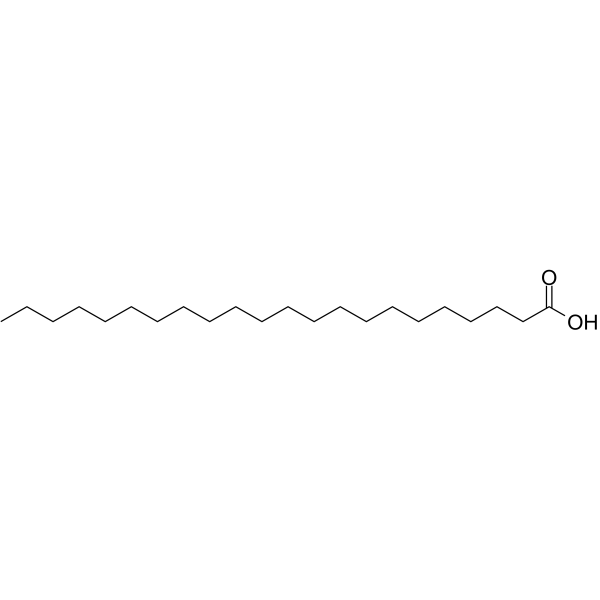
Physicochemical Properties
| Molecular Formula | C22H44O2 |
| Molecular Weight | 340.5836 |
| Exact Mass | 340.334 |
| CAS # | 112-85-6 |
| Related CAS # | 16529-65-0 (zinc salt);18990-72-2 (aluminum salt);20259-31-8 (iron(+3) salt);2489-05-6 (silver(+1) salt);2636-16-0 (barium salt);34303-23-6 (cadmium salt);4499-91-6 (lithium salt);5331-77-1 (hydrochloride salt);7211-53-2 (potassium salt) |
| PubChem CID | 8215 |
| Appearance | Off-white to light yellow solid powder |
| Density | 0.9±0.1 g/cm3 |
| Boiling Point | 391.8±5.0 °C at 760 mmHg |
| Melting Point | 72-80 °C(lit.) |
| Flash Point | 176.3±12.5 °C |
| Vapour Pressure | 0.0±0.9 mmHg at 25°C |
| Index of Refraction | 1.459 |
| LogP | 10.34 |
| Hydrogen Bond Donor Count | 1 |
| Hydrogen Bond Acceptor Count | 2 |
| Rotatable Bond Count | 20 |
| Heavy Atom Count | 24 |
| Complexity | 250 |
| Defined Atom Stereocenter Count | 0 |
| InChi Key | UKMSUNONTOPOIO-UHFFFAOYSA-N |
| InChi Code | InChI=1S/C22H44O2/c1-2-3-4-5-6-7-8-9-10-11-12-13-14-15-16-17-18-19-20-21-22(23)24/h2-21H2,1H3,(H,23,24) |
| Chemical Name | docosanoic acid |
| HS Tariff Code | 2934.99.9001 |
| Storage |
Powder-20°C 3 years 4°C 2 years In solvent -80°C 6 months -20°C 1 month Note: This product requires protection from light (avoid light exposure) during transportation and storage. |
| Shipping Condition | Room temperature (This product is stable at ambient temperature for a few days during ordinary shipping and time spent in Customs) |
Biological Activity
| ln Vivo |
In 7 men with mild hypercholesterolemia, dietary supplementation with Docosanoic acid (behenic acid, 22:0) via behenate oil resulted in mean total cholesterol (5.87 ± 0.8 mmol/L) and LDL cholesterol (4.40 ± 0.8 mmol/L) concentrations not significantly different from those of palm oil (rich in palmitic acid: total cholesterol 5.84 ± 0.7 mmol/L, LDL cholesterol 4.42 ± 0.7 mmol/L) [1] The total cholesterol and LDL cholesterol concentrations induced by docosanoic acid were significantly higher than those of high–oleic acid sunflower oil (total cholesterol 5.12 ± 0.5 mmol/L, LDL cholesterol 3.70 ± 0.6 mmol/L) [1] No significant differences in triacylglycerol or HDL cholesterol concentrations were observed among the three diet groups (behenate oil, palm oil, high–oleic acid sunflower oil) [1] Plasma triacylglycerol fatty acid analysis showed only a small amount of docosanoic acid (1.0 ± 1.0% by wt) in the behenate oil group; the total saturated fatty acid content (30.4 ± 3.3% by wt) was significantly higher than that of high–oleic acid sunflower oil (24.8 ± 2.5% by wt) but not different from that of palm oil (33.1 ± 2.3% by wt) [1] |
| Animal Protocol |
Human metabolic ward study (randomized, single-blind, crossover design): Seven men aged 55–75 y (BMI 27 ± 5) with mild hypercholesterolemia (baseline total cholesterol 5.69 ± 0.54 mmol/L) were recruited. The study included 3 diet periods (each 3 wk), separated by ≥1 wk of ad libitum outpatient diet. Each diet consisted of low-fat natural foods plus one fat supplement (behenate oil, palm oil, or high–oleic acid sunflower oil). The overall diet energy composition was 53% fat, 35% carbohydrate, and 12%. The base diet provided 10% of total fat (3% saturated, 4% monounsaturated, 3% polyunsaturated) and 91 mg/d dietary cholesterol. Fat supplements provided 43% of daily energy; behenate oil contained 39.5% docosanoic acid, and its daily allotment was increased by 24% to ensure equal absorbable energy from test fats. Patients consumed all foods under supervision, with daily interviews to confirm intake. Body weight was maintained constant by adjusting total energy intake. During the final 4 d of each diet period, blood was drawn after a 14-h fast for lipid, lipoprotein, and plasma fatty acid analysis [1] |
| ADME/Pharmacokinetics |
Absorption: The absorption rate of Docosanoic acid in humans is approximately 30%, which is much lower than that of palmitic acid (95–98%) [1] Metabolism: After absorption, docosanoic acid may be hydrolyzed into shorter-chain saturated fatty acids (e.g., myristic acid, palmitic acid, stearic acid) [1] Distribution: Only a small amount of intact docosanoic acid is distributed into the plasma triacylglycerol pool [1] Excretion: No specific excretion parameters were reported [1] |
| Toxicity/Toxicokinetics |
Toxicity Summary Oral LD50 value of docosanoic acid for rats is greater than 2,000 mg/kg. There are no available data for irritation and sensitization. In an oral study using the OECD combined repeated dose and reproductive/developmental toxicity test [OECD TG 422], docosanoic acid was administered to rats at doses of 0, 100, 300, 1,000 mg/kg/day for at least 42 days . No deaths occurred and also no substance related toxic effects were observed in any parameters. Therefore, the NOAEL is considered to be 1,000 mg/kg/day for both repeated dose toxicity and reproductive/developmental toxicity. The chemical was negative in both a bacterial mutation test [OECD TG 471, 472] and a chromosomal aberration test in vitro [OECD TG 473]. ... Acute toxicity values of docosanoic acid on alga (Selenastrum capricornutum), aquatic invertebrate (Daphnia magna) or fish (Oryzias latipes) are greater than its water solubility (0.016 mg/L). The NOEC in a 21-day reproduction test with Daphnia magna is also greater than its water solubility. No significant effects are observed in any tests conducted at extremely high concentrations by using dispersant under OECD test guidelines [TG201, 202, 203, 204, or 211]. There is information that some fatty acids with shorter carbon chain caused no mortality at saturated concentration in certain aquatic organisms (gammarus in freshwater; Medaka in seawater condition). Considering from these data and additional information, it is reasonable to assume that docosanoic acid is not toxic to aquatic organisms at the concentration less than its water solubility (0.016 mg/L). A PNEC is not calculated since NOEC values obtained are above the water solubility of the substance. Interactions THE BLOOD PLATELET AGGREGATING EFFECT OF BEHENIC ACID ON WASHED PIG BLOOD PLATELETS WAS ENHANCED BY THE ADDITION OF CALCIUM IONS. LINOLENIC ACID COMPLETELY INHIBITED THE EFFECT OF BEHENIC ACID WHEN BOTH WERE ADDED IN EQUIMOLAR CONCENTRATIONS. Non-Human Toxicity Values LD50 Rats oral >2,000 mg/kg /Purity 85.9 %; Impurities: (C14-C20) fatty acids 10.9 %, C24 fatty acid 2.3 %/ Subjects tolerated the docosanoic acid-rich diet well, with no significant gastrointestinal discomfort or adverse reactions related to high test oil intake [1] |
| References |
[1]. Behenic acid is a cholesterol-raising saturated fatty acid in humans. Am J Clin Nutr. 2001 Jan;73(1):41-4. |
| Additional Infomation |
Docosanoic acid is a straight-chain, C22, long-chain saturated fatty acid. It has a role as a plant metabolite. It is a straight-chain saturated fatty acid and a long-chain fatty acid. It is a conjugate acid of a behenate. Docosanoic acid has been reported in Calodendrum capense, Arisaema tortuosum, and other organisms with data available. Behenic Acid is a saturated very long-chain fatty acid with a 22-carbon backbone. Behenic acid is a major component of ben oil, extracted from the seeds of the moringa tree. See also: Borage Seed Oil (part of). Docosanoic acid (behenic acid, 22:0) is a long-chain saturated fatty acid [1] It is poorly absorbed in humans (≈30%) due to its very long chain length [1] Its cholesterol-raising potential is comparable to that of palmitic acid, and it is not a suitable substitute for palmitic acid in manufactured triacylglycerols [1] The mechanism underlying its cholesterol-raising effect may involve degradation to shorter-chain saturated fatty acids that are known to raise cholesterol [1] |
Solubility Data
| Solubility (In Vitro) |
DMSO : ~1.43 mg/mL (~4.20 mM) H2O : ~1 mg/mL (~2.94 mM) |
| Solubility (In Vivo) |
Note: Listed below are some common formulations that may be used to formulate products with low water solubility (e.g. < 1 mg/mL), you may test these formulations using a minute amount of products to avoid loss of samples. Injection Formulations (e.g. IP/IV/IM/SC) Injection Formulation 1: DMSO : Tween 80: Saline = 10 : 5 : 85 (i.e. 100 μL DMSO stock solution → 50 μL Tween 80 → 850 μL Saline) *Preparation of saline: Dissolve 0.9 g of sodium chloride in 100 mL ddH ₂ O to obtain a clear solution. Injection Formulation 2: DMSO : PEG300 :Tween 80 : Saline = 10 : 40 : 5 : 45 (i.e. 100 μL DMSO → 400 μLPEG300 → 50 μL Tween 80 → 450 μL Saline) Injection Formulation 3: DMSO : Corn oil = 10 : 90 (i.e. 100 μL DMSO → 900 μL Corn oil) Example: Take the Injection Formulation 3 (DMSO : Corn oil = 10 : 90) as an example, if 1 mL of 2.5 mg/mL working solution is to be prepared, you can take 100 μL 25 mg/mL DMSO stock solution and add to 900 μL corn oil, mix well to obtain a clear or suspension solution (2.5 mg/mL, ready for use in animals). Injection Formulation 4: DMSO : 20% SBE-β-CD in saline = 10 : 90 [i.e. 100 μL DMSO → 900 μL (20% SBE-β-CD in saline)] *Preparation of 20% SBE-β-CD in Saline (4°C,1 week): Dissolve 2 g SBE-β-CD in 10 mL saline to obtain a clear solution. Injection Formulation 5: 2-Hydroxypropyl-β-cyclodextrin : Saline = 50 : 50 (i.e. 500 μL 2-Hydroxypropyl-β-cyclodextrin → 500 μL Saline) Injection Formulation 6: DMSO : PEG300 : castor oil : Saline = 5 : 10 : 20 : 65 (i.e. 50 μL DMSO → 100 μLPEG300 → 200 μL castor oil → 650 μL Saline) Injection Formulation 7: Ethanol : Cremophor : Saline = 10: 10 : 80 (i.e. 100 μL Ethanol → 100 μL Cremophor → 800 μL Saline) Injection Formulation 8: Dissolve in Cremophor/Ethanol (50 : 50), then diluted by Saline Injection Formulation 9: EtOH : Corn oil = 10 : 90 (i.e. 100 μL EtOH → 900 μL Corn oil) Injection Formulation 10: EtOH : PEG300:Tween 80 : Saline = 10 : 40 : 5 : 45 (i.e. 100 μL EtOH → 400 μLPEG300 → 50 μL Tween 80 → 450 μL Saline) Oral Formulations Oral Formulation 1: Suspend in 0.5% CMC Na (carboxymethylcellulose sodium) Oral Formulation 2: Suspend in 0.5% Carboxymethyl cellulose Example: Take the Oral Formulation 1 (Suspend in 0.5% CMC Na) as an example, if 100 mL of 2.5 mg/mL working solution is to be prepared, you can first prepare 0.5% CMC Na solution by measuring 0.5 g CMC Na and dissolve it in 100 mL ddH2O to obtain a clear solution; then add 250 mg of the product to 100 mL 0.5% CMC Na solution, to make the suspension solution (2.5 mg/mL, ready for use in animals). Oral Formulation 3: Dissolved in PEG400 Oral Formulation 4: Suspend in 0.2% Carboxymethyl cellulose Oral Formulation 5: Dissolve in 0.25% Tween 80 and 0.5% Carboxymethyl cellulose Oral Formulation 6: Mixing with food powders Note: Please be aware that the above formulations are for reference only. InvivoChem strongly recommends customers to read literature methods/protocols carefully before determining which formulation you should use for in vivo studies, as different compounds have different solubility properties and have to be formulated differently. (Please use freshly prepared in vivo formulations for optimal results.) |
| Preparing Stock Solutions | 1 mg | 5 mg | 10 mg | |
| 1 mM | 2.9362 mL | 14.6808 mL | 29.3617 mL | |
| 5 mM | 0.5872 mL | 2.9362 mL | 5.8723 mL | |
| 10 mM | 0.2936 mL | 1.4681 mL | 2.9362 mL |