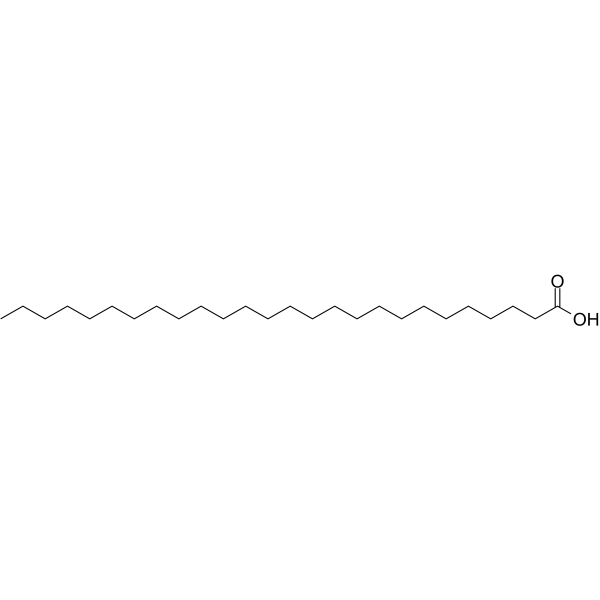
Physicochemical Properties
| Molecular Formula | C26H52O2 |
| Molecular Weight | 396.6899 |
| Exact Mass | 396.396 |
| CAS # | 506-46-7 |
| PubChem CID | 10469 |
| Appearance | White to off-white solid powder |
| Density | 0.9±0.1 g/cm3 |
| Boiling Point | 418.7±8.0 °C at 760 mmHg |
| Melting Point | 86-87 °C |
| Flash Point | 187.6±13.3 °C |
| Vapour Pressure | 0.0±1.0 mmHg at 25°C |
| Index of Refraction | 1.461 |
| LogP | 12.47 |
| Hydrogen Bond Donor Count | 1 |
| Hydrogen Bond Acceptor Count | 2 |
| Rotatable Bond Count | 24 |
| Heavy Atom Count | 28 |
| Complexity | 301 |
| Defined Atom Stereocenter Count | 0 |
| InChi Key | XMHIUKTWLZUKEX-UHFFFAOYSA-N |
| InChi Code | InChI=1S/C26H52O2/c1-2-3-4-5-6-7-8-9-10-11-12-13-14-15-16-17-18-19-20-21-22-23-24-25-26(27)28/h2-25H2,1H3,(H,27,28) |
| Chemical Name | hexacosanoic acid |
| Synonyms | HEXACOSANOIC ACID; 506-46-7; Cerotic acid; Ceratinic acid; Ceric acid; Cerinic acid; Hexacosanic acid; Cerylic acid; |
| HS Tariff Code | 2934.99.9001 |
| Storage |
Powder-20°C 3 years 4°C 2 years In solvent -80°C 6 months -20°C 1 month |
| Shipping Condition | Room temperature (This product is stable at ambient temperature for a few days during ordinary shipping and time spent in Customs) |
Biological Activity
| Targets | Endogenous Metabolite |
| ln Vitro | Hexacosanoic acid (C26:0) (1), a very long-chain fatty acid, is related to various diseases such as adrenoleukodystrophy (ALD), adrenomyeloneuropathy (AMN) and atherosclerosis. As the level of 1 higher than the normal is related to diseases above, hexacosanoic acid (1) and the ceramide 2, which contains 1, are thought to play an important role in various tissues. Hexacosanoic acid (1) is known to be a waxy solid and to be hard to dissolve in water as well as organic solvents. Due to this physical property, it is not easy to handle hexacosanoic acid (1) in a laboratory. Therefore, efficient chemical synthesis of the compounds 1 and 2 has not been reported. Here, we report a versatile synthetic method for hexacosanoic acid (1) and the ceramide 2 containing the fatty acid 1. Synthesis of hexacosanoic acid (1) was achieved by applying the coupling of two alkyl units as a key step. Ceramide 2 was efficiently synthesized by applying the reported procedure together with hexacosanoic acid (1) synthesized here. This synthetic strategy has an advantage of getting various carbon chain length fatty acids and their ceramides by using a variety of carbon chain units. This method is also applicable for large-scale synthesis. In addition, these compounds 1 and 2 are useful for investigation of details of these compounds related to diseases such as ALD and AMN. [1] |
| Toxicity/Toxicokinetics |
Toxicity Summary Adrenoleukodystrophy (ALD) is caused by mutations in ABCD1, a gene located on the X chromosome that codes for ALD, a peroxisomal membrane transporter protein. The exact mechanism of the pathogenesis of the various forms of ALD is not known. Biochemically, individuals with ALD show very high levels of unbranched, saturated, very long chain fatty acids, particularly cerotic acid (26:0). The level of cerotic acid in plasma does not correlate with clinical presentation. Health Effects Hexacosanoic acid, or cerotic acid, is associated with adrenoleukodystrophy (also known as X-linked adrenoleukodystrophy, ALD, X-ALD, adrenomyeloneuropathy, AMN, Siemerling–Creutzfeldt disease or bronze Schilder disease) is a disorder of peroxisomal fatty acid beta oxidation which results in the accumulation of very-long chain fatty acids in tissues throughout the body. The most severely affected tissues are the myelin in the central nervous system, the adrenal cortex and the Leydig cells in the testes. Symptoms Clinically, adrenoleukodystrophy (ALD) is a heterogenous disorder, presenting with several distinct phenotypes, and no clear pattern of genotype-phenotype correlation. As an X-linked disorder, ALD presents most commonly in males, however approximately 50% of heterozygote females show some symptoms later in life. Approximately two-thirds of ALD patients will present with the childhood cerebral form of the disease, which is the most severe form. It is characterized by normal development in early childhood, followed by rapid degeneration to a vegetative state. The other forms of ALD vary in terms of onset and clinical severity, ranging from adrenal insufficiency to progressive paraparesis in early adulthood (this form of the disease is typically known as adrenomyeloneuropathy). Treatment Treatment options for adrenoleukodystrophy (ALD) are limited. Dietary treatment is with Lorenzo's oil. For the childhood cerebral form, stem cell transplant and gene therapy are options if the disease is detected early in the clinical course. Adrenal insufficiency in ALD patients can be successfully treated. |
| References |
[1]. Chemical Synthesis of a Very Long-Chain Fatty Acid, Hexacosanoic Acid (C26:0), and the Ceramide Containing Hexacosanoic Acid. J Nutr Sci Vitaminol (Tokyo). 2015;61(3):222-7. |
| Additional Infomation |
Hexacosanoic acid is a 26-carbon, straight-chain, saturated fatty acid. It is a very long-chain fatty acid, a straight-chain saturated fatty acid and a fatty acid 26:0. It is a conjugate acid of a cerotate. Hexacosanoic acid has been reported in Trichosanthes tricuspidata, Mandragora autumnalis, and other organisms with data available. Hexacosanoic acid, or cerotic acid, is a 26-carbon long-chain saturated fatty acid with the chemical formula CH3(CH2)24COOH. It is most commonly found in beeswax and carnauba wax, and is a white crystalline solid. (Wikipedia) X-linked adrenoleukodystrophy (X-ALD) is a peroxisomal disorder biochemically characterized by the accumulation of very long chain fatty acids (VLCFA), particularly hexacosanoic acid (C(26:0)) and tetracosanoic acid (C(24:0)), in tissues and biological fluids. (A3378) cerotic acid is a metabolite found in or produced by Saccharomyces cerevisiae. - Hexacosanoic acid (C26:0) is a very long-chain fatty acid (VLCFA). Literature [1] focuses on its chemical synthesis and the synthesis of ceramide containing this fatty acid [1] - The chemical synthesis of Hexacosanoic acid reported in [1] uses commercially available short-chain fatty acid derivatives as starting materials. The synthesis process includes key steps such as carboxyl group protection, carbon chain extension via iterative reactions (to reach 26 carbon atoms), and final deprotection to obtain pure Hexacosanoic acid with a confirmed structure (via nuclear magnetic resonance spectroscopy and mass spectrometry) [1] - In addition, [1] also describes the synthesis of ceramide containing Hexacosanoic acid: Hexacosanoic acid is first activated to form an acyl chloride derivative, which then reacts with a sphingosine derivative (with protected amino and hydroxyl groups) to form an amide bond, followed by deprotection to yield the target ceramide [1] - Hexacosanoic acid is naturally present in small amounts in some biological tissues (e.g., mammalian brain and skin) and is a component of certain sphingolipids (such as ceramides), [1] |
Solubility Data
| Solubility (In Vitro) | THF : 5.56 mg/mL (~14.02 mM) |
| Solubility (In Vivo) |
Note: Listed below are some common formulations that may be used to formulate products with low water solubility (e.g. < 1 mg/mL), you may test these formulations using a minute amount of products to avoid loss of samples. Injection Formulations (e.g. IP/IV/IM/SC) Injection Formulation 1: DMSO : Tween 80: Saline = 10 : 5 : 85 (i.e. 100 μL DMSO stock solution → 50 μL Tween 80 → 850 μL Saline) *Preparation of saline: Dissolve 0.9 g of sodium chloride in 100 mL ddH ₂ O to obtain a clear solution. Injection Formulation 2: DMSO : PEG300 :Tween 80 : Saline = 10 : 40 : 5 : 45 (i.e. 100 μL DMSO → 400 μLPEG300 → 50 μL Tween 80 → 450 μL Saline) Injection Formulation 3: DMSO : Corn oil = 10 : 90 (i.e. 100 μL DMSO → 900 μL Corn oil) Example: Take the Injection Formulation 3 (DMSO : Corn oil = 10 : 90) as an example, if 1 mL of 2.5 mg/mL working solution is to be prepared, you can take 100 μL 25 mg/mL DMSO stock solution and add to 900 μL corn oil, mix well to obtain a clear or suspension solution (2.5 mg/mL, ready for use in animals). Injection Formulation 4: DMSO : 20% SBE-β-CD in saline = 10 : 90 [i.e. 100 μL DMSO → 900 μL (20% SBE-β-CD in saline)] *Preparation of 20% SBE-β-CD in Saline (4°C,1 week): Dissolve 2 g SBE-β-CD in 10 mL saline to obtain a clear solution. Injection Formulation 5: 2-Hydroxypropyl-β-cyclodextrin : Saline = 50 : 50 (i.e. 500 μL 2-Hydroxypropyl-β-cyclodextrin → 500 μL Saline) Injection Formulation 6: DMSO : PEG300 : castor oil : Saline = 5 : 10 : 20 : 65 (i.e. 50 μL DMSO → 100 μLPEG300 → 200 μL castor oil → 650 μL Saline) Injection Formulation 7: Ethanol : Cremophor : Saline = 10: 10 : 80 (i.e. 100 μL Ethanol → 100 μL Cremophor → 800 μL Saline) Injection Formulation 8: Dissolve in Cremophor/Ethanol (50 : 50), then diluted by Saline Injection Formulation 9: EtOH : Corn oil = 10 : 90 (i.e. 100 μL EtOH → 900 μL Corn oil) Injection Formulation 10: EtOH : PEG300:Tween 80 : Saline = 10 : 40 : 5 : 45 (i.e. 100 μL EtOH → 400 μLPEG300 → 50 μL Tween 80 → 450 μL Saline) Oral Formulations Oral Formulation 1: Suspend in 0.5% CMC Na (carboxymethylcellulose sodium) Oral Formulation 2: Suspend in 0.5% Carboxymethyl cellulose Example: Take the Oral Formulation 1 (Suspend in 0.5% CMC Na) as an example, if 100 mL of 2.5 mg/mL working solution is to be prepared, you can first prepare 0.5% CMC Na solution by measuring 0.5 g CMC Na and dissolve it in 100 mL ddH2O to obtain a clear solution; then add 250 mg of the product to 100 mL 0.5% CMC Na solution, to make the suspension solution (2.5 mg/mL, ready for use in animals). Oral Formulation 3: Dissolved in PEG400 Oral Formulation 4: Suspend in 0.2% Carboxymethyl cellulose Oral Formulation 5: Dissolve in 0.25% Tween 80 and 0.5% Carboxymethyl cellulose Oral Formulation 6: Mixing with food powders Note: Please be aware that the above formulations are for reference only. InvivoChem strongly recommends customers to read literature methods/protocols carefully before determining which formulation you should use for in vivo studies, as different compounds have different solubility properties and have to be formulated differently. (Please use freshly prepared in vivo formulations for optimal results.) |
| Preparing Stock Solutions | 1 mg | 5 mg | 10 mg | |
| 1 mM | 2.5209 mL | 12.6043 mL | 25.2086 mL | |
| 5 mM | 0.5042 mL | 2.5209 mL | 5.0417 mL | |
| 10 mM | 0.2521 mL | 1.2604 mL | 2.5209 mL |