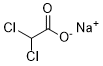
Dichloroacetate (CPC-211; DCA; X-11S) is a potent and specific inhibitor of pyruvate dehydrogenase kinase (PDK) with IC50 values of 183 and 80 μM for PDK2 and PDK4 respectively. It has the potential for the treatment of myocardia ischemia. Dichloroacetate has been shown to derepress a mitochondrial potassium-ion channel axis, trigger apoptosis in cancer cells, and inhibit tumor growth. DCA can trigger apoptosis of human lung, breast and brain cancer cells. After DCA treatment, cancer cells shows increased levels of ROS, depolarization of the MMP in vitro and increased apoptosis both in vitro and in vivo.
Physicochemical Properties
| Molecular Formula | C2HCL2O2.NA | |
| Molecular Weight | 150.92 | |
| Exact Mass | 149.925 | |
| Elemental Analysis | C, 15.92; H, 0.67; Cl, 46.98; Na, 15.23; O, 21.20 | |
| CAS # | 2156-56-1 | |
| Related CAS # |
|
|
| PubChem CID | 517326 | |
| Appearance | White to off-white solid powder | |
| Boiling Point | 194ºC at 760mmHg | |
| Melting Point | 198 °C (dec.)(lit.) | |
| Vapour Pressure | 0.196mmHg at 25°C | |
| Hydrogen Bond Donor Count | 0 | |
| Hydrogen Bond Acceptor Count | 2 | |
| Rotatable Bond Count | 1 | |
| Heavy Atom Count | 7 | |
| Complexity | 64.7 | |
| Defined Atom Stereocenter Count | 0 | |
| InChi Key | LUPNKHXLFSSUGS-UHFFFAOYSA-M | |
| InChi Code | InChI=1S/C2H2Cl2O2.Na/c3-1(4)2(5)6;/h1H,(H,5,6);/q;+1/p-1 | |
| Chemical Name | sodium;2,2-dichloroacetate | |
| Synonyms |
|
|
| HS Tariff Code | 2934.99.9001 | |
| Storage |
Powder-20°C 3 years 4°C 2 years In solvent -80°C 6 months -20°C 1 month Note: Please store this product in a sealed and protected environment, avoid exposure to moisture. |
|
| Shipping Condition | Room temperature (This product is stable at ambient temperature for a few days during ordinary shipping and time spent in Customs) |
Biological Activity
| Targets | Apoptosis; ROS/Reactive oxygen species; PDHK; NKCC | ||
| ln Vitro | In mitochondria, sodium dichloroacetate promotes the production of ROS. Sodium dichloroacetate influences cell viability and growth by increasing the production of reactive oxygen species (ROS) that arises from oxidative metabolism promotion. Pyruvate dehydrogenase kinases (PDK) inhibition, restored pyruvate dehydrogenase (PDH) activity, and the promotion of oxidative metabolism in conjunction with increased intracellular ROS production—all of which are dependent on the dosage of sodium dichloroacetate—were linked to the effects of sodium dichloroacetate on multiple myeloma cell viability, cell cycle arrest, and apoptotic cell death. In rat VM-M3 glioblastoma cells, the effects of sodium dichloroacetate combined with CI inhibition to promote oxidative stress. Elevated reactive oxygen species (ROS) in cancer cells treated with sodium dichloroacetate are linked to apoptosis induction brought on by elevated cytochrome c expression. T-cell differentiation is dependent on ROS and is induced by sodium dichloroacetate[1]. | ||
| ln Vivo | When male gonad-intact and castrated rats are treated with sodium dichloroacetate, the levels of NKCC1 RNA expression are markedly reduced; in contrast, no such effect is observed in female gonad-intact and castrated rats treated with sodium dichloroacetate[1]. In Wistar male rats, a single dose of sodium dichloroacetate results in a noticeably greater 24-hour diuresis; this increased diuresis is associated with NKCC2 inhibition. When comparing the kidneys of intact male and female Sprague-Dawley rats, the kidneys of intact female rats have more NKCC2 than the kidneys of intact male rats[1]. When male rats who are naïve are dosed 5, 20, and 100 mg/kg of sodium dichloroacetate orally, their bioavailability is significantly lower than that of rats whose GSTζ is depleted (10%, 13%, 81%, and 31%, 75%, 100%, respectively). Rats depleted of GSTζ exhibit linear kinetics for the liver extraction of sodium dichloroacetate; however, at higher doses, this process decreases with metabolism saturation[1]. | ||
| Enzyme Assay | Sodium dichloroacetate (DCA) is eliminated mainly through GSTζ-catalyzed dechlorination to glyoxylic acid, which is further metabolized by mitochondrial or cytosolic enzymes. Sodium dichloroacetate can also be dechlorinated to monochloroacetic acid in the blood. The metabolism of DCA in rodents decreases for prolonged administration as DCA expresses a fast effect in inhibiting its own metabolism after the first dosing, and an increased inhibition was noted after the second oral dosing in male rats by inhibiting GSTζ. In the pharmacokinetic model, measuring plasma DCA concentrations in naive and male rats and mice pretreated with 2 g/L DCA in drinking water, the estimated reduction in DCA metabolism among naive and 2 g/L pretreated rodents was 99% in rats and 76% in mice, showing significant species-related differences in DCA degradation. The rate constants for DCA-dependent GSTζ inactivation in mouse, rat, and human liver cytosol were different as rat > mouse > human [1]. | ||
| Cell Assay | Sodium dichloroacetate (DCA) affects cell growth and viability through the ROS production increase derived from the promotion of oxidative metabolism. The effects of DCA on multiple myeloma cell viability, cell cycle arrest, and apoptotic cell death were associated with PDK inhibition, restored PDH activity, and the promotion of oxidative metabolism in association with increased intracellular ROS production which depends on the DCA dose. The DCA effect cooperated with C I inhibition promoting the oxidative stress in rat VM-M3 glioblastoma cells. Increased ROS levels in DCA-treated cancer cells were related to the induction of apoptosis associated with the increased cytochrome c expression.[1] | ||
| Animal Protocol |
|
||
| References |
[1]. The Importance of Gender-Related Anticancer Research on Mitochondrial Regulator Sodium Dichloroacetate in Preclinical Studies In Vivo. Cancers (Basel). 2019 Aug 20;11(8). pii: E1210. |
||
| Additional Infomation |
Sodium Dichloroacetate is the sodium salt of dichloroacetic acid with potential antineoplastic activity. Dichloroacetate ion inhibits pyruvate dehydrogenase kinase, resulting in the inhibition of glycolysis and a decrease in lactate production. This agent may stimulate apoptosis in cancer cells by restoring normal mitochondrial-induced apoptotic signaling. A derivative of ACETIC ACID that contains two CHLORINE atoms attached to its methyl group. |
Solubility Data
| Solubility (In Vitro) |
|
|||
| Solubility (In Vivo) |
Solubility in Formulation 1: ≥ 2.25 mg/mL (14.91 mM) (saturation unknown) in 10% DMSO + 40% PEG300 + 5% Tween80 + 45% Saline (add these co-solvents sequentially from left to right, and one by one), clear solution. For example, if 1 mL of working solution is to be prepared, you can add 100 μL of 22.5 mg/mL clear DMSO stock solution to 400 μL PEG300 and mix evenly; then add 50 μL Tween-80 to the above solution and mix evenly; then add 450 μL normal saline to adjust the volume to 1 mL. Preparation of saline: Dissolve 0.9 g of sodium chloride in 100 mL ddH₂ O to obtain a clear solution. Solubility in Formulation 2: ≥ 2.25 mg/mL (14.91 mM) (saturation unknown) in 10% DMSO + 90% (20% SBE-β-CD in Saline) (add these co-solvents sequentially from left to right, and one by one), clear solution. For example, if 1 mL of working solution is to be prepared, you can add 100 μL of 22.5 mg/mL clear DMSO stock solution to 900 μL of 20% SBE-β-CD physiological saline solution and mix evenly. Preparation of 20% SBE-β-CD in Saline (4°C,1 week): Dissolve 2 g SBE-β-CD in 10 mL saline to obtain a clear solution. Solubility in Formulation 3: ≥ 2.25 mg/mL (14.91 mM) (saturation unknown) in 10% DMSO + 90% Corn Oil (add these co-solvents sequentially from left to right, and one by one), clear solution. For example, if 1 mL of working solution is to be prepared, you can add 100 μL of 22.5 mg/mL clear DMSO stock solution to 900 μL of corn oil and mix evenly. Solubility in Formulation 4: 100 mg/mL (662.60 mM) in PBS (add these co-solvents sequentially from left to right, and one by one), clear solution; with ultrasonication. (Please use freshly prepared in vivo formulations for optimal results.) |
| Preparing Stock Solutions | 1 mg | 5 mg | 10 mg | |
| 1 mM | 6.6260 mL | 33.1301 mL | 66.2603 mL | |
| 5 mM | 1.3252 mL | 6.6260 mL | 13.2521 mL | |
| 10 mM | 0.6626 mL | 3.3130 mL | 6.6260 mL |