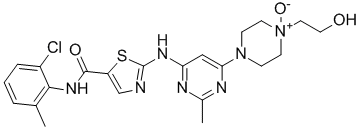
Dasatinib N-oxide is a major and N-oxidated metabolite of Dasatinib (BMS354825; Sprycel), which is an approved anticancer drug acting as a dual Bcr-Abl and Src kinase inhibitor. It is also an impurity during the production of dasatinib.
Physicochemical Properties
| Molecular Formula | C22H26N7O3SCL |
| Molecular Weight | 504.01 |
| Exact Mass | 503.151 |
| Elemental Analysis | C, 52.43 H, 5.20 Cl, 7.03 N, 19.45 O, 9.52 S, 6.36 |
| CAS # | 910297-52-8 |
| Related CAS # | Dasatinib N-oxide-d8;1189988-36-0; Dasatinib hydrochloride;854001-07-3;Dasatinib monohydrate;863127-77-9;Dasatinib-d8;1132093-70-9; 302962-49-8 (free); 2112837-79-1 (cabaldehyde); 910297-52-8 (N-oxide) |
| PubChem CID | 11854535 |
| Appearance | White to off-white solid powder |
| LogP | 3.806 |
| Hydrogen Bond Donor Count | 3 |
| Hydrogen Bond Acceptor Count | 9 |
| Rotatable Bond Count | 7 |
| Heavy Atom Count | 34 |
| Complexity | 687 |
| Defined Atom Stereocenter Count | 0 |
| InChi Key | UEFNEEZCTQCRAW-UHFFFAOYSA-N InChi Code |
| InChi Code | InChI=1S/C22H26ClN7O3S/c1-14-4-3-5-16(23)20(14)28-21(32)17-13-24-22(34-17)27-18-12-19(26-15(2)25-18)29-6-8-30(33,9-7-29)10-11-31/h3-5,12-13,31H,6-11H2,1-2H3,(H,28,32)(H,24,25,26,27) |
| Chemical Name | N-(2-chloro-6-methylphenyl)-2-[[6-[4-(2-hydroxyethyl)-4-oxido-1-piperazinyl]-2-methyl-4-pyrimidinyl]amino]-5-thiazolecarboxamide |
| Synonyms | BMS-354825 N-oxide; Dasatinib N-Oxide; 910297-52-8; Dasatinib metabolite M5; B16WQA6880; BMS-606181; 5-Thiazolecarboxamide, N-(2-chloro-6-methylphenyl)-2-((6-(4-(2-hydroxyethyl)-4-oxido-1-piperazinyl)-2-methyl-4-pyrimidinyl)amino)-; N-(2-Chloro-6-methyl-phenyl)-2-((6-(4-(2-hydroxyethyl)-4-oxido-piperazin-4-ium-1-yl)-2-methyl-pyrimidin-4-yl)amino)thiazole-5-carboxamide; N-(2-chloro-6-methylphenyl)-2-[[6-[4-(2-hydroxyethyl)-4-oxido-1-piperazinyl]-2-methyl-4-pyrimidinyl]amino]-5-thiazolecarboxamide; |
| HS Tariff Code | 2934.99.9001 |
| Storage |
Powder-20°C 3 years 4°C 2 years In solvent -80°C 6 months -20°C 1 month Note: This product requires protection from light (avoid light exposure) during transportation and storage. |
| Shipping Condition | Room temperature (This product is stable at ambient temperature for a few days during ordinary shipping and time spent in Customs) |
Biological Activity
| Targets | Active metabolite of Dasatinib; Src/Bcr-Abl |
| ln Vitro | Dasatinib (Sprycel) is a potent antitumor agent prescribed for patients with chronic myeloid leukemia (CML). To enable reliable quantification of dasatinib and its pharmacologically active metabolites in human plasma during clinical testing, a sensitive and reliable liquid chromatography-tandem mass spectrometry (LC-MS/MS) method was developed and validated. Samples were prepared using solid phase extraction on Oasis HLB 96-well plates. Chromatographic separation was achieved isocratically on a Luna phenyl-hexyl analytical column. Analytes and the stable labeled internal standards were detected by positive ion electrospray tandem mass spectrometry. The assay was validated over a concentration range of 1.00-1000 ng/mL for dasatinib and its two active metabolites. Intra- and inter-assay precision values for replicate QC control samples were within 5.3% for all analytes during the assay validation. Mean QC control accuracy values were within ± 9.0% of nominal values for all analytes. Assay recoveries were high (>79%) and internal standard normalized matrix effects were minimal. The three analytes were stable in human plasma for at least 22 h at room temperature, for at least 123 days at -20°C, and following at least six freeze-thaw cycles. The validated method was successfully applied to the quantification of dasatinib and two active metabolites in a human pharmacokinetic study[2]. |
| ln Vivo | Following oral treatment, dasatinib N-oxide is a metabolite that exhibits pharmacological activity [1]. |
| Animal Protocol | SPRYCEL (dasatinib, BMS-354825; Bristol-Myers Squibb, Princeton, NJ), a multiple kinase inhibitor, is currently approved to treat chronic myelogenous leukemia and Philadelphia chromosome-positive acute lymphoblastic leukemia tumors in patients who are resistant or intolerant to imatinib mesylate (Gleevec; Novartis, Basel, Switzerland). After a 100-mg single p.o. dose of [(14)C]dasatinib to healthy volunteers, the radioactivity was rapidly absorbed (T(max) approximately 0.5 h). Both dasatinib and total radioactivity (TRA) plasma concentrations decreased rapidly with elimination half-life values of <4 h. Dasatinib was the major drug-related component in human plasma. At 2 h, dasatinib accounted for 25% of the TRA in plasma, suggesting that metabolites contributed significantly to the total drug-related component. There were many circulating metabolites detected that included hydroxylated metabolites (M20 and M24), an N-dealkylated metabolite (M4), an N-oxide (M5), an acid metabolite (M6), glucuronide conjugates (M8a,b), and products of further metabolism of these primary metabolites. Most of the administered radioactivity was eliminated in the feces (85%). Urine recovery accounted for <4% of the dose. Dasatinib accounted for <1 and 19% of the dose in urine and feces, respectively, suggesting that dasatinib was well absorbed after p.o. administration and extensively metabolized before being eliminated from the body. The exposures of pharmacologically active metabolites M4, M5, M6, M20, and M24 in patients, along with their cell-based IC(50) for Src and Bcr-Abl kinase inhibition, suggested that these metabolites were not expected to contribute significantly toward in vivo activity.[1] |
| References |
[1]. Metabolism and disposition of dasatinib after oral administration to humans. Drug Metab Dispos. 2008 Jul;36(7):1357-64. [2]. A validated LC-MS/MS assay for the simultaneous determination of the anti-leukemic agent dasatinib and two pharmacologically active metabolites in human plasma: application to a clinical pharmacokinetic study. J Pharm Biomed Anal. 2012. |
| Additional Infomation | Dasatinib n-oxide is an aromatic amide. |
Solubility Data
| Solubility (In Vitro) | DMSO : ~8.33 mg/mL (~16.53 mM) |
| Solubility (In Vivo) |
Solubility in Formulation 1: ≥ 0.83 mg/mL (1.65 mM) (saturation unknown) in 10% DMSO + 40% PEG300 + 5% Tween80 + 45% Saline (add these co-solvents sequentially from left to right, and one by one), clear solution. For example, if 1 mL of working solution is to be prepared, you can add 100 μL of 8.3 mg/mL clear DMSO stock solution to 400 μL of PEG300 and mix evenly; then add 50 μL of Tween-80 to the above solution and mix evenly; then add 450 μL of normal saline to adjust the volume to 1 mL. Preparation of saline: Dissolve 0.9 g of sodium chloride in 100 mL ddH₂ O to obtain a clear solution. Solubility in Formulation 2: ≥ 0.83 mg/mL (1.65 mM) (saturation unknown) in 10% DMSO + 90% (20% SBE-β-CD in Saline) (add these co-solvents sequentially from left to right, and one by one), clear solution. For example, if 1 mL of working solution is to be prepared, you can add 100 μL of 8.3 mg/mL clear DMSO stock solution to 900 μL of 20% SBE-β-CD physiological saline solution and mix evenly. Preparation of 20% SBE-β-CD in Saline (4°C,1 week): Dissolve 2 g SBE-β-CD in 10 mL saline to obtain a clear solution. Solubility in Formulation 3: ≥ 0.83 mg/mL (1.65 mM) (saturation unknown) in 10% DMSO + 90% Corn Oil (add these co-solvents sequentially from left to right, and one by one), clear solution. For example, if 1 mL of working solution is to be prepared, you can add 100 μL of 8.3 mg/mL clear DMSO stock solution to 900 μL of corn oil and mix evenly. (Please use freshly prepared in vivo formulations for optimal results.) |
| Preparing Stock Solutions | 1 mg | 5 mg | 10 mg | |
| 1 mM | 1.9841 mL | 9.9204 mL | 19.8409 mL | |
| 5 mM | 0.3968 mL | 1.9841 mL | 3.9682 mL | |
| 10 mM | 0.1984 mL | 0.9920 mL | 1.9841 mL |