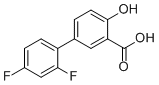
Diflunisal (also known as MK-647; trade name Dolobid) is a novel and potent salicylate derivative with nonsteroidal anti-inflammatory and uricosuric properties, it is used alone as an analgesic and in rheumatoid arthritis patients. Diflunisal acts as a Cyclooxygenase (COX) inhibitor and was developed by Merck Sharp & Dohme in 1971 after showing promise in a research project studying more potent chemical analogs of aspirin. It is classed as a non-steroidal anti-inflammatory drug (NSAID).
Physicochemical Properties
| Molecular Formula | C13H8F2O3 |
| Molecular Weight | 250.1976 |
| Exact Mass | 250.044 |
| CAS # | 22494-42-4 |
| Related CAS # | Diflunisal-d3;1286107-99-0 |
| PubChem CID | 3059 |
| Appearance | White to off-white solid powder |
| Density | 1.4±0.1 g/cm3 |
| Boiling Point | 386.9±42.0 °C at 760 mmHg |
| Melting Point | 32-36 °C |
| Flash Point | 187.8±27.9 °C |
| Vapour Pressure | 0.0±0.9 mmHg at 25°C |
| Index of Refraction | 1.601 |
| LogP | 4.44 |
| Hydrogen Bond Donor Count | 2 |
| Hydrogen Bond Acceptor Count | 5 |
| Rotatable Bond Count | 2 |
| Heavy Atom Count | 18 |
| Complexity | 311 |
| Defined Atom Stereocenter Count | 0 |
| InChi Key | HUPFGZXOMWLGNK-UHFFFAOYSA-N |
| InChi Code | InChI=1S/C13H8F2O3/c14-8-2-3-9(11(15)6-8)7-1-4-12(16)10(5-7)13(17)18/h1-6,16H,(H,17,18) |
| Chemical Name | 2',4'-difluoro-4-hydroxy-[1,1'-biphenyl]-3-carboxylic acid |
| Synonyms | MK-647; MK647; MK 647; trade names: Dolobid; Dolobis; Flovacil; Fluniget; Fluodonil; Dflunisal |
| HS Tariff Code | 2934.99.9001 |
| Storage |
Powder-20°C 3 years 4°C 2 years In solvent -80°C 6 months -20°C 1 month |
| Shipping Condition | Room temperature (This product is stable at ambient temperature for a few days during ordinary shipping and time spent in Customs) |
Biological Activity
| ln Vivo | Rats given increasing dosages of diflunisal showed that the pharmacokinetics of the drug are complexly influenced by dose. Diflunisal exhibits an exponential drop in plasma concentration over time, whereas its half-life increases when the dosage is increased. When the dose was increased from 3 to 10 mg/kg, CLP dramatically dropped and subsequently stayed mostly stable throughout the 10 mg/kg to 60 mg/kg treatment range. It has been demonstrated that diflunisal binds strongly and concentration-dependently to the plasma proteins of rats. In the range of 5 to 300 μg/mL, there was an approximate 10-fold increase in the proportion of unbound diflunisal [1]. Following oral administration, diflunisal has an activity that is roughly 25 times more than aspirin, 3 times greater than glafenine, and 2 times greater than zomelar [2]. |
| ADME/Pharmacokinetics |
Absorption, Distribution and Excretion Rapidly and completely absorbed following oral administration, with a bioavailability of 80-90%. Peak plasma concentrations are achieved 2 - 3 hours following oral administration. The drug is excreted in the urine as two soluble glucuronide conjugates accounting for about 90% of the administered dose. Little or no diflunisal is excreted in the feces. Metabolism / Metabolites Hepatic, primarily via glucuronide conjugation (90% of administered dose). Hepatic, primarily via glucuronide conjugation (90% of administered dose). Route of Elimination: The drug is excreted in the urine as two soluble glucuronide conjugates accounting for about 90% of the administered dose. Little or no diflunisal is excreted in the feces. Half Life: 8 to 12 hours Biological Half-Life 8 to 12 hours |
| Toxicity/Toxicokinetics |
Toxicity Summary The precise mechanism of the analgesic and anti-inflammatory actions of diflunisal is not known. Diflunisal is a prostaglandin synthetase inhibitor. In animals, prostaglandins sensitize afferent nerves and potentiate the action of bradykinin in inducing pain. Since prostaglandins are known to be among the mediators of pain and inflammation, the mode of action of diflunisal may be due to a decrease of prostaglandins in peripheral tissues. Hepatotoxicity Diflunisal therapy is reported to be associated with a low rate of asymptomatic and transient serum aminotransferase elevations, which may resolve even with drug continuation. Marked aminotransferase elevations (>3 fold elevated) occur rarely. Clinically apparent liver injury with jaundice from diflunisal is uncommon; only case reports have been published. The clinical and histologic features of diflunisal hepatotoxicity, however, are distinct and resemble an immunoallergic hepatitis, which is quite different from the liver injury that occurs with aspirin or other salicylates (Case 1). The latency to onset ranges from 1 to 4 weeks and the pattern of enzyme elevations is typically cholestatic, but can also be mixed. Most patients have immunoallergic manifestations such as rash, fever and arthralgias; eosinophilia or atypical lymphocytosis are also common. A history of aspirin allergy has not been reported among cases with allergic reactions to diflunisal. Diflunisal is not a commonly used drug and is not mentioned in large case series on drug induced liver injury or acute liver failure. Likelihood score: C (probable cause of clinically apparent liver injury). Effects During Pregnancy and Lactation ◉ Summary of Use during Lactation The small amounts of diflunisal in milk do not appear to pose a serious risk to breastfeeding infants. However, a shorter-acting agent having more published information may be preferred, especially while nursing a newborn or preterm infant. ◉ Effects in Breastfed Infants Relevant published information was not found as of the revision date. ◉ Effects on Lactation and Breastmilk Relevant published information was not found as of the revision date. Protein Binding At least 98 to 99% of diflunisal in plasma is bound to proteins. Toxicity Data LD50: 392 mg/kg (Oral, Rat) (A308) LD50: 439 mg/kg (Oral, Mouse) (A308) LD50: 603 mg/kg (Oral, Rabbit) (A308) |
| References |
[1]. Dose-dependent pharmacokinetics of diflunisal in rats: dual effects of protein binding and metabolism. J Pharmacol Exp Ther. 1985 Nov;235(2):402-6. [2]. Analgesic activity of diflunisal [MK-647; 5-(2,4-difluorophenyl)salicylic acid] in rats with hyperalgesia induced by Freund's adjuvant. J Pharmacol Exp Ther. 1979 Dec;211(3):678-85. [3]. Relationship between cyclooxygenase 1 and 2 selective inhibitors and fetal development when administered to rats and rabbits during the sensitive periods for heart development and midline closure. Birth Defects Res B Dev Reprod Toxicol. |
| Additional Infomation |
Diflunisal can cause developmental toxicity and female reproductive toxicity according to state or federal government labeling requirements. Diflunisal is an organofluorine compound comprising salicylic acid having a 2,4-difluorophenyl group at the 5-position. It has a role as a non-steroidal anti-inflammatory drug and a non-narcotic analgesic. It is an organofluorine compound and a monohydroxybenzoic acid. It is functionally related to a salicylic acid and a 1,3-difluorobenzene. Diflunisal, a salicylate derivative, is a nonsteroidal anti-inflammatory agent (NSAIA) with pharmacologic actions similar to other prototypical NSAIAs. Diflunisal possesses anti-inflammatory, analgesic and antipyretic activity. Though its mechanism of action has not been clearly established, most of its actions appear to be associated with inhibition of prostaglandin synthesis via the arachidonic acid pathway. Diflunisal is used to relieve pain accompanied with inflammation and in the symptomatic treatment of rheumatoid arthritis and osteoarthritis. Diflunisal is a Nonsteroidal Anti-inflammatory Drug. The mechanism of action of diflunisal is as a Cyclooxygenase Inhibitor. Diflunisal is a salicylic acid derivative that is used in the therapy of chronic arthritis and mild to moderate acute pain. Diflunisal has been linked mild, transient elevations in serum aminotransferase levels during therapy as well as to rare instances of idiosyncratic drug induced liver disease. Diflunisal is a difluorophenyl derivate of salicylic acid and a nonsteroidal anti-inflammatory drug (NSAID) with antipyretic, analgesic and anti-inflammatory properties. Diflunisal competitively inhibits both cyclooxygenase (COX) -1 and -2, with higher affinity for COX-1, and subsequently blocks the conversion of arachidonic acid to prostaglandin precursors. This leads to an inhibition of the formation of prostaglandins that are involved in pain, inflammation and fever. Diflunisal differs from other salicylates, in that it is not metabolized to salicylic acid, hence it has a longer half-life. Diflunisal, a salicylate derivative, is a nonsteroidal anti-inflammatory agent (NSAIA) with pharmacologic actions similar to other prototypical NSAIAs. Diflunisal possesses anti-inflammatory, analgesic and antipyretic activity. Though its mechanism of action has not been clearly established, most of its actions appear to be associated with inhibition of prostaglandin synthesis via the arachidonic acid pathway. Diflunisal is used to relieve pain accompanied with inflammation and in the symptomatic treatment of rheumatoid arthritis and osteoarthritis. A salicylate derivative and anti-inflammatory analgesic with actions and side effects similar to those of ASPIRIN. See also: Diflunisal sodium (is active moiety of). Drug Indication For symptomatic treatment of mild to moderate pain accompanied by inflammation (e.g. musculoskeletal trauma, post-dental extraction, post-episiotomy), osteoarthritis, and rheumatoid arthritis. FDA Label Mechanism of Action The precise mechanism of the analgesic and anti-inflammatory actions of diflunisal is not known. Diflunisal is a prostaglandin synthetase inhibitor. In animals, prostaglandins sensitize afferent nerves and potentiate the action of bradykinin in inducing pain. Since prostaglandins are known to be among the mediators of pain and inflammation, the mode of action of diflunisal may be due to a decrease of prostaglandins in peripheral tissues. Pharmacodynamics Diflunisal is a nonsteroidal drug with analgesic, anti-inflammatory and antipyretic properties. It is a peripherally-acting non-narcotic analgesic drug. Habituation, tolerance and addiction have not been reported. Diflunisal is a difluorophenyl derivative of salicylic acid. Chemically, diflunisal differs from aspirin (acetylsalicylic acid) in two respects. The first of these two is the presence of a difluorophenyl substituent at carbon 1. The second difference is the removal of the 0-acetyl group from the carbon 4 position. Diflunisal is not metabolized to salicylic acid, and the fluorine atoms are not displaced from the difluorophenyl ring structure. |
Solubility Data
| Solubility (In Vitro) | DMSO : ~50 mg/mL (~199.84 mM) |
| Solubility (In Vivo) |
Solubility in Formulation 1: ≥ 2.5 mg/mL (9.99 mM) (saturation unknown) in 10% DMSO + 40% PEG300 + 5% Tween80 + 45% Saline (add these co-solvents sequentially from left to right, and one by one), clear solution. For example, if 1 mL of working solution is to be prepared, you can add 100 μL of 25.0 mg/mL clear DMSO stock solution to 400 μL PEG300 and mix evenly; then add 50 μL Tween-80 to the above solution and mix evenly; then add 450 μL normal saline to adjust the volume to 1 mL. Preparation of saline: Dissolve 0.9 g of sodium chloride in 100 mL ddH₂ O to obtain a clear solution. Solubility in Formulation 2: ≥ 2.5 mg/mL (9.99 mM) (saturation unknown) in 10% DMSO + 90% Corn Oil (add these co-solvents sequentially from left to right, and one by one), clear solution. For example, if 1 mL of working solution is to be prepared, you can add 100 μL of 25.0 mg/mL clear DMSO stock solution to 900 μL of corn oil and mix evenly. (Please use freshly prepared in vivo formulations for optimal results.) |
| Preparing Stock Solutions | 1 mg | 5 mg | 10 mg | |
| 1 mM | 3.9968 mL | 19.9840 mL | 39.9680 mL | |
| 5 mM | 0.7994 mL | 3.9968 mL | 7.9936 mL | |
| 10 mM | 0.3997 mL | 1.9984 mL | 3.9968 mL |