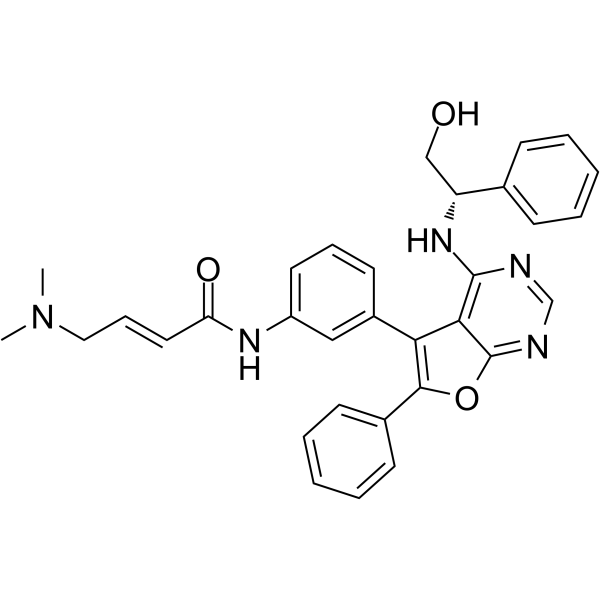
Physicochemical Properties
| Molecular Formula | C32H31N5O3 |
| Molecular Weight | 533.6202 |
| Exact Mass | 533.242 |
| CAS # | 1226549-49-0 |
| PubChem CID | 46212971 |
| Appearance | Off-white to light yellow solid powder |
| LogP | 4.9 |
| Hydrogen Bond Donor Count | 3 |
| Hydrogen Bond Acceptor Count | 7 |
| Rotatable Bond Count | 10 |
| Heavy Atom Count | 40 |
| Complexity | 812 |
| Defined Atom Stereocenter Count | 1 |
| SMILES | O1C2C(=C(N=C([H])N=2)N([H])[C@]([H])(C([H])([H])O[H])C2C([H])=C([H])C([H])=C([H])C=2[H])C(C2C([H])=C([H])C([H])=C(C=2[H])N([H])C(/C(/[H])=C(\[H])/C([H])([H])N(C([H])([H])[H])C([H])([H])[H])=O)=C1C1C([H])=C([H])C([H])=C([H])C=1[H] |
| InChi Key | NQAMTZUVRFRJCZ-VMMYIZNOSA-N |
| InChi Code | InChI=1S/C32H31N5O3/c1-37(2)18-10-17-27(39)35-25-16-9-15-24(19-25)28-29-31(36-26(20-38)22-11-5-3-6-12-22)33-21-34-32(29)40-30(28)23-13-7-4-8-14-23/h3-17,19,21,26,38H,18,20H2,1-2H3,(H,35,39)(H,33,34,36)/b17-10+/t26-/m1/s1 |
| Chemical Name | (E)-4-(dimethylamino)-N-[3-[4-[[(1S)-2-hydroxy-1-phenylethyl]amino]-6-phenylfuro[2,3-d]pyrimidin-5-yl]phenyl]but-2-enamide |
| HS Tariff Code | 2934.99.9001 |
| Storage |
Powder-20°C 3 years 4°C 2 years In solvent -80°C 6 months -20°C 1 month |
| Shipping Condition | Room temperature (This product is stable at ambient temperature for a few days during ordinary shipping and time spent in Customs) |
Biological Activity
| Targets | EGFRL858R/T790M 48 nM (IC50) EGFRWT 15 nM (IC50) |
| ln Vitro | In a dose-dependent manner, DBPR112 (compound 78; 0.32-1000 nM; 16 hours) reduces phosphorylated EGFR[1]. HCC827 (CC50=25 nM), H1975 (CC50=620 nM), and A431 Cell (CC50=1.02 μM) cell lines are all inhibited by DBPR112[1]. With its occupation of the ATP-binding site and its interactions—covalent, hydrogen, and hydrophobic—with neighboring residues, DBPR112 exhibits a strong inhibitory effect on WT EGFR[1]. |
| ln Vivo | In the HCC827 tumor model, DBPR112 (orally administered at 20–50 mg/kg, five days per week for two weeks in a row) dramatically slows tumor growth. In the H1975 tumor model, DBPR112 (orally; 50 mg/kg; once daily for 15 days) significantly inhibits tumor development (mean tumor growth suppression of 34%)[1]. The T1/2, CL, and Vss of DBPR112 (IV; 5 mg/kg) in rats are 2.3 hours, 55.6 mL/min·kg, and 8.6 L/kg, respectively[1]. |
| Cell Assay |
Western Blot Analysis[1] Cell Types: H1975 cells Tested Concentrations: 0.32, 1.6, 8.0, 40, 200, 1000 nM Incubation Duration: 16 hrs (hours) Experimental Results: Induced reduction of phosphorylated EGFR in a dose-dependent manner in H1975 cells. |
| Animal Protocol |
Animal/Disease Models: HCC827 tumor model (6- to 8weeks old athymic NU-Fox1nu nude mice)[1] Doses: 20, 50 mg/kg Route of Administration: po (oral gavage) 5 days/week for 2 consecutive weeks (days 1-5 and 8-12) Experimental Results: Dramatically decreased tumor growth. Animal/Disease Models: Rats[1] Doses: 5 mg/kg for IV and 20 mg/kg for PO (pharmacokinetic/PK Analysis) Route of Administration: IV or PO Experimental Results: Had a T1/2 of 2.3 hrs (hours), a CL of 55.6 mL/min·kg, and a Vss of 8.6 L/kg by IV. Had a T1/2 of 3.4 hrs (hours), a Cmax of 508 ng/mL and an AUC of 2978 ng/mL·h by PO. |
| References |
[1]. Discovery of a Furanopyrimidine-Based Epidermal Growth Factor Receptor Inhibitor (DBPR112) as a Clinical Candidate for the Treatment of Non-Small Cell Lung Cancer. J Med Chem. 2019 Nov 27;62(22):10108-10123. |
Solubility Data
| Solubility (In Vitro) | DMSO: 250 mg/mL (468.50 mM) |
| Solubility (In Vivo) |
Solubility in Formulation 1: ≥ 2.08 mg/mL (3.90 mM) (saturation unknown) in 10% DMSO + 40% PEG300 + 5% Tween80 + 45% Saline (add these co-solvents sequentially from left to right, and one by one), clear solution. For example, if 1 mL of working solution is to be prepared, you can add 100 μL of 20.8 mg/mL clear DMSO stock solution to 400 μL PEG300 and mix evenly; then add 50 μL Tween-80 to the above solution and mix evenly; then add 450 μL normal saline to adjust the volume to 1 mL. Preparation of saline: Dissolve 0.9 g of sodium chloride in 100 mL ddH₂ O to obtain a clear solution. Solubility in Formulation 2: 2.08 mg/mL (3.90 mM) in 10% DMSO + 90% (20% SBE-β-CD in Saline) (add these co-solvents sequentially from left to right, and one by one), suspension solution; with ultrasonication. For example, if 1 mL of working solution is to be prepared, you can add 100 μL of 20.8 mg/mL clear DMSO stock solution to 900 μL of 20% SBE-β-CD physiological saline solution and mix evenly. Preparation of 20% SBE-β-CD in Saline (4°C,1 week): Dissolve 2 g SBE-β-CD in 10 mL saline to obtain a clear solution. Solubility in Formulation 3: ≥ 2.08 mg/mL (3.90 mM) (saturation unknown) in 10% DMSO + 90% Corn Oil (add these co-solvents sequentially from left to right, and one by one), clear solution. For example, if 1 mL of working solution is to be prepared, you can add 100 μL of 20.8 mg/mL clear DMSO stock solution to 900 μL of corn oil and mix evenly. (Please use freshly prepared in vivo formulations for optimal results.) |
| Preparing Stock Solutions | 1 mg | 5 mg | 10 mg | |
| 1 mM | 1.8740 mL | 9.3700 mL | 18.7399 mL | |
| 5 mM | 0.3748 mL | 1.8740 mL | 3.7480 mL | |
| 10 mM | 0.1874 mL | 0.9370 mL | 1.8740 mL |