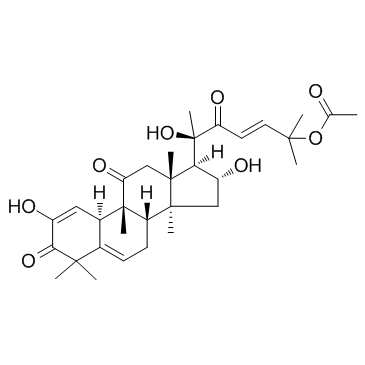
Cucurbitacin E, a naturally occurring triterpene analog isolated from the climbing stem of Cucumic melo L with a potential therapeutic agent for metabolic diseases, significantly suppresses the activity of the cyclin B1/CDC2 complex. Cucurbitacin E (CuE) was found to reduce adipogenesis in murine adipocytes. CuE treatment diminished hypertrophy of adipocytes, visceral obesity and lipogenesis gene expression in diet induced mice model of metabolic syndrome (MetS). CuE also ameliorated adipose tissue dysfunction by reducing hyperleptinemia and TNF-alpha levels and enhancing hypoadiponectinemia. Results show that CuE mediated these effects by attenuating Jenus kinase- Signal transducer and activator of transcription 5 (JAK- STAT5) signaling in visceral fat tissue. As a result, CuE treatment also reduced PPAR gamma expression. Glucose uptake enhanced in adipocytes after stimulation with CuE and insulin resistance diminished in mice treated with CuE, as reflected by reduced glucose intolerance and glucose stimulated insulin secretion. CuE restored insulin sensitivity indirectly by inhibiting JAK phosphorylation and improving AMPK activity. Consequently, insulin signaling was up-regulated in mice muscle. As CuE positively regulated adipose tissue function and suppressed visceral obesity, dyslipedemia, hyperglycemia and insulin resistance in mice model of MetS, CuE may be used as novel approach to treat metabolic diseases.
Physicochemical Properties
| Molecular Formula | C32H44O8 |
| Molecular Weight | 556.6870 |
| Exact Mass | 556.303 |
| CAS # | 18444-66-1 |
| Related CAS # | Cucurbitacin B;6199-67-3;Cucurbitacin I;2222-07-3 |
| PubChem CID | 5281319 |
| Appearance | White to off-white solid powder |
| Density | 1.2±0.1 g/cm3 |
| Boiling Point | 712.6±60.0 °C at 760 mmHg |
| Melting Point | 228-234ºC |
| Flash Point | 224.4±26.4 °C |
| Vapour Pressure | 0.0±5.2 mmHg at 25°C |
| Index of Refraction | 1.579 |
| LogP | 3.15 |
| Hydrogen Bond Donor Count | 3 |
| Hydrogen Bond Acceptor Count | 8 |
| Rotatable Bond Count | 6 |
| Heavy Atom Count | 40 |
| Complexity | 1270 |
| Defined Atom Stereocenter Count | 8 |
| SMILES | CC(=O)OC(C)(C)/C=C/C(=O)[C@@](C)([C@H]1[C@@H](C[C@@]2([C@@]1(CC(=O)[C@@]3([C@H]2CC=C4[C@H]3C=C(C(=O)C4(C)C)O)C)C)C)O)O |
| InChi Key | NDYMQXYDSVBNLL-MUYMLXPFSA-N |
| InChi Code | InChI=1S/C32H44O8/c1-17(33)40-27(2,3)13-12-23(36)32(9,39)25-21(35)15-29(6)22-11-10-18-19(14-20(34)26(38)28(18,4)5)31(22,8)24(37)16-30(25,29)7/h10,12-14,19,21-22,25,34-35,39H,11,15-16H2,1-9H3/b13-12+/t19-,21-,22+,25+,29+,30-,31+,32+/m1/s1 |
| Chemical Name | [(E,6R)-6-[(8S,9R,10R,13R,14S,16R,17R)-2,16-dihydroxy-4,4,9,13,14-pentamethyl-3,11-dioxo-8,10,12,15,16,17-hexahydro-7H-cyclopenta[a]phenanthren-17-yl]-6-hydroxy-2-methyl-5-oxohept-3-en-2-yl] acetate |
| Synonyms | Cucurbitacin E; α-Elaterin; α-Elaterine |
| HS Tariff Code | 2934.99.9001 |
| Storage |
Powder-20°C 3 years 4°C 2 years In solvent -80°C 6 months -20°C 1 month |
| Shipping Condition | Room temperature (This product is stable at ambient temperature for a few days during ordinary shipping and time spent in Customs) |
Biological Activity
| ln Vitro | Cucurbitacin E (CuE) was exposed to increasing concentrations of colorectal cancer (CRC) cell lines (0, 2.5, 5, and 7.5 μM) for a duration of 24 hours in an in vitro study to investigate the anticancer effect of CuE on CRC cells. We next used the MTT method to measure the proliferation of cancer cells treated with cucurbitacin E. For primary colon cancer cells, curcumin E promotes morphological alterations. Microscopically, cucurbitacin E (5 μM) treatment caused a considerable alteration in the morphology of primary colon cancer cells between 6 to 24 hours. By preventing the production of the GADD45γ gene and the cyclin B1/CDC2 complex in primary CRC cells, curcumin E inhibits the cell cycle in the G2/M phase of the cell cycle, which in turn stops its proliferation [1]. |
| ln Vivo | The effects of cucurbitacin E (CuE) on body weight and adipose tissue biology were assessed using the high-fat diet mouse model of metabolic syndrome (HFD-MetS). When compared to HFD-MetS mice treated with vehicle alone, cucurbitacin E (0.5 mg/kg)-treated mice showed a significant reduction in body weight. In HFD-MetS mice, cucurbitacin E treatment decreased all fat pad weights. Following treatment with cucurbitacin E, mice's total fat decreased by 55% when compared to HFD-MetS mice. Metabolic syndrome is closely linked to abdominal obesity. Following cucurbitacin E treatment, central adiposity in HFD MetS mice was reduced to 50%, demonstrating the efficacy of cucurbitacin E in targeting MetS [2]. |
| References |
[1]. Therapeutic ROS targeting of GADD45γ in the induction of G2/M arrest in primary human colorectal cancer cell lines by cucurbitacin E. Cell Death Dis. 2014 Apr 24;5:e1198. [2]. Cucurbitacin E reduces obesity and related metabolic dysfunction in mice by targeting JAK-STAT5 signaling pathway. PLoS One. 2017 Jun 9;12(6):e0178910. |
| Additional Infomation |
Cucurbitacin E is a cucurbitacin in which a lanostane skeleton is multi-substituted with hydroxy, methyl and oxo substituents, with unsaturation at positions 1, 5 and 23. It is a cucurbitacin and a tertiary alpha-hydroxy ketone. Cucurbitacin E has been reported in Begonia nantoensis, Bacopa monnieri, and other organisms with data available. |
Solubility Data
| Solubility (In Vitro) | DMSO : ~50 mg/mL (~89.82 mM) |
| Solubility (In Vivo) |
Solubility in Formulation 1: 2.5 mg/mL (4.49 mM) in 10% DMSO + 40% PEG300 + 5% Tween80 + 45% Saline (add these co-solvents sequentially from left to right, and one by one), suspension solution; with sonication. For example, if 1 mL of working solution is to be prepared, you can add 100 μL of 25.0 mg/mL clear DMSO stock solution to 400 μL PEG300 and mix evenly; then add 50 μL Tween-80 to the above solution and mix evenly; then add 450 μL normal saline to adjust the volume to 1 mL. Preparation of saline: Dissolve 0.9 g of sodium chloride in 100 mL ddH₂ O to obtain a clear solution. Solubility in Formulation 2: ≥ 2.5 mg/mL (4.49 mM) (saturation unknown) in 10% DMSO + 90% Corn Oil (add these co-solvents sequentially from left to right, and one by one), clear solution. For example, if 1 mL of working solution is to be prepared, you can add 100 μL of 25.0 mg/mL clear DMSO stock solution to 900 μL of corn oil and mix evenly. (Please use freshly prepared in vivo formulations for optimal results.) |
| Preparing Stock Solutions | 1 mg | 5 mg | 10 mg | |
| 1 mM | 1.7963 mL | 8.9817 mL | 17.9633 mL | |
| 5 mM | 0.3593 mL | 1.7963 mL | 3.5927 mL | |
| 10 mM | 0.1796 mL | 0.8982 mL | 1.7963 mL |