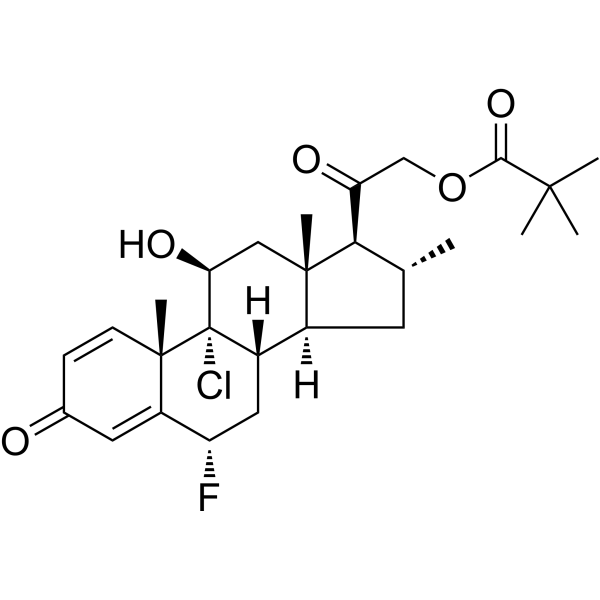
Physicochemical Properties
| Molecular Formula | C27H36CLFO5 |
| Molecular Weight | 495.02 |
| Exact Mass | 494.223 |
| CAS # | 34097-16-0 |
| PubChem CID | 5282493 |
| Appearance | White to off-white solid powder |
| Density | 1.2±0.1 g/cm3 |
| Boiling Point | 598.0±50.0 °C at 760 mmHg |
| Flash Point | 315.4±30.1 °C |
| Vapour Pressure | 0.0±3.8 mmHg at 25°C |
| Index of Refraction | 1.552 |
| LogP | 4.36 |
| Hydrogen Bond Donor Count | 1 |
| Hydrogen Bond Acceptor Count | 6 |
| Rotatable Bond Count | 5 |
| Heavy Atom Count | 34 |
| Complexity | 982 |
| Defined Atom Stereocenter Count | 9 |
| SMILES | C[C@@H]1C[C@H]2[C@@H]3C[C@@H](C4=CC(=O)C=C[C@@]4([C@]3([C@H](C[C@@]2([C@H]1C(=O)COC(=O)C(C)(C)C)C)O)Cl)C)F |
| InChi Key | SXYZQZLHAIHKKY-GSTUPEFVSA-N |
| InChi Code | InChI=1S/C27H36ClFO5/c1-14-9-16-17-11-19(29)18-10-15(30)7-8-26(18,6)27(17,28)21(32)12-25(16,5)22(14)20(31)13-34-23(33)24(2,3)4/h7-8,10,14,16-17,19,21-22,32H,9,11-13H2,1-6H3/t14-,16+,17+,19+,21+,22-,25+,26+,27+/m1/s1 |
| Chemical Name | [2-[(6S,8S,9R,10S,11S,13S,14S,16R,17S)-9-chloro-6-fluoro-11-hydroxy-10,13,16-trimethyl-3-oxo-7,8,11,12,14,15,16,17-octahydro-6H-cyclopenta[a]phenanthren-17-yl]-2-oxoethyl] 2,2-dimethylpropanoate |
| HS Tariff Code | 2934.99.9001 |
| Storage |
Powder-20°C 3 years 4°C 2 years In solvent -80°C 6 months -20°C 1 month |
| Shipping Condition | Room temperature (This product is stable at ambient temperature for a few days during ordinary shipping and time spent in Customs) |
Biological Activity
| Toxicity/Toxicokinetics |
Effects During Pregnancy and Lactation ◉ Summary of Use during Lactation Topical clocortolone has not been studied during breastfeeding. Since only extensive application of the most potent corticosteroids may cause systemic effects in the mother, it is unlikely that short-term application of topical corticosteroids would pose a risk to the breastfed infant by passage into breastmilk. However, it would be prudent to use the least potent drug on the smallest area of skin possible. It is particularly important to ensure that the infant's skin does not come into direct contact with the areas of skin that have been treated. Only water-miscible cream or gel products should be applied to the breast because ointments may expose the infant to high levels of mineral paraffins via licking. Any topical corticosteroid should be wiped off thoroughly prior to nursing if it is being applied to the breast or nipple area. ◉ Effects in Breastfed Infants Topical application of a corticosteroid with relatively high mineralocorticoid activity (isofluprednone acetate) to the mother's nipples resulted in prolonged QT interval, cushingoid appearance, severe hypertension, decreased growth and electrolyte abnormalities in her 2-month-old breastfed infant. The mother had used the cream since birth for painful nipples. ◉ Effects on Lactation and Breastmilk Relevant published information was not found as of the revision date. |
| References |
[1]. The treatment of inflammatory facial dermatoses with topical corticosteroids: focus on clocortolone pivalate 0.1% cream. J Drugs Dermatol. 2012 Oct;11(10):1194-8. |
| Additional Infomation |
Clocortolone pivalate is the 21-O-pivalate ester of clocortolone. It is used for the relief of inflammatory and pruritic (itching) skin disorders. It has a role as an anti-inflammatory drug and an antipruritic drug. It is a glucocorticoid, an 11beta-hydroxy steroid, a pivalate ester, a 20-oxo steroid, a fluorinated steroid, a 3-oxo-Delta(1),Delta(4)-steroid and a chlorinated steroid. It is functionally related to a clocortolone. Clocortolone Pivalate is a glucocorticoid receptor agonist with metabolic, anti-inflammatory, and immunosuppressive activity. Clocortolone pivalate exerts its effect by interacting with specific intracellular receptors and subsequently binds to DNA to modify gene expression. This results in an induction of the synthesis of certain anti-inflammatory proteins while inhibiting the synthesis of certain inflammatory mediators. Consequently, an overall reduction in chronic inflammation and autoimmune reactions are accomplished. See also: Clocortolone (has active moiety). |
Solubility Data
| Solubility (In Vitro) | May dissolve in DMSO (in most cases), if not, try other solvents such as H2O, Ethanol, or DMF with a minute amount of products to avoid loss of samples |
| Solubility (In Vivo) |
Note: Listed below are some common formulations that may be used to formulate products with low water solubility (e.g. < 1 mg/mL), you may test these formulations using a minute amount of products to avoid loss of samples. Injection Formulations (e.g. IP/IV/IM/SC) Injection Formulation 1: DMSO : Tween 80: Saline = 10 : 5 : 85 (i.e. 100 μL DMSO stock solution → 50 μL Tween 80 → 850 μL Saline) *Preparation of saline: Dissolve 0.9 g of sodium chloride in 100 mL ddH ₂ O to obtain a clear solution. Injection Formulation 2: DMSO : PEG300 :Tween 80 : Saline = 10 : 40 : 5 : 45 (i.e. 100 μL DMSO → 400 μLPEG300 → 50 μL Tween 80 → 450 μL Saline) Injection Formulation 3: DMSO : Corn oil = 10 : 90 (i.e. 100 μL DMSO → 900 μL Corn oil) Example: Take the Injection Formulation 3 (DMSO : Corn oil = 10 : 90) as an example, if 1 mL of 2.5 mg/mL working solution is to be prepared, you can take 100 μL 25 mg/mL DMSO stock solution and add to 900 μL corn oil, mix well to obtain a clear or suspension solution (2.5 mg/mL, ready for use in animals). Injection Formulation 4: DMSO : 20% SBE-β-CD in saline = 10 : 90 [i.e. 100 μL DMSO → 900 μL (20% SBE-β-CD in saline)] *Preparation of 20% SBE-β-CD in Saline (4°C,1 week): Dissolve 2 g SBE-β-CD in 10 mL saline to obtain a clear solution. Injection Formulation 5: 2-Hydroxypropyl-β-cyclodextrin : Saline = 50 : 50 (i.e. 500 μL 2-Hydroxypropyl-β-cyclodextrin → 500 μL Saline) Injection Formulation 6: DMSO : PEG300 : castor oil : Saline = 5 : 10 : 20 : 65 (i.e. 50 μL DMSO → 100 μLPEG300 → 200 μL castor oil → 650 μL Saline) Injection Formulation 7: Ethanol : Cremophor : Saline = 10: 10 : 80 (i.e. 100 μL Ethanol → 100 μL Cremophor → 800 μL Saline) Injection Formulation 8: Dissolve in Cremophor/Ethanol (50 : 50), then diluted by Saline Injection Formulation 9: EtOH : Corn oil = 10 : 90 (i.e. 100 μL EtOH → 900 μL Corn oil) Injection Formulation 10: EtOH : PEG300:Tween 80 : Saline = 10 : 40 : 5 : 45 (i.e. 100 μL EtOH → 400 μLPEG300 → 50 μL Tween 80 → 450 μL Saline) Oral Formulations Oral Formulation 1: Suspend in 0.5% CMC Na (carboxymethylcellulose sodium) Oral Formulation 2: Suspend in 0.5% Carboxymethyl cellulose Example: Take the Oral Formulation 1 (Suspend in 0.5% CMC Na) as an example, if 100 mL of 2.5 mg/mL working solution is to be prepared, you can first prepare 0.5% CMC Na solution by measuring 0.5 g CMC Na and dissolve it in 100 mL ddH2O to obtain a clear solution; then add 250 mg of the product to 100 mL 0.5% CMC Na solution, to make the suspension solution (2.5 mg/mL, ready for use in animals). Oral Formulation 3: Dissolved in PEG400 Oral Formulation 4: Suspend in 0.2% Carboxymethyl cellulose Oral Formulation 5: Dissolve in 0.25% Tween 80 and 0.5% Carboxymethyl cellulose Oral Formulation 6: Mixing with food powders Note: Please be aware that the above formulations are for reference only. InvivoChem strongly recommends customers to read literature methods/protocols carefully before determining which formulation you should use for in vivo studies, as different compounds have different solubility properties and have to be formulated differently. (Please use freshly prepared in vivo formulations for optimal results.) |
| Preparing Stock Solutions | 1 mg | 5 mg | 10 mg | |
| 1 mM | 2.0201 mL | 10.1006 mL | 20.2012 mL | |
| 5 mM | 0.4040 mL | 2.0201 mL | 4.0402 mL | |
| 10 mM | 0.2020 mL | 1.0101 mL | 2.0201 mL |