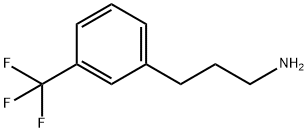
Cinacalcet metabolite M4 is a metabolite of Cinacalcet (AMG-073; KRN-1493; Regpara; Sensipar; Mimpara), which is allosteric agonist of Ca receptor (CaR) approved as a medication for the treatment of hyperparathyroidism, parathyroid carcinoma, and primary hyperparathyroidism.
Physicochemical Properties
| Molecular Formula | C10H12NF3 |
| Molecular Weight | 203.20418 |
| Exact Mass | 203.092 |
| CAS # | 104774-87-0 |
| PubChem CID | 19797640 |
| Appearance | Colorless to light yellow liquid(Density:1.154±0.06 g/cm3) |
| Density | 1.2±0.1 g/cm3 |
| Boiling Point | 222.2±40.0 °C at 760 mmHg |
| Flash Point | 92.6±12.0 °C |
| Vapour Pressure | 0.1±0.4 mmHg at 25°C |
| Index of Refraction | 1.468 |
| LogP | 2.4 |
| Hydrogen Bond Donor Count | 1 |
| Hydrogen Bond Acceptor Count | 4 |
| Rotatable Bond Count | 3 |
| Heavy Atom Count | 14 |
| Complexity | 167 |
| Defined Atom Stereocenter Count | 0 |
| SMILES | C1=CC(=CC(=C1)C(F)(F)F)CCCN |
| InChi Key | JMTLMFBJIQWJPW-UHFFFAOYSA-N |
| InChi Code | InChI=1S/C10H12F3N/c11-10(12,13)9-5-1-3-8(7-9)4-2-6-14/h1,3,5,7H,2,4,6,14H2 |
| Chemical Name | 3-[3-(trifluoromethyl)phenyl]propan-1-amine |
| HS Tariff Code | 2934.99.9001 |
| Storage |
Powder-20°C 3 years 4°C 2 years In solvent -80°C 6 months -20°C 1 month |
| Shipping Condition | Room temperature (This product is stable at ambient temperature for a few days during ordinary shipping and time spent in Customs) |
Biological Activity
| Targets | metabolite of Cinacalcet; CaSR |
| ln Vivo |
The metabolism and disposition of calcimimetic agent cinacalcet HCl was examined after a single oral administration to mice, rats, monkeys, and human volunteers. In all species examined, cinacalcet was well absorbed, with greater than 74% oral bioavailability of cinacalcet-derived radioactivity in monkeys and humans. In rats, cinacalcet-derived radioactivity was widely distributed into most tissues, with no marked gender-related differences. In all animal models examined, radioactivity was excreted rapidly via both hepatobiliary and urinary routes. In humans, radioactivity was cleared primarily via the urinary route (80%), with 17% excreted in the feces. Cinacalcet was not detected in the urine in humans. The primary routes of metabolism of cinacalcet were N-dealkylation leading to carboxylic acid derivatives (excreted in urine as glycine conjugates) and oxidation of naphthalene ring to form dihydrodiols (excreted in urine and bile as glucuronide conjugates). The plasma radioactivity in both animals and humans was primarily composed of carboxylic acid metabolites and dihydrodiol glucuronides, with <1% circulating radioactivity accounting for the unchanged cinacalcet. Overall, the circulating and excreted metabolite profile of cinacalcet in humans was qualitatively similar to that observed in preclinical animal models [1]. Idiopathic hypercalciuria is the most common metabolic abnormality in patients with nephrolithiasis. Through successive inbreeding, we have developed a strain of rats whose urine calcium (UCa) excretion is approximately 8-10-fold greater than that of control rats and who spontaneously form kidney stones. We have termed these rats genetic hypercalciuric stone-forming (GHS) rats. The physiology of the hypercalciuria in the GHS rats closely parallels that of man. We have recently shown that the GHS rat kidneys have an increased number of receptors for calcium (CaR) compared to Sprague-Dawley rats, the strain of rats originally bred to develop the GHS rats. Calcimimetics, such as cinacalcet (Cin), increase the sensitivity of the CaR to Ca. The effects of Cin on UCa are complex and difficult to predict. We tested the hypothesis that Cin would alter urinary (U) Ca and supersaturation with respect to calcium hydrogen phosphate (CaHPO(4)) and calcium oxalate (CaOx). GHS or control rats were fed a normal Ca diet (0.6% Ca) for 28 days with Cin (30 mg/kg/24 h) added to the diet of half of each group for the last 14 days. The protocol was then repeated while the rats were fed a low Ca (0.02% Ca) diet. We found that Cin led to a marked reduction in circulating parathyroid hormone and a modest reduction in serum Ca. Cin did not alter UCa when the GHS rats were fed the normal Ca diet but lowered UCa when they were fed the low Ca diet. However, Cin did not alter U supersaturation with respect to either CaOx or CaHPO(4) on either diet. If these findings in GHS rats can be confirmed in man, it suggests that Cin would not be an effective agent in the treatment of human idiopathic hypercalciuria and resultant stone formation[2]. |
| Animal Protocol | [14C-2-CH2]Cinacalcet (58.1 mCi/mmol) and [14C-CF3]cinacalcet (47.6 mCi/mmol) as a free base were synthesized by ChemSyn (Lenexa, KS). Cinacalcet hydrochloride was synthesized by Sumika Fine Chemicals (Osaka, Japan). The animal experiments were conducted in accordance with the Guide for the Care and Use of Laboratory Animals as adopted and promulgated by the U.S. National Institutes of Health. For the human disposition study, written informed consent from the volunteers and approval by the..[1] |
| References |
[1]. Metabolism and disposition of calcimimetic agent cinacalcet HCl in humans and animalmodels. Drug Metab Dispos. 2004 Dec;32(12):1491-500. [2]. Effect of cinacalcet on urine calcium excretion and supersaturation in genetic hypercalciuric stone-forming rats. Kidney Int. 2006 May;69(9):1586-92. |
Solubility Data
| Solubility (In Vitro) | May dissolve in DMSO (in most cases), if not, try other solvents such as H2O, Ethanol, or DMF with a minute amount of products to avoid loss of samples |
| Solubility (In Vivo) |
Note: Listed below are some common formulations that may be used to formulate products with low water solubility (e.g. < 1 mg/mL), you may test these formulations using a minute amount of products to avoid loss of samples. Injection Formulations (e.g. IP/IV/IM/SC) Injection Formulation 1: DMSO : Tween 80: Saline = 10 : 5 : 85 (i.e. 100 μL DMSO stock solution → 50 μL Tween 80 → 850 μL Saline) *Preparation of saline: Dissolve 0.9 g of sodium chloride in 100 mL ddH ₂ O to obtain a clear solution. Injection Formulation 2: DMSO : PEG300 :Tween 80 : Saline = 10 : 40 : 5 : 45 (i.e. 100 μL DMSO → 400 μLPEG300 → 50 μL Tween 80 → 450 μL Saline) Injection Formulation 3: DMSO : Corn oil = 10 : 90 (i.e. 100 μL DMSO → 900 μL Corn oil) Example: Take the Injection Formulation 3 (DMSO : Corn oil = 10 : 90) as an example, if 1 mL of 2.5 mg/mL working solution is to be prepared, you can take 100 μL 25 mg/mL DMSO stock solution and add to 900 μL corn oil, mix well to obtain a clear or suspension solution (2.5 mg/mL, ready for use in animals). Injection Formulation 4: DMSO : 20% SBE-β-CD in saline = 10 : 90 [i.e. 100 μL DMSO → 900 μL (20% SBE-β-CD in saline)] *Preparation of 20% SBE-β-CD in Saline (4°C,1 week): Dissolve 2 g SBE-β-CD in 10 mL saline to obtain a clear solution. Injection Formulation 5: 2-Hydroxypropyl-β-cyclodextrin : Saline = 50 : 50 (i.e. 500 μL 2-Hydroxypropyl-β-cyclodextrin → 500 μL Saline) Injection Formulation 6: DMSO : PEG300 : castor oil : Saline = 5 : 10 : 20 : 65 (i.e. 50 μL DMSO → 100 μLPEG300 → 200 μL castor oil → 650 μL Saline) Injection Formulation 7: Ethanol : Cremophor : Saline = 10: 10 : 80 (i.e. 100 μL Ethanol → 100 μL Cremophor → 800 μL Saline) Injection Formulation 8: Dissolve in Cremophor/Ethanol (50 : 50), then diluted by Saline Injection Formulation 9: EtOH : Corn oil = 10 : 90 (i.e. 100 μL EtOH → 900 μL Corn oil) Injection Formulation 10: EtOH : PEG300:Tween 80 : Saline = 10 : 40 : 5 : 45 (i.e. 100 μL EtOH → 400 μLPEG300 → 50 μL Tween 80 → 450 μL Saline) Oral Formulations Oral Formulation 1: Suspend in 0.5% CMC Na (carboxymethylcellulose sodium) Oral Formulation 2: Suspend in 0.5% Carboxymethyl cellulose Example: Take the Oral Formulation 1 (Suspend in 0.5% CMC Na) as an example, if 100 mL of 2.5 mg/mL working solution is to be prepared, you can first prepare 0.5% CMC Na solution by measuring 0.5 g CMC Na and dissolve it in 100 mL ddH2O to obtain a clear solution; then add 250 mg of the product to 100 mL 0.5% CMC Na solution, to make the suspension solution (2.5 mg/mL, ready for use in animals). Oral Formulation 3: Dissolved in PEG400 Oral Formulation 4: Suspend in 0.2% Carboxymethyl cellulose Oral Formulation 5: Dissolve in 0.25% Tween 80 and 0.5% Carboxymethyl cellulose Oral Formulation 6: Mixing with food powders Note: Please be aware that the above formulations are for reference only. InvivoChem strongly recommends customers to read literature methods/protocols carefully before determining which formulation you should use for in vivo studies, as different compounds have different solubility properties and have to be formulated differently. (Please use freshly prepared in vivo formulations for optimal results.) |
| Preparing Stock Solutions | 1 mg | 5 mg | 10 mg | |
| 1 mM | 4.9213 mL | 24.6063 mL | 49.2126 mL | |
| 5 mM | 0.9843 mL | 4.9213 mL | 9.8425 mL | |
| 10 mM | 0.4921 mL | 2.4606 mL | 4.9213 mL |