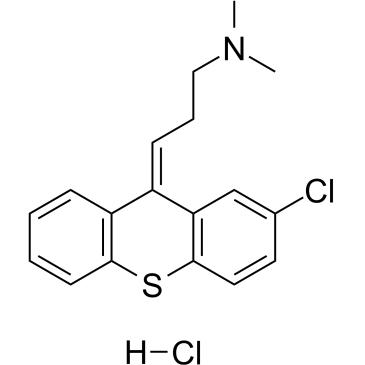
Chlorprothixene HCl is a typical antipsychotic drug of the thioxanthene class and an antagonist of dopamine and histamine receptors such as D1, D2, D3, D5, H1, 5-HT2, 5-HT6 and 5-HT7, with Ki of 18 nM, 2.96 nM, 4.56 nM, 9 nM, 3.75 nM, 9.4 nM, 3 nM and 5.6 nM, respectively. It was the series' first synthesized product. Chlorprothixene has little affinity for H3, but it exhibits strong binding affinities to dopamine and histamine receptors, such as D1, D2, D3, D5, and H1, with Ki values of 18 nM, 2.96 nM, 4.56 nM, 9 nM, and 3.75 nM, respectively. Furthermore, rat 5-HT6 from stably transfected HEK-293 cells and rat 5-HT7 receptors from transiently expressed COS-7 cells exhibit strong affinities for chlorprothixene, with Ki values of 3 nM and 5.6 nM, respectively.
Physicochemical Properties
| Molecular Formula | C18H19CL2NS |
| Molecular Weight | 352.32116 |
| Exact Mass | 351.062 |
| Elemental Analysis | C, 61.36; H, 5.44; Cl, 20.12; N, 3.98; S, 9.10 |
| CAS # | 6469-93-8 |
| Related CAS # | Chlorprothixene; 113-59-7; Chlorprothixene-d6 hydrochloride |
| PubChem CID | 667466 |
| Appearance | White to off-white solid powder |
| Boiling Point | 461.8ºC at 760 mmHg |
| Melting Point | 221ºC |
| Flash Point | 233.1ºC |
| LogP | 5.99 |
| Hydrogen Bond Donor Count | 0 |
| Hydrogen Bond Acceptor Count | 2 |
| Rotatable Bond Count | 3 |
| Heavy Atom Count | 21 |
| Complexity | 381 |
| Defined Atom Stereocenter Count | 0 |
| SMILES | Cl.ClC1C=CC2=C(/C(/C3=CC=CC=C3S2)=C\CCN(C([2H])([2H])[2H])C([2H])([2H])[2H])C=1 |
| InChi Key | YWKRLOSRDGPEJR-KIUKIJHYSA-N |
| InChi Code | InChI=1S/C18H18ClNS.ClH/c1-20(2)11-5-7-14-15-6-3-4-8-17(15)21-18-10-9-13(19)12-16(14)18;/h3-4,6-10,12H,5,11H2,1-2H3;1H/b14-7-; |
| Chemical Name | (3Z)-3-(2-chlorothioxanthen-9-ylidene)-N,N-dimethylpropan-1-amine;hydrochloride |
| Synonyms | Truxal; Taractan; Minithixen; Truxal hydrochloride; Chlorprothixene; NSC 169899; NSC 56379; NSC 78193 |
| HS Tariff Code | 2934.99.9001 |
| Storage |
Powder-20°C 3 years 4°C 2 years In solvent -80°C 6 months -20°C 1 month Note: Please store this product in a sealed and protected environment, avoid exposure to moisture. |
| Shipping Condition | Room temperature (This product is stable at ambient temperature for a few days during ordinary shipping and time spent in Customs) |
Biological Activity
| Targets | Human D1 Receptor ( Ki = 18 nM ); Human D2 Receptor ( Ki = 2.96 nM ); Human D3 Receptor ( Ki = 4.56 nM ); Human D5 Receptor ( Ki = 9 nM ); Human H1 Receptor ( Ki = 3.75 nM ) |
| ln Vitro | Chlorprothixene adsorbs and binds to 5-HT, and its pKi for 5-HT7, 5-HT6 and 5-HT2 are 8.3, 8.5 and 9.4 respectively [2]. |
| ADME/Pharmacokinetics |
Metabolism / Metabolites Hepatic Half Life: 8 to 12 hours |
| Toxicity/Toxicokinetics |
Toxicity Summary Chlorprothixene blocks postsynaptic mesolimbic dopaminergic D1 and D2 receptors in the brain; depresses the release of hypothalamic and hypophyseal hormones and is believed to depress the reticular activating system thus affecting basal metabolism, body temperature, wakefulness, vasomotor tone, and emesis. |
| References |
[1]. Potential utility of histamine H3 receptor antagonist pharmacophore in antipsychotics. Bioorg Med Chem Lett. 2009 Jan 15;19(2):538-42. [2]. Binding of typical and atypical antipsychotic agents to 5-hydroxytryptamine-6 and 5-hydroxytryptamine-7 receptors. J Pharmacol Exp Ther. 1994 Mar;268(3):1403-10. |
| Additional Infomation |
Chlorprothixene is a member of thioxanthenes, a tertiary amino compound and an organochlorine compound. It has a role as a non-narcotic analgesic, an antiemetic, a sedative, a cholinergic antagonist, a dopaminergic antagonist and a first generation antipsychotic. It is a conjugate base of a chlorprothixene(1+). Chlorprothixene is only found in individuals that have used or taken this drug. It is a typical antipsychotic drug of the thioxanthene (tricyclic) class. Chlorprothixene exerts strong blocking effects by blocking the 5-HT2 D1, D2, D3, histamine H1, muscarinic and alpha1 adrenergic receptors. Chlorprothixene blocks postsynaptic mesolimbic dopaminergic D1 and D2 receptors in the brain; depresses the release of hypothalamic and hypophyseal hormones and is believed to depress the reticular activating system thus affecting basal metabolism, body temperature, wakefulness, vasomotor tone, and emesis. A thioxanthine with effects similar to the phenothiazine antipsychotics. See also: Chlorprothixene (annotation moved to). |
Solubility Data
| Solubility (In Vitro) |
H2O: ~25 mg/mL (~71 mM) Ethanol: ~25 mg/mL (~71 mM) DMSO: 2.5~70 mg/mL (7.1~198.7 mM) |
| Solubility (In Vivo) |
Solubility in Formulation 1: ≥ 2.5 mg/mL (7.10 mM) (saturation unknown) in 10% EtOH + 40% PEG300 + 5% Tween80 + 45% Saline (add these co-solvents sequentially from left to right, and one by one), clear solution. For example, if 1 mL of working solution is to be prepared, you can add 100 μL of 25.0 mg/mL clear EtOH stock solution to 400 μL PEG300 and mix evenly; then add 50 μL Tween-80 to the above solution and mix evenly; then add 450 μL normal saline to adjust the volume to 1 mL. Preparation of saline: Dissolve 0.9 g of sodium chloride in 100 mL ddH₂ O to obtain a clear solution. Solubility in Formulation 2: ≥ 2.5 mg/mL (7.10 mM) (saturation unknown) in 10% EtOH + 90% (20% SBE-β-CD in Saline) (add these co-solvents sequentially from left to right, and one by one), clear solution. For example, if 1 mL of working solution is to be prepared, you can add 100 μL of 25.0 mg/mL clear EtOH stock solution to 900 μL of 20% SBE-β-CD physiological saline solution and mix evenly. Preparation of 20% SBE-β-CD in Saline (4°C,1 week): Dissolve 2 g SBE-β-CD in 10 mL saline to obtain a clear solution. Solubility in Formulation 3: ≥ 2.5 mg/mL (7.10 mM) (saturation unknown) in 10% EtOH + 90% Corn Oil (add these co-solvents sequentially from left to right, and one by one), clear solution. For example, if 1 mL of working solution is to be prepared, you can add 100 μL of 25.0 mg/mL clear EtOH stock solution to 900 μL of corn oil and mix evenly. (Please use freshly prepared in vivo formulations for optimal results.) |
| Preparing Stock Solutions | 1 mg | 5 mg | 10 mg | |
| 1 mM | 2.8383 mL | 14.1916 mL | 28.3833 mL | |
| 5 mM | 0.5677 mL | 2.8383 mL | 5.6767 mL | |
| 10 mM | 0.2838 mL | 1.4192 mL | 2.8383 mL |