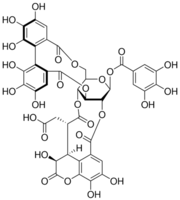
Chebulagic acid is a naturally occurring COX-LOX dual inhibitor isolated from the Terminalia chebula Retz. It has antiviral activity and can inhibit SARS-CoV-2 viral replication with an EC50 of 9.76 μM.
Physicochemical Properties
| Molecular Formula | C41H30O27 |
| Molecular Weight | 954.6607 |
| Exact Mass | 954.097 |
| CAS # | 23094-71-5 |
| PubChem CID | 250397 |
| Appearance | Off-white to light yellow solid powder |
| Density | 2.1±0.1 g/cm3 |
| Boiling Point | 1610.6±65.0 °C at 760 mmHg |
| Melting Point | >300℃ |
| Flash Point | 480.0±27.8 °C |
| Vapour Pressure | 0.0±0.3 mmHg at 25°C |
| Index of Refraction | 1.876 |
| LogP | 2.25 |
| Hydrogen Bond Donor Count | 13 |
| Hydrogen Bond Acceptor Count | 27 |
| Rotatable Bond Count | 5 |
| Heavy Atom Count | 68 |
| Complexity | 1970 |
| Defined Atom Stereocenter Count | 0 |
| InChi Key | HGJXAVROWQLCTP-UHFFFAOYSA-N |
| InChi Code | InChI=1S/C41H30O27/c42-13-1-8(2-14(43)24(13)49)35(56)68-41-34-33-31(64-39(60)12(6-19(47)48)22-23-11(38(59)67-34)5-17(46)27(52)32(23)65-40(61)30(22)55)18(63-41)7-62-36(57)9-3-15(44)25(50)28(53)20(9)21-10(37(58)66-33)4-16(45)26(51)29(21)54/h1-5,12,18,22,30-31,33-34,41-46,49-55H,6-7H2,(H,47,48) |
| Chemical Name | 2-[13,14,15,18,19,20,31,35,36-nonahydroxy-2,10,23,28,32-pentaoxo-5-(3,4,5-trihydroxybenzoyl)oxy-3,6,9,24,27,33-hexaoxaheptacyclo[28.7.1.04,25.07,26.011,16.017,22.034,38]octatriaconta-1(37),11,13,15,17,19,21,34(38),35-nonaen-29-yl]acetic acid |
| HS Tariff Code | 2934.99.9001 |
| Storage |
Powder-20°C 3 years 4°C 2 years In solvent -80°C 6 months -20°C 1 month |
| Shipping Condition | Room temperature (This product is stable at ambient temperature for a few days during ordinary shipping and time spent in Customs) |
Biological Activity
| ln Vitro | Autophagy is enhanced by chelagic acid. Chebulic acid possesses anti-infective and anti-inflammatory properties. Similar to the clinical symptoms of Parkinson's disease, 1-methyl-4-phenylpyridinium (MPP+)-induced cytotoxicity is another condition against which chelagic acid shows preventive properties. Chebulagic acid suppresses the elevation of TNF-α and IL-1β generated by LPS in a way that is dependent on both dose and time. Additionally, in EA.hy926 cells, chemilagic acid therapy reduced LPS-activated MAPK signaling. |
| References |
[1]. Neuroprotective Effect of Chebulagic Acid via Autophagy Induction in SH-SY5Y Cells. Biomol Ther (Seoul). 2014 Jul;22(4):275-81. [2]. Chebulagic acid inhibits the LPS-induced expression of TNF-α and IL-1β in endothelial cells by suppressing MAPK activation. Exp Ther Med. 2015 Jul;10(1):263-268. [3]. Inhibition of Angiogenesis In Vitro by Chebulagic Acid: A COX-LOX Dual Inhibitor. Int J Vasc Med. 2013;2013:843897. [4]. Virtual Screening Identifies Chebulagic Acid as an Inhibitor of the M2(S31N) Viral Ion Channel and Influenza A Virus. Molecules 2020, 25, 2903. [5]. Discovery of Chebulagic Acid and Punicalagin as Novel Allosteric Inhibitors of SARS-CoV-2 3CLpro. Antivir Res. 2021, 105075. |
| Additional Infomation |
Chebulagic acid has been reported in Phyllanthus emblica, Acalypha indica, and Terminalia chebula with data available. See also: Chebulagic acid (annotation moved to). |
Solubility Data
| Solubility (In Vitro) | DMSO : ~100 mg/mL (~104.75 mM) |
| Solubility (In Vivo) |
Solubility in Formulation 1: ≥ 0.83 mg/mL (0.87 mM) (saturation unknown) in 10% DMSO + 40% PEG300 + 5% Tween80 + 45% Saline (add these co-solvents sequentially from left to right, and one by one), clear solution. For example, if 1 mL of working solution is to be prepared, you can add 100 μL of 8.3 mg/mL clear DMSO stock solution to 400 μL of PEG300 and mix evenly; then add 50 μL of Tween-80 to the above solution and mix evenly; then add 450 μL of normal saline to adjust the volume to 1 mL. Preparation of saline: Dissolve 0.9 g of sodium chloride in 100 mL ddH₂ O to obtain a clear solution. Solubility in Formulation 2: ≥ 0.83 mg/mL (0.87 mM) (saturation unknown) in 10% DMSO + 90% (20% SBE-β-CD in Saline) (add these co-solvents sequentially from left to right, and one by one), clear solution. For example, if 1 mL of working solution is to be prepared, you can add 100 μL of 8.3 mg/mL clear DMSO stock solution to 900 μL of 20% SBE-β-CD physiological saline solution and mix evenly. Preparation of 20% SBE-β-CD in Saline (4°C,1 week): Dissolve 2 g SBE-β-CD in 10 mL saline to obtain a clear solution. Solubility in Formulation 3: ≥ 0.83 mg/mL (0.87 mM) (saturation unknown) in 10% DMSO + 90% Corn Oil (add these co-solvents sequentially from left to right, and one by one), clear solution. For example, if 1 mL of working solution is to be prepared, you can add 100 μL of 8.3 mg/mL clear DMSO stock solution to 900 μL of corn oil and mix evenly. (Please use freshly prepared in vivo formulations for optimal results.) |
| Preparing Stock Solutions | 1 mg | 5 mg | 10 mg | |
| 1 mM | 1.0475 mL | 5.2375 mL | 10.4749 mL | |
| 5 mM | 0.2095 mL | 1.0475 mL | 2.0950 mL | |
| 10 mM | 0.1047 mL | 0.5237 mL | 1.0475 mL |