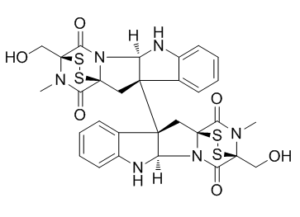
Chaetocin, a naturally occurring fungal mycotoxin extracted from Chaetomium, is a novel and non-specific inhibitor of the histone lysine methyltransferase (HMT) G9a with an IC50 of 2.5 μM. It belongs to the class of 3,6-epidithio-diketopiperazines. Chaetocin also inhibits thioredoxin reductase (TrxR) with an IC50 of 4 μM. Chaetocin was originally reported as the first lysine-specific histone methyltransferase inhibitor. Chaetocin can selectively reduce intracellular H3K9me2 and H3K9me3 levels but has no effect on other epigenetic modifications tested. In addition, Chaetocin can induce apoptosis in human melanoma cells, generating reactive oxygen species and the intrinsic mitochondrial pathway.
Physicochemical Properties
| Molecular Formula | C30H28N6O6S4 |
| Molecular Weight | 696.8399 |
| Exact Mass | 696.095 |
| CAS # | 28097-03-2 |
| PubChem CID | 161591 |
| Appearance | Light yellow to yellow solid powder |
| Density | 1.9±0.1 g/cm3 |
| Index of Refraction | 1.930 |
| LogP | 3.1 |
| Hydrogen Bond Donor Count | 4 |
| Hydrogen Bond Acceptor Count | 12 |
| Rotatable Bond Count | 3 |
| Heavy Atom Count | 46 |
| Complexity | 1400 |
| Defined Atom Stereocenter Count | 0 |
| InChi Key | CNTRDQLQYLGSKO-KPCONVMXSA-N |
| InChi Code | InChI=1S/C30H28N6O6S4/c1-32-23(39)27-11-16-20-17(31-21(16)35(27)25(41)29(32,12-37)45-43-27)7-5-9-19(20)34-18-8-4-3-6-14(18)15-10-28-24(40)33(2)30(13-38,46-44-28)26(42)36(28)22(15)34/h3-9,15-16,21-22,31,37-38H,10-13H2,1-2H3/t15?,16-,21-,22?,27?,28+,29+,30+/m1/s1 |
| Chemical Name | 14-(hydroxymethyl)-3-[14-(hydroxymethyl)-18-methyl-13,17-dioxo-15,16-dithia-10,12,18-triazapentacyclo[12.2.2.01,12.03,11.04,9]octadeca-4,6,8-trien-3-yl]-18-methyl-15,16-dithia-10,12,18-triazapentacyclo[12.2.2.01,12.03,11.04,9]octadeca-4,6,8-triene-13,17-dione |
| Synonyms | Chaetocin; (3S,3'S,5aR,5aR,10bR,10'bR,11aS,11'aS)-2,2',3,3',5a,5'a,6,6'-octahydro-3,3'-bis(hydroxymethyl)-2,2'-dimethyl-[10b,10'b(11H,11'H)-bi3,11a-epidithio-11aH-pyrazino[1',2':1,5]pyrrolo[2,3-b]indole]-1,1',4,4'-tetrone |
| HS Tariff Code | 2934.99.9001 |
| Storage |
Powder-20°C 3 years 4°C 2 years In solvent -80°C 6 months -20°C 1 month |
| Shipping Condition | Room temperature (This product is stable at ambient temperature for a few days during ordinary shipping and time spent in Customs) |
Biological Activity
| ln Vitro | Chaetin is a member of the 3-6-ethodithiodionepiperazine (ETP) class of compounds, and it was first isolated from the fermentation broth of Chaetomium. SU (VAR) 3-9 has an IC50 of 0.6 μM, making it a viable yeast substitute for S-adenosylmethionine. Chaetocin dSU (VAR) 3-9's human homologue has an IC50 of 0.8 μM. Other known Lys9 triangular HMTs with IC50 values of 2.5 and 3 mM, respectively, inhibit TrxR1-initiated turnover of the synthetic substrate DTNB in dose-responsive manner in cell-free tests [1]. These HMTs are geometric G9a and Neurospora crassa DIM5 chaetocin. |
| ln Vivo | The Drosophila tissue cells can be cultured with or without SL-2. Cultivated cells are poisonous to chaetin. The initial cell density had a significant impact on the toxicity of chaetocin when it was introduced to the culture. There was a considerable decrease in the quantity of H3 molecules that were dimethylated at Lys9 (H3K9me2) after the cells were cultured for five days in the presence of 0.5 μM Chaetocin. Although not as dramatically as with higher concentrations, histones recovered from cells treated with 0.1 μM for shorter times also displayed a decrease in Lys9 methylation [1]. |
| References |
[1]. Identification of a specific inhibitor of the histone methyltransferase SU(VAR)3-9. Nat Chem Biol. 2005 Aug;1(3):143-5. [2]. The anticancer agent chaetocin is a competitive substrate and inhibitor of thioredoxin reductase. Antioxid Redox Signal. 2009 May;11(5):1097-106. |
| Additional Infomation | LSM-6198 is a pyrroloindole. |
Solubility Data
| Solubility (In Vitro) | DMSO : ≥ 26 mg/mL (~37.31 mM) |
| Solubility (In Vivo) |
Solubility in Formulation 1: 2.08 mg/mL (2.98 mM) in 10% DMSO + 40% PEG300 + 5% Tween80 + 45% Saline (add these co-solvents sequentially from left to right, and one by one), suspension solution; with sonication. For example, if 1 mL of working solution is to be prepared, you can add 100 μL of 20.8 mg/mL clear DMSO stock solution to 400 μL PEG300 and mix evenly; then add 50 μL Tween-80 to the above solution and mix evenly; then add 450 μL normal saline to adjust the volume to 1 mL. Preparation of saline: Dissolve 0.9 g of sodium chloride in 100 mL ddH₂ O to obtain a clear solution. Solubility in Formulation 2: ≥ 2.08 mg/mL (2.98 mM) (saturation unknown) in 10% DMSO + 90% Corn Oil (add these co-solvents sequentially from left to right, and one by one), clear solution. For example, if 1 mL of working solution is to be prepared, you can add 100 μL of 20.8 mg/mL clear DMSO stock solution to 900 μL of corn oil and mix evenly. (Please use freshly prepared in vivo formulations for optimal results.) |
| Preparing Stock Solutions | 1 mg | 5 mg | 10 mg | |
| 1 mM | 1.4350 mL | 7.1752 mL | 14.3505 mL | |
| 5 mM | 0.2870 mL | 1.4350 mL | 2.8701 mL | |
| 10 mM | 0.1435 mL | 0.7175 mL | 1.4350 mL |