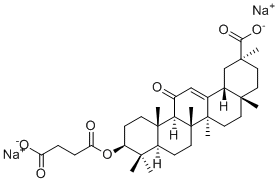
Carbenoxolone sodium (Pyrogastrone; Biogastrone; Bioral; Duogastrone; Sanodin), an analogue of glycyrrhizin, is the active metabolite of Glycyrrhizic acid and an inhibitor of human 11β-HSD and bacterial 3α, 20β-HSD. It is an uncoupling agent for gap junctions and a potent inhibitor of Vaccinia virus replication. Carbenoxolone disodium has the potential to be used for peptic, esophageal and oral ulceration and inflammation.
Physicochemical Properties
| Molecular Formula | C34H48NA2O7 |
| Molecular Weight | 614.73 |
| Exact Mass | 614.32 |
| CAS # | 7421-40-1 |
| Related CAS # | 5697-56-3 (Parent) |
| PubChem CID | 636402 |
| Appearance | White to off-white solid powder |
| Boiling Point | 687.4ºC at 760 mmHg |
| Flash Point | 211.6ºC |
| LogP | 4.158 |
| Hydrogen Bond Donor Count | 0 |
| Hydrogen Bond Acceptor Count | 7 |
| Rotatable Bond Count | 4 |
| Heavy Atom Count | 43 |
| Complexity | 1190 |
| Defined Atom Stereocenter Count | 9 |
| SMILES | C[C@]12CC[C@](C[C@H]1C3=CC(=O)[C@@H]4[C@]5(CC[C@@H](C([C@@H]5CC[C@]4([C@@]3(CC2)C)C)(C)C)OC(=O)CCC(=O)[O-])C)(C)C(=O)[O-].[Na+].[Na+] |
| InChi Key | BQENDLAVTKRQMS-SBBGFIFASA-L |
| InChi Code | InChI=1S/C34H50O7.2Na/c1-29(2)23-10-13-34(7)27(32(23,5)12-11-24(29)41-26(38)9-8-25(36)37)22(35)18-20-21-19-31(4,28(39)40)15-14-30(21,3)16-17-33(20,34)6/h18,21,23-24,27H,8-17,19H2,1-7H3,(H,36,37)(H,39,40)/q2*+1/p-2/t21-,23-,24-,27+,30+,31-,32-,33+,34+/m0../s1 |
| Chemical Name | sodium (2S,4aS,6aS,6bR,8aR,10S,12aS,12bR,14bR)-10-((3-carboxylatopropanoyl)oxy)-2,4a,6a,6b,9,9,12a-heptamethyl-13-oxo-1,2,3,4,4a,5,6,6a,6b,7,8,8a,9,10,11,12,12a,12b,13,14b-icosahydropicene-2-carboxylate |
| Synonyms | PyrogastroneBiogastrone Bioral Duogastrone Sanodin |
| HS Tariff Code | 2934.99.9001 |
| Storage |
Powder-20°C 3 years 4°C 2 years In solvent -80°C 6 months -20°C 1 month Note: Please store this product in a sealed and protected environment, avoid exposure to moisture. |
| Shipping Condition | Room temperature (This product is stable at ambient temperature for a few days during ordinary shipping and time spent in Customs) |
Biological Activity
| ln Vitro | Carbenoxolone disodium (6-150 μM; 1 hour pretreatment) is hazardous to VACV-A5L-EGFP infection for 48 hours and inhibits the vaccinia virus (VACV) from replicating itself in gap junctions in HaCaT cells[2]. In hacat cells, carbenoxolone (30 μM; 1 h pre-treatment) increases late protein A27 expression but does not upregulate PP2A expression [2]. |
| ln Vivo | When compared to saline, carbenoxolone (i.p. ; 100, 200, and 300 mg/kg; 30, 60, and 60 minutes prior to diazepam) exhibits muscle relaxant activity and is superior to the diazepam test in terms of its ability to produce this effect [3]. In mice used in the pentylenetetrazole (PTZ) seizure model, carbenoxolone (ip; 100, 200, and 300 mg/kg; 30, 60, and 60 minutes before to pentylenetetrazole) dramatically lengthens sleep duration and decreases latency in a dose-dependent way. ..83.3 mg/kg is the ED50 value (%95 CL:556.29)[3]. |
| Cell Assay |
Cell Viability Assay[2] Cell Types: HaCaT cells Tested Concentrations: 6 μM, 12 μM, 30 μM, 60 μM, 150 μM Incubation Duration: Pre-treatment 1 hour Experimental Results: Had no toxicity until 48 hrs (hours) at high dose in virus-infected cells. Western Blot Analysis[2] Cell Types: HaCaT cells Tested Concentrations: 30 μM Incubation Duration: Pre-treatment 1 hour Experimental Results: Presented an obvious upregulation of A27. |
| Animal Protocol |
Animal/Disease Models: Male balb/c (Bagg ALBino) mouse[3] Doses: 100, 200 and 300 mg/kg Route of Administration: intraperitoneal (ip)injection; 30, 60 and 60 min before Pentylenetetrazole Experimental Results: Dramatically increased the sleeping time in mice. |
| References |
[1]. Steroid Dehydrogenase Structures, Mechanism of Action, and Disease. Vitam Horm. 2000;58:121-48. [2]. Anticonvulsant, Sedative and Muscle Relaxant Effects of Carbenoxolone in Mice. BMC Pharmacol. 2003 Apr 29;3:3. [3]. Carbenoxolone-mediated Cytotoxicity Inhibits Vaccinia Virus Replication in a Human Keratinocyte Cell Line. Sci Rep. 2018 Nov 16;8(1):16956. [4]. Carbenoxolone-mediated cytotoxicity inhibits Vaccinia virus replication in a human keratinocyte cell line. Sci Rep. 2018 Nov 16;8(1):16956. |
| Additional Infomation |
Carbenoxolone sodium is a triterpenoid. An agent derived from licorice root. It is used for the treatment of digestive tract ulcers, especially in the stomach. Antidiuretic side effects are frequent, but otherwise the drug is low in toxicity. See also: Carbenoxolone (annotation moved to). |
Solubility Data
| Solubility (In Vitro) |
H2O : ~50 mg/mL (~81.34 mM) DMSO : ~16.67 mg/mL (~27.12 mM) |
| Solubility (In Vivo) |
Solubility in Formulation 1: 1.67 mg/mL (2.72 mM) in 10% DMSO + 40% PEG300 + 5% Tween80 + 45% Saline (add these co-solvents sequentially from left to right, and one by one), clear solution; with sonication. For example, if 1 mL of working solution is to be prepared, you can add 100 μL of 16.7 mg/mL clear DMSO stock solution to 400 μL PEG300 and mix evenly; then add 50 μL Tween-80 to the above solution and mix evenly; then add 450 μL normal saline to adjust the volume to 1 mL. Preparation of saline: Dissolve 0.9 g of sodium chloride in 100 mL ddH₂ O to obtain a clear solution. Solubility in Formulation 2: ≥ 1.67 mg/mL (2.72 mM) (saturation unknown) in 10% DMSO + 90% Corn Oil (add these co-solvents sequentially from left to right, and one by one), clear solution. For example, if 1 mL of working solution is to be prepared, you can add 100 μL of 16.7 mg/mL clear DMSO stock solution to 900 μL of corn oil and mix evenly. Solubility in Formulation 3: ≥ 0.93 mg/mL (1.51 mM) (saturation unknown) in 10% DMSO + 90% (20% SBE-β-CD in Saline) (add these co-solvents sequentially from left to right, and one by one), clear solution. For example, if 1 mL of working solution is to be prepared, you can add 100 μL of 9.3 mg/mL clear DMSO stock solution to 900 μL of 20% SBE-β-CD physiological saline solution and mix evenly. Preparation of 20% SBE-β-CD in Saline (4°C,1 week): Dissolve 2 g SBE-β-CD in 10 mL saline to obtain a clear solution. Solubility in Formulation 4: 6.25 mg/mL (10.17 mM) in PBS (add these co-solvents sequentially from left to right, and one by one), clear solution; with ultrasonication (<60°C). (Please use freshly prepared in vivo formulations for optimal results.) |
| Preparing Stock Solutions | 1 mg | 5 mg | 10 mg | |
| 1 mM | 1.6267 mL | 8.1337 mL | 16.2673 mL | |
| 5 mM | 0.3253 mL | 1.6267 mL | 3.2535 mL | |
| 10 mM | 0.1627 mL | 0.8134 mL | 1.6267 mL |