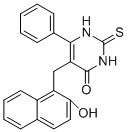
Cambinol (formerly NSC-112546) is a potent SIRT (silent information regulator enzymes) inhibitor with IC50 values of 56 and 59 μM for SIRT1 and SIRT2, respectively. It inhibits NAD-dependent deacetylase activity of human SIRT1 and SIRT2. Inhibition of SIRT1 activity with cambinol during genotoxic stress leads to hyperacetylation of key stress response proteins and promotes cell cycle arrest. Treatment of BCL6-expressing Burkitt lymphoma cells with cambinol as a single agent induced apoptosis, which was accompanied by hyperacetylation of BCL6 and p53. Because acetylation inactivates BCL6 and has the opposite effect on the function of p53 and other checkpoint pathways, the antitumor activity of cambinol in Burkitt lymphoma cells may be accomplished through a combined effect of BCL6 inactivation and checkpoint activation. Cambinol was well tolerated in mice and inhibited growth of Burkitt lymphoma xenografts.
Physicochemical Properties
| Molecular Formula | C21H16N2O2S | |
| Molecular Weight | 360.43 | |
| Exact Mass | 360.093 | |
| CAS # | 14513-15-6 | |
| Related CAS # |
|
|
| PubChem CID | 3246390 | |
| Appearance | White to off-white solid powder | |
| Density | 1.4±0.1 g/cm3 | |
| Boiling Point | 667ºC at 760mmHg | |
| Melting Point | 235 °C(dec.) | |
| Flash Point | 357.2ºC | |
| Vapour Pressure | 2.12E-18mmHg at 25°C | |
| Index of Refraction | 1.771 | |
| LogP | 4.71 | |
| Hydrogen Bond Donor Count | 3 | |
| Hydrogen Bond Acceptor Count | 3 | |
| Rotatable Bond Count | 3 | |
| Heavy Atom Count | 26 | |
| Complexity | 597 | |
| Defined Atom Stereocenter Count | 0 | |
| InChi Key | RVNSQVIUFZVNAU-UHFFFAOYSA-N | |
| InChi Code | InChI=1S/C21H16N2O2S/c24-18-11-10-13-6-4-5-9-15(13)16(18)12-17-19(14-7-2-1-3-8-14)22-21(26)23-20(17)25/h1-11,24H,12H2,(H2,22,23,25,26) | |
| Chemical Name |
|
|
| Synonyms |
|
|
| HS Tariff Code | 2934.99.9001 | |
| Storage |
Powder-20°C 3 years 4°C 2 years In solvent -80°C 6 months -20°C 1 month Note: This product requires protection from light (avoid light exposure) during transportation and storage. |
|
| Shipping Condition | Room temperature (This product is stable at ambient temperature for a few days during ordinary shipping and time spent in Customs) |
Biological Activity
| ln Vitro | Human SIRT1 and SIRT2 NAD-dependent deacetylase activity is inhibited by cambinol. Using Cambinol to inhibit SIRT1 activity during genotoxic stress causes important stress response proteins to become hyperacetylated, which in turn encourages cell cycle arrest. When cambinol is used alone to treat BCL6-expressing Burkitt lymphoma cells, it causes apoptosis along with hyperacetylation of p53 and BCL6. Cambinol exhibits no action against SIRT3 and only modest inhibition of SIRT5 (42% inhibition at 300 μM) [1]. | ||
| ln Vivo | In mice, camebinol (100 mg/kg) is well tolerated and suppresses the growth of xenografts with Burkitt lymphoma. Animals treated with cambinol do not significantly lose weight in comparison to controls. Novel anticancer drugs could be NAD-dependent deacetylase inhibitors[1]. | ||
| Animal Protocol |
|
||
| References |
[1]. Antitumor activity of a small-molecule inhibitor of human silent information regulator 2 enzymes. Cancer Res. 2006 Apr 15;66(8):4368-77. [2]. Advances in the discovery of exosome inhibitors in cancer. J Enzyme Inhib Med Chem. 2020 Dec;35(1):1322-1330. |
||
| Additional Infomation |
Cambinol is a beta-naphtol derivative that inhibits NAD-dependant deacetylases to reduce cell survival under stress. This activity is currently being investigated for its use as a cancer treatment. Mechanism of Action Cambinol inhibits the NAD-dependant deacetylases SIRT1 and SIRT2, members of a protein family known as sirtuins. Inhibiting SIRT1 and SIRT2 while cells are under stress increases acetylation of p53, Ku70, and Foxo3a. This inhibition sensitizes cells to the action of drugs like [etoposide] and [paclitaxel], not just other drugs that damage DNA. Although the mechanism of this sensitizing is not defined, it is not dependent on p53, Ku70, or Foxo3a. The independent mechanism suggests the existence of more molecular targets. Cambinol is noncompetitive against NAD and competitive against H-4 peptide, substrates of SIRT2. Inhibiting SIRT2 increases the acetylation of tubulin. Cambinol also increases the acetylation of BCL6, a protein necessary for oncogenesis. Cambinol is also a weak inhibitor of SIRT5. |
Solubility Data
| Solubility (In Vitro) |
|
|||
| Solubility (In Vivo) |
Solubility in Formulation 1: ≥ 2.08 mg/mL (5.77 mM) (saturation unknown) in 10% DMSO + 40% PEG300 + 5% Tween80 + 45% Saline (add these co-solvents sequentially from left to right, and one by one), clear solution. For example, if 1 mL of working solution is to be prepared, you can add 100 μL of 20.8 mg/mL clear DMSO stock solution to 400 μL PEG300 and mix evenly; then add 50 μL Tween-80 to the above solution and mix evenly; then add 450 μL normal saline to adjust the volume to 1 mL. Preparation of saline: Dissolve 0.9 g of sodium chloride in 100 mL ddH₂ O to obtain a clear solution. Solubility in Formulation 2: ≥ 2.08 mg/mL (5.77 mM) (saturation unknown) in 10% DMSO + 90% Corn Oil (add these co-solvents sequentially from left to right, and one by one), clear solution. For example, if 1 mL of working solution is to be prepared, you can add 100 μL of 20.8 mg/mL clear DMSO stock solution to 900 μL of corn oil and mix evenly. (Please use freshly prepared in vivo formulations for optimal results.) |
| Preparing Stock Solutions | 1 mg | 5 mg | 10 mg | |
| 1 mM | 2.7745 mL | 13.8723 mL | 27.7446 mL | |
| 5 mM | 0.5549 mL | 2.7745 mL | 5.5489 mL | |
| 10 mM | 0.2774 mL | 1.3872 mL | 2.7745 mL |