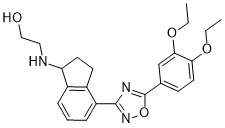
CYM-5442 is anovel, potent and highly-selective S1P1 (Spingosine 1-Phosphate Receptor 1) agonist which reduces the severity of acute GVHD by inhibiting macrophage recruitment. CYM-5442 prevented aGVHD but only markedly inhibited it. Tissue macrophages originate from monocytes, which migrate less when treated with CYM-5442 because it downregulates the expression of CCL2 and CCL7 in endothelial cells. CYM-5442 could be a possible course of treatment for aGVHD.
Physicochemical Properties
| Molecular Formula | C23H27N3O4 |
| Molecular Weight | 409.486 |
| Exact Mass | 409.2 |
| Elemental Analysis | C, 67.46; H, 6.65; N, 10.26; O, 15.63 |
| CAS # | 1094042-01-9 |
| Related CAS # | CYM5442 hydrochloride; 1783987-80-3 |
| PubChem CID | 25110406 |
| Appearance | Light yellow to light brown solid powder |
| LogP | 4.161 |
| Hydrogen Bond Donor Count | 2 |
| Hydrogen Bond Acceptor Count | 7 |
| Rotatable Bond Count | 9 |
| Heavy Atom Count | 30 |
| Complexity | 525 |
| Defined Atom Stereocenter Count | 0 |
| SMILES | O1C(C2C([H])=C([H])C(=C(C=2[H])OC([H])([H])C([H])([H])[H])OC([H])([H])C([H])([H])[H])=NC(C2C([H])=C([H])C([H])=C3C=2C([H])([H])C([H])([H])C3([H])N([H])C([H])([H])C([H])([H])O[H])=N1 |
| InChi Key | NUIKTBLZSPQGCP-UHFFFAOYSA-N |
| InChi Code | InChI=1S/C23H27N3O4/c1-3-28-20-11-8-15(14-21(20)29-4-2)23-25-22(26-30-23)18-7-5-6-17-16(18)9-10-19(17)24-12-13-27/h5-8,11,14,19,24,27H,3-4,9-10,12-13H2,1-2H3 |
| Chemical Name | 2-[[4-[5-(3,4-diethoxyphenyl)-1,2,4-oxadiazol-3-yl]-2,3-dihydro-1H-inden-1-yl]amino]ethanol |
| Synonyms | CYM 5442; CYM-5442; CYM5442 |
| HS Tariff Code | 2934.99.9001 |
| Storage |
Powder-20°C 3 years 4°C 2 years In solvent -80°C 6 months -20°C 1 month |
| Shipping Condition | Room temperature (This product is stable at ambient temperature for a few days during ordinary shipping and time spent in Customs) |
Biological Activity
| Targets | Sphingosine 1-phosphate (S1P1) receptor ( EC50 = 1.35 nM ) |
| ln Vitro | Treatment with CYM5442 (0.5 μM; 0-60 min; HEK293 cells) stimulates S1P1 phosphorylation in a time-dependent manner in P32 orthophosphate-labeled cells [1]. Medium/p44-MAPK phosphorylation, EC50 is 46 nM. The alanine R120 (R120A) mutant retained p42/p44-MAPK activity (EC50 of 67 nM) when stained with CYM5442. CYM5442 activates p42/p44-MAPK in E121A S1P1 cells in a concentration-dependent manner, with an average EC50 value of 134 nM [1]. Western Blot Analysis[1] Cell line: HEK293 cells stably expressing S1P1 fused to GFP at the carboxyl terminus Concentration: 0.5 µM Incubation time: 0 min, 2 min, 5 min, 10 min, 30 min, 60 min Results: in time Stimulates S1P1 phosphorylation in a dependent manner. |
| ln Vivo | CYM5442 (1 mg/kg; intraperitoneal injection; daily; for 5 days; male albinism Wistar status) treatment showed preservation of courtyard function at the courtyard evoked potential (VEP). CYM-treated animals compared to vehicle The fibrous layer (RNFL) is significantly thicker [2]. 1 mg/kg Administration: intraperitoneal injection; daily; continued for 5 days Results: Visual evoked potential (VEP) showed preservation of visual function. The number of retinal ganglion cells (RGC) increased significantly. |
| Cell Assay |
Cell Line: HEK293 cells stably expressing S1P1 fused to GFP on the carboxy-terminus Concentration: 0.5 µM Incubation Time: 0 minutes, 2 minutes, 5 minutes, 10 minutes, 30 minutes, 60 minutes Result: Stimulated S1P1 phosphorylation in a time-dependent manner. |
| Animal Protocol |
Adult male albino Wistar rats (8-10 weeks old; 180-230 g) infected ocular endothelin-1 (ET-1) 1 mg/kg Intraperitoneal injection; daily; for 5 days |
| References |
[1]. Full pharmacological efficacy of a novel S1P1 agonist that does not require S1P-like headgroup interactions. Mol Pharmacol. 2008 Nov;74(5):1308-18. [2]. The S1P1 receptor-selective agonist CYM-5442 protects retinal ganglion cells in endothelin-1 induced retinal ganglion cell loss. Exp Eye Res. 2017 Nov;164:37-45. |
| Additional Infomation | CYM5442 is an oxadiazole and a ring assembly. |
Solubility Data
| Solubility (In Vitro) | DMSO: ~2.6 mg/mL (~6.4 mM) |
| Solubility (In Vivo) |
Note: Listed below are some common formulations that may be used to formulate products with low water solubility (e.g. < 1 mg/mL), you may test these formulations using a minute amount of products to avoid loss of samples. Injection Formulations (e.g. IP/IV/IM/SC) Injection Formulation 1: DMSO : Tween 80: Saline = 10 : 5 : 85 (i.e. 100 μL DMSO stock solution → 50 μL Tween 80 → 850 μL Saline) *Preparation of saline: Dissolve 0.9 g of sodium chloride in 100 mL ddH ₂ O to obtain a clear solution. Injection Formulation 2: DMSO : PEG300 :Tween 80 : Saline = 10 : 40 : 5 : 45 (i.e. 100 μL DMSO → 400 μLPEG300 → 50 μL Tween 80 → 450 μL Saline) Injection Formulation 3: DMSO : Corn oil = 10 : 90 (i.e. 100 μL DMSO → 900 μL Corn oil) Example: Take the Injection Formulation 3 (DMSO : Corn oil = 10 : 90) as an example, if 1 mL of 2.5 mg/mL working solution is to be prepared, you can take 100 μL 25 mg/mL DMSO stock solution and add to 900 μL corn oil, mix well to obtain a clear or suspension solution (2.5 mg/mL, ready for use in animals). Injection Formulation 4: DMSO : 20% SBE-β-CD in saline = 10 : 90 [i.e. 100 μL DMSO → 900 μL (20% SBE-β-CD in saline)] *Preparation of 20% SBE-β-CD in Saline (4°C,1 week): Dissolve 2 g SBE-β-CD in 10 mL saline to obtain a clear solution. Injection Formulation 5: 2-Hydroxypropyl-β-cyclodextrin : Saline = 50 : 50 (i.e. 500 μL 2-Hydroxypropyl-β-cyclodextrin → 500 μL Saline) Injection Formulation 6: DMSO : PEG300 : castor oil : Saline = 5 : 10 : 20 : 65 (i.e. 50 μL DMSO → 100 μLPEG300 → 200 μL castor oil → 650 μL Saline) Injection Formulation 7: Ethanol : Cremophor : Saline = 10: 10 : 80 (i.e. 100 μL Ethanol → 100 μL Cremophor → 800 μL Saline) Injection Formulation 8: Dissolve in Cremophor/Ethanol (50 : 50), then diluted by Saline Injection Formulation 9: EtOH : Corn oil = 10 : 90 (i.e. 100 μL EtOH → 900 μL Corn oil) Injection Formulation 10: EtOH : PEG300:Tween 80 : Saline = 10 : 40 : 5 : 45 (i.e. 100 μL EtOH → 400 μLPEG300 → 50 μL Tween 80 → 450 μL Saline) Oral Formulations Oral Formulation 1: Suspend in 0.5% CMC Na (carboxymethylcellulose sodium) Oral Formulation 2: Suspend in 0.5% Carboxymethyl cellulose Example: Take the Oral Formulation 1 (Suspend in 0.5% CMC Na) as an example, if 100 mL of 2.5 mg/mL working solution is to be prepared, you can first prepare 0.5% CMC Na solution by measuring 0.5 g CMC Na and dissolve it in 100 mL ddH2O to obtain a clear solution; then add 250 mg of the product to 100 mL 0.5% CMC Na solution, to make the suspension solution (2.5 mg/mL, ready for use in animals). Oral Formulation 3: Dissolved in PEG400 Oral Formulation 4: Suspend in 0.2% Carboxymethyl cellulose Oral Formulation 5: Dissolve in 0.25% Tween 80 and 0.5% Carboxymethyl cellulose Oral Formulation 6: Mixing with food powders Note: Please be aware that the above formulations are for reference only. InvivoChem strongly recommends customers to read literature methods/protocols carefully before determining which formulation you should use for in vivo studies, as different compounds have different solubility properties and have to be formulated differently. (Please use freshly prepared in vivo formulations for optimal results.) |
| Preparing Stock Solutions | 1 mg | 5 mg | 10 mg | |
| 1 mM | 2.4421 mL | 12.2103 mL | 24.4206 mL | |
| 5 mM | 0.4884 mL | 2.4421 mL | 4.8841 mL | |
| 10 mM | 0.2442 mL | 1.2210 mL | 2.4421 mL |