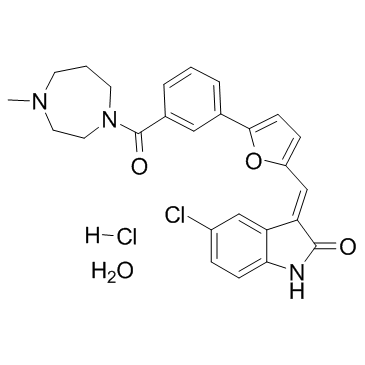
CX-6258 HCl hydrate is a novel, potent, selective and orally bioactive pan-Pim kinase inhibitor with IC50 of 5 nM, 25 nM and 16 nM for Pim1, Pim2, and Pim3, respectively. At CX-6258 showed robust antiproliferative potencies against all cell lines tested derived from human solid tumors and hematological malignancies. In mechanistic cellular assays with MV-4-11 human AML cells, caused dose-dependent inhibition of the phosphorylation of 2 pro-survival proteins, Bad and 4E-BP1, at the Pim kinase specific sites S112 and S65 and T37/46, respectively.
Physicochemical Properties
| Molecular Formula | C26H27CL2N3O4 |
| Molecular Weight | 516.416284799576 |
| Exact Mass | 515.137 |
| CAS # | 1353858-99-7 |
| Related CAS # | CX-6258;1202916-90-2 |
| PubChem CID | 74892460 |
| Appearance | Yellow to orange solid powder |
| LogP | 5.621 |
| Hydrogen Bond Donor Count | 3 |
| Hydrogen Bond Acceptor Count | 5 |
| Rotatable Bond Count | 3 |
| Heavy Atom Count | 35 |
| Complexity | 774 |
| Defined Atom Stereocenter Count | 0 |
| SMILES | CN1CCCN(CC1)C(=O)C2=CC=CC(=C2)C3=CC=C(O3)/C=C/4\C5=C(C=CC(=C5)Cl)NC4=O.O.Cl |
| InChi Key | ZOZTWDKBSOVPDP-LLDDCTHSSA-N |
| InChi Code | InChI=1S/C26H24ClN3O3.ClH.H2O/c1-29-10-3-11-30(13-12-29)26(32)18-5-2-4-17(14-18)24-9-7-20(33-24)16-22-21-15-19(27)6-8-23(21)28-25(22)31;;/h2,4-9,14-16H,3,10-13H2,1H3,(H,28,31);1H;1H2/b22-16+;; |
| Chemical Name | (3E)-5-chloro-3-[[5-[3-(4-methyl-1,4-diazepane-1-carbonyl)phenyl]furan-2-yl]methylidene]-1H-indol-2-one;hydrate;hydrochloride |
| HS Tariff Code | 2934.99.9001 |
| Storage |
Powder-20°C 3 years 4°C 2 years In solvent -80°C 6 months -20°C 1 month Note: Please store this product in a sealed and protected environment, avoid exposure to moisture. |
| Shipping Condition | Room temperature (This product is stable at ambient temperature for a few days during ordinary shipping and time spent in Customs) |
Biological Activity
| ln Vitro | Two pro-survival proteins, Bad and 4E-BP1, are phosphorylated at Pim kinase specific sites S112, S65, and T37/46, respectively, and are inhibited by CX-6258 in a dose-dependent manner[1]. In PC3 cells, CX-6258 treatment (12 mM, 3 h) reduces steady-state levels of ectopic NKX3.1[2]. The half-life of NKX3.1 is significantly shortened by CX-6258 treatment[2]. |
| ln Vivo | Two Pim kinases-driven tumor models demonstrate strong in vivo effectiveness for CX-6258 (50-100 mg/kg; po; daily; for 21 days)[1]. |
| Cell Assay |
Western Blot Analysis[1] Cell Types: MV-4-11 human AML cells. Tested Concentrations: 0.1 μM, 1 μM, 10 μM. Incubation Duration: 2 hrs (hours). Experimental Results: Caused dose dependent inhibition of the phosphorylation of two pro-survival proteins, Bad and 4E-BP1, at the Pim kinase specific sites S112 and S65 and T37/46, respectively. |
| Animal Protocol |
Animal/Disease Models: Nude mice, MV-4-11 xenograft models[1] Doses: 50 mg/kg, 100 mg/kg. Route of Administration: Oral administration; one time/day; over a period of 21 days. Experimental Results: demonstrated dose dependent efficacy, with a 50 mg/kg dose producing 45% tumor growth inhibition (TGI) and a 100 mg/kg dose producing 75% TGI. |
| References |
[1]. Mustapha Haddach, Jerome Michaux, Michael K, Discovery of CX-6258. A Potent, Selective, and Orally Efficacious pan-Pim Kinases Inhibitor. ACS Med. Chem. Lett., 2012, 3 (2), pp 135-139. [2]. Padmanabhan A, Gosc EB, Bieberich CJ. Stabilization of the prostate-specific tumor suppressor NKX3.1 by the oncogenic protein kinase Pim-1 in prostate cancer cells. J Cell Biochem. 2013 May;114(5):1050-7. |
Solubility Data
| Solubility (In Vitro) |
DMSO : ~25 mg/mL (~48.41 mM) H2O : ~7.14 mg/mL (~13.83 mM) |
| Solubility (In Vivo) |
Solubility in Formulation 1: ≥ 2.5 mg/mL (4.84 mM) (saturation unknown) in 10% DMSO + 40% PEG300 + 5% Tween80 + 45% Saline (add these co-solvents sequentially from left to right, and one by one), clear solution. For example, if 1 mL of working solution is to be prepared, you can add 100 μL of 25.0 mg/mL clear DMSO stock solution to 400 μL PEG300 and mix evenly; then add 50 μL Tween-80 to the above solution and mix evenly; then add 450 μL normal saline to adjust the volume to 1 mL. Preparation of saline: Dissolve 0.9 g of sodium chloride in 100 mL ddH₂ O to obtain a clear solution. Solubility in Formulation 2: ≥ 2.5 mg/mL (4.84 mM) (saturation unknown) in 10% DMSO + 90% Corn Oil (add these co-solvents sequentially from left to right, and one by one), clear solution. For example, if 1 mL of working solution is to be prepared, you can add 100 μL of 25.0 mg/mL clear DMSO stock solution to 900 μL of corn oil and mix evenly. Solubility in Formulation 3: 20 mg/mL (38.73 mM) in 20% HP-β-CD in Saline (add these co-solvents sequentially from left to right, and one by one), suspension solution; Need ultrasonic and warming and heat to 48°C. Preparation of saline: Dissolve 0.9 g of sodium chloride in 100 mL ddH₂ O to obtain a clear solution. (Please use freshly prepared in vivo formulations for optimal results.) |
| Preparing Stock Solutions | 1 mg | 5 mg | 10 mg | |
| 1 mM | 1.9364 mL | 9.6820 mL | 19.3641 mL | |
| 5 mM | 0.3873 mL | 1.9364 mL | 3.8728 mL | |
| 10 mM | 0.1936 mL | 0.9682 mL | 1.9364 mL |