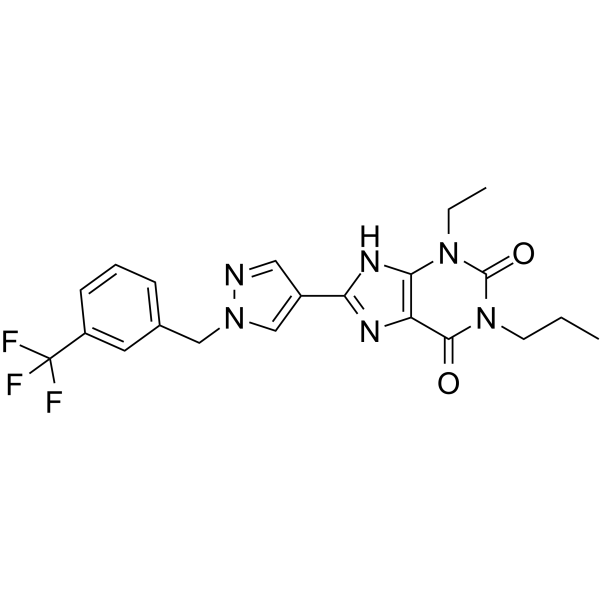
Physicochemical Properties
| Molecular Formula | C21H21F3N6O2 |
| Molecular Weight | 446.42 |
| Exact Mass | 446.168 |
| CAS # | 752222-83-6 |
| PubChem CID | 11270783 |
| Appearance | White to light brown solid powder |
| Density | 1.44 |
| Boiling Point | 538.4ºC at 760 mmHg |
| Index of Refraction | 1.64 |
| LogP | 3.246 |
| Hydrogen Bond Donor Count | 1 |
| Hydrogen Bond Acceptor Count | 7 |
| Rotatable Bond Count | 6 |
| Heavy Atom Count | 32 |
| Complexity | 708 |
| Defined Atom Stereocenter Count | 0 |
| SMILES | CCCN1C(=O)C2=C(NC(=N2)C3=CN(CC4=CC(=CC=C4)C(F)(F)F)N=C3)N(CC)C1=O |
| InChi Key | KOYXXLLNCXWUNF-UHFFFAOYSA-N |
| InChi Code | InChI=1S/C21H21F3N6O2/c1-3-8-30-19(31)16-18(29(4-2)20(30)32)27-17(26-16)14-10-25-28(12-14)11-13-6-5-7-15(9-13)21(22,23)24/h5-7,9-10,12H,3-4,8,11H2,1-2H3,(H,26,27) |
| Chemical Name | 3-ethyl-1-propyl-8-[1-[[3-(trifluoromethyl)phenyl]methyl]pyrazol-4-yl]-7H-purine-2,6-dione |
| Synonyms | CVT-6883; CVT 6883; CVT6883 |
| HS Tariff Code | 2934.99.9001 |
| Storage |
Powder-20°C 3 years 4°C 2 years In solvent -80°C 6 months -20°C 1 month |
| Shipping Condition | Room temperature (This product is stable at ambient temperature for a few days during ordinary shipping and time spent in Customs) |
Biological Activity
| ln Vivo | The plasma levels of IL-6, TNF-α, E-selectin, ICAM-1, and VCAM are dramatically reduced by GS-6201 (CVT-6883) (4 mg/kg; i.p.; every 12 hours for 14 days) [ 2]. Left and right ventricular hypertrophy and dysfunction were brought on by GS-6201 (4 mg/kg; intraperitoneal; every 12 hours for 14 days); these effects were markedly reduced after 7 days and persisted after 14 and 28 days [2]. The oral GS-6201 (2 mg/kg) therapy showed a Cmax of 1110 ng/mL, a dAUC of 6500 ng·h/mL, and a t1/2 of 4.25 hours, respectively [1]. |
| Animal Protocol |
Animal/Disease Models: Adult outbred male CD1 mice (8-12 weeks old, AMI model) [2] Doses: 4 mg/kg Route of Administration: intraperitoneal (ip) injection; every 12 hrs (hrs (hours)) for 14 days Experimental Results: IL-6 , TNF-α, E-selectin, ICAM-1 and VCAM plasma levels were Dramatically diminished. Animal/Disease Models: SD (SD (Sprague-Dawley)) rat[1] Doses: 2 mg/kg Route of Administration: po (pharmacokinetic/PK/PK analysis) Experimental Results: Cmax, dAUC and t1/2 were 1110 ng/mL, 6500 ng·h/ mL and 4.25 hrs (hrs (hours)). |
| References |
[1]. Elzein E, et al. Discovery of a novel A2B adenosine receptor antagonist as a clinical candidate for chronic inflammatory airway diseases. J Med Chem. 2008 Apr 10;51(7):2267-78. [2]. Toldo S, et al. GS-6201, a selective blocker of the A2B adenosine receptor, attenuates cardiac remodeling after acute myocardial infarction in the mouse. J Pharmacol Exp Ther. 2012 Dec;343(3):587-95. [3]. Mustafa SJ, et al. Effect of a specific and selective A(2B) adenosine receptor antagonist on adenosine agonist AMP and allergen-induced airway responsiveness and cellular influx in a mouse model of asthma. J Pharmacol Exp Ther. 2007 Mar;320(3):1246-51. |
| Additional Infomation |
CVT-6883 is a selective, potent and orally available A2B-adenosine receptor antagonist which CV Therapeutics is investigating for the potential treatment of asthma and other conditions related to inflammation and fibrosis. Drug Indication Investigated for use/treatment in asthma. |
Solubility Data
| Solubility (In Vitro) | DMSO : ~100 mg/mL (~224.00 mM) |
| Solubility (In Vivo) |
Solubility in Formulation 1: 2 mg/mL (4.48 mM) in 10% DMSO + 40% PEG300 + 5% Tween80 + 45% Saline (add these co-solvents sequentially from left to right, and one by one), suspension solution; with sonication. For example, if 1 mL of working solution is to be prepared, you can add 100 μL of 20.0 mg/mL clear DMSO stock solution to 400 μL PEG300 and mix evenly; then add 50 μL Tween-80 to the above solution and mix evenly; then add 450 μL normal saline to adjust the volume to 1 mL. Preparation of saline: Dissolve 0.9 g of sodium chloride in 100 mL ddH₂ O to obtain a clear solution. Solubility in Formulation 2: ≥ 2 mg/mL (4.48 mM) (saturation unknown) in 10% DMSO + 90% Corn Oil (add these co-solvents sequentially from left to right, and one by one), clear solution. For example, if 1 mL of working solution is to be prepared, you can add 100 μL of 20.0 mg/mL clear DMSO stock solution to 900 μL of corn oil and mix evenly. (Please use freshly prepared in vivo formulations for optimal results.) |
| Preparing Stock Solutions | 1 mg | 5 mg | 10 mg | |
| 1 mM | 2.2400 mL | 11.2002 mL | 22.4004 mL | |
| 5 mM | 0.4480 mL | 2.2400 mL | 4.4801 mL | |
| 10 mM | 0.2240 mL | 1.1200 mL | 2.2400 mL |