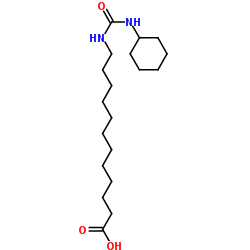
CUDA is a novel and potent inhibitor of sEH (soluble epoxide hydrolase) with potential to be used in cardiovascular disease. It inhibits sEH with IC50s of 11.1 nM and 112 nM for mouse sEH and human sEH, respectively. CUDA selectively increases peroxisome proliferator-activated receptor (PPAR) alpha activity
Physicochemical Properties
| Molecular Formula | C19H36N2O3 |
| Molecular Weight | 340.500745773315 |
| Exact Mass | 340.272 |
| CAS # | 479413-68-8 |
| PubChem CID | 22978774 |
| Appearance | White to off-white solid powder |
| Density | 1.0±0.1 g/cm3 |
| Boiling Point | 549.4±19.0 °C at 760 mmHg |
| Flash Point | 286.1±21.5 °C |
| Vapour Pressure | 0.0±3.2 mmHg at 25°C |
| Index of Refraction | 1.501 |
| LogP | 4.79 |
| Hydrogen Bond Donor Count | 3 |
| Hydrogen Bond Acceptor Count | 3 |
| Rotatable Bond Count | 13 |
| Heavy Atom Count | 24 |
| Complexity | 342 |
| Defined Atom Stereocenter Count | 0 |
| InChi Key | HPTJABJPZMULFH-UHFFFAOYSA-N |
| InChi Code | InChI=1S/C19H36N2O3/c22-18(23)15-11-6-4-2-1-3-5-7-12-16-20-19(24)21-17-13-9-8-10-14-17/h17H,1-16H2,(H,22,23)(H2,20,21,24) |
| Chemical Name | 12-(cyclohexylcarbamoylamino)dodecanoic acid |
| HS Tariff Code | 2934.99.9001 |
| Storage |
Powder-20°C 3 years 4°C 2 years In solvent -80°C 6 months -20°C 1 month |
| Shipping Condition | Room temperature (This product is stable at ambient temperature for a few days during ordinary shipping and time spent in Customs) |
Biological Activity
| Targets |
|
|
| ln Vitro | In COS-7 cells, CUDA (10 μM; 18 hours) stimulates PPARalpha by 6 and 3 times, respectively[2]. In addition to competitively inhibiting Wy-14643 (pirinixic acid) from binding to the PPARalpha ligand binding domain, CUDA does not change the expression of the PPARalpha protein, indicating that it is a PPARalpha ligand[2]. | |
| Cell Assay |
Western Blot Analysis[2] Cell Types: COS-7 cells Tested Concentrations: 10 μM Incubation Duration: 18 hrs (hours) Experimental Results: Activated PPARα by binding to the ligand binding domain of PPARα. |
|
| References |
[1]. Structural refinement of inhibitors of urea-based soluble epoxide hydrolases. Biochem Pharmacol. 2002 May 1;63(9):1599-608. [2]. Activation of peroxisome proliferator-activated receptor alpha by substituted urea-derived soluble epoxide hydrolase inhibitors. J Pharmacol Exp Ther. 2005 Jul;314(1):260-70. |
|
| Additional Infomation | 12-[(Cyclohexylcarbamoyl)amino]dodecanoic acid is a medium-chain fatty acid. |
Solubility Data
| Solubility (In Vitro) | DMSO : ~25 mg/mL (~73.42 mM) |
| Solubility (In Vivo) |
Solubility in Formulation 1: ≥ 0.5 mg/mL (1.47 mM) (saturation unknown) in 10% DMSO + 90% Corn Oil (add these co-solvents sequentially from left to right, and one by one), clear solution. For example, if 1 mL of working solution is to be prepared, you can add 100 μL of 5.0 mg/mL clear DMSO stock solution to 900 μL of corn oil and mix evenly. (Please use freshly prepared in vivo formulations for optimal results.) |
| Preparing Stock Solutions | 1 mg | 5 mg | 10 mg | |
| 1 mM | 2.9369 mL | 14.6843 mL | 29.3686 mL | |
| 5 mM | 0.5874 mL | 2.9369 mL | 5.8737 mL | |
| 10 mM | 0.2937 mL | 1.4684 mL | 2.9369 mL |