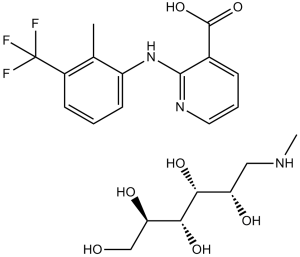
Flunixin Meglumin (Banamine; Flumeglumine; Flunixin-S), a non-steroidal anti-inflammatory drug (NSAID), is a potent inhibitor of the enzyme COX-cyclooxygenase with analgesic, anti-inflammatory and antipyretic activities. Flunixin meglumine is alsoa non-narcotic and non-steroidal analgesic agent with antipyretic activity. In addition, Flunixin meglumine may be used as a drug in animals for the management of intestinal ischaemia, colic, and endotoxemia.
Physicochemical Properties
| Molecular Formula | C14H11F3N2O2.C7H17NO5 | |
| Molecular Weight | 491.46 | |
| Exact Mass | 491.187 | |
| CAS # | 42461-84-7 | |
| Related CAS # | Flunixin-d3;1015856-60-6 | |
| PubChem CID | 39212 | |
| Appearance | White to off-white solid powder | |
| Density | 1.403 g/cm3 | |
| Boiling Point | 378.7ºC at 760 mmHg | |
| Melting Point | 136-138ºC | |
| Flash Point | 182.8ºC | |
| LogP | 0.956 | |
| Hydrogen Bond Donor Count | 8 | |
| Hydrogen Bond Acceptor Count | 13 | |
| Rotatable Bond Count | 9 | |
| Heavy Atom Count | 34 | |
| Complexity | 510 | |
| Defined Atom Stereocenter Count | 4 | |
| SMILES | CC1=C(C=CC=C1NC2=C(C=CC=N2)C(=O)O)C(F)(F)F.CNC[C@@H]([C@H]([C@@H]([C@@H](CO)O)O)O)O |
|
| InChi Key | MGCCHNLNRBULBU-WZTVWXICSA-N | |
| InChi Code | InChI=1S/C14H11F3N2O2.C7H17NO5/c1-8-10(14(15,16)17)5-2-6-11(8)19-12-9(13(20)21)4-3-7-18-12;1-8-2-4(10)6(12)7(13)5(11)3-9/h2-7H,1H3,(H,18,19)(H,20,21);4-13H,2-3H2,1H3/t;4-,5+,6+,7+/m.0/s1 | |
| Chemical Name | (2R,3R,4R,5S)-6-(methylamino)hexane-1,2,3,4,5-pentaol 2-((2-methyl-3-(trifluoromethyl)phenyl)amino)nicotinate | |
| Synonyms |
|
|
| HS Tariff Code | 2934.99.9001 | |
| Storage |
Powder-20°C 3 years 4°C 2 years In solvent -80°C 6 months -20°C 1 month Note: Please store this product in a sealed and protected environment, avoid exposure to moisture. |
|
| Shipping Condition | Room temperature (This product is stable at ambient temperature for a few days during ordinary shipping and time spent in Customs) |
Biological Activity
| Targets |
Cyclooxygenase-1 (COX-1) (no IC50; Flunixin Meglumine at 2.2 mg/kg (i.v.) reduced sheep platelet COX-1-derived thromboxane B2 (TXB2) by 92 ± 3% at 2 h post-administration) [1] - Cyclooxygenase-2 (COX-2) (no IC50; Flunixin Meglumine at 2.2 mg/kg (i.v.) reduced sheep synovial fluid COX-2-derived prostaglandin E2 (PGE2) by 88 ± 4% at 2 h post-administration) [1] - Nuclear Factor-κB (NF-κB) (no IC50; Flunixin Meglumine at 10 μM reduced LPS-induced NF-κB p65 nuclear translocation by 45 ± 4% in bovine aortic endothelial cells (BAECs)) [2] |
| ln Vitro |
In RAW 264.7 murine macrophages, flunixin meglumine (10-1000 μM, 2 h) suppresses the activity of inducible nitric oxide synthase (iNOS) induced by lipopolysaccharide (LPS)[2]. In RAW 264.7 murine macrophages, lipopolysaccharide-induced activation of nuclear factor kappa B (NfκB) is inhibited by flunixin meglumine (10-1000 μM, 2 h)[2]. 1. Inhibition of NF-κB activation and inflammatory mediator secretion (BAECs): Bovine aortic endothelial cells (BAECs) were cultured in DMEM supplemented with 10% fetal bovine serum (FBS) and 1% penicillin-streptomycin. Cells were plated in 6-well plates (2×10⁵ cells/well) and pre-treated with Flunixin Meglumine (1 μM, 5 μM, 10 μM) for 1 h, then stimulated with LPS (1 μg/mL) for 24 h. Immunofluorescence staining showed that 10 μM flunixin meglumine reduced LPS-induced NF-κB p65 nuclear translocation by 45 ± 4% compared to the LPS-only group. ELISA analysis of culture supernatant revealed that 10 μM flunixin meglumine decreased PGE2 secretion by 38 ± 3% and TNF-α secretion by 32 ± 4%. MTT assay showed no significant cytotoxicity at concentrations ≤10 μM (cell viability ≥90% vs. control) [2] |
| ln Vivo |
Treatment with flunixin meglumine (intravenous injection; 1.1 mg/kg; once) decreases the production of serum TXB2 and exudate PGE2[1]. 1. Anti-inflammatory and antipyretic effects in sheep: Male Merino sheep (40-50 kg, n=6/group) were randomly divided into control group, flunixin meglumine 1.1 mg/kg group, and flunixin meglumine 2.2 mg/kg group. All drugs were administered as a single intravenous injection. For COX inhibition assessment: Blood samples were collected at 0.5, 1, 2, 4, 8 hours post-administration. Plasma TXB2 (COX-1 marker) in the 2.2 mg/kg group was reduced by 89 ± 4% (2 h post-administration) and 72 ± 5% (4 h post-administration) compared to baseline. Synovial fluid PGE2 (COX-2 marker) in the 2.2 mg/kg group was reduced by 88 ± 4% (2 h) and 68 ± 6% (4 h). For antipyretic assessment: Sheep were injected with LPS (1 μg/kg, i.v.) to induce fever 1 hour after drug administration. The 2.2 mg/kg group showed a maximum body temperature reduction of 1.2 ± 0.2°C (4 h post-LPS), compared to the control group (fever increase of 1.8 ± 0.2°C) [1] 2. Central anti-inflammatory effect in sheep: Cerebrospinal fluid (CSF) was collected from sheep via lumbar puncture 2 hours post-drug administration. The 2.2 mg/kg flunixin meglumine group had a 75 ± 5% reduction in CSF PGE2 concentration compared to the control group, indicating central inhibition of COX-2 activity [1] |
| Cell Assay |
Cell Viability Assay[2] Cell Types: RAW 264.7 murine macrophages Tested Concentrations: 10, 100, 300, and 1000 μM Incubation Duration: 2 hrs (hours) Experimental Results: Inhibited LPS-induced nitric oxide release at concentrations between 100 and 1,000 µM (P=0.01). 1. Bovine aortic endothelial cell (BAEC) culture and NF-κB/PGE2 assay: - Cell isolation and culture: Bovine aorta was harvested from healthy adult cattle, and endothelial cells were isolated by collagenase digestion (0.1% collagenase type II, 37°C for 30 min). Cells were filtered through a 70 μm strainer, resuspended in DMEM + 10% FBS + 1% penicillin-streptomycin, and cultured at 37°C in 5% CO₂. Cells from passages 3-5 were used for experiments. - Drug treatment and stimulation: Cells were plated in 6-well plates (2×10⁵ cells/well) and allowed to adhere overnight. Flunixin Meglumine (1 μM, 5 μM, 10 μM) was added for 1 h pre-treatment, followed by LPS (1 μg/mL) stimulation for 24 h. - NF-κB detection: Cells were fixed with 4% paraformaldehyde, permeabilized with 0.2% Triton X-100, and incubated with anti-NF-κB p65 primary antibody overnight at 4°C. Fluorescent secondary antibody was added, and nuclear translocation of p65 was observed under a fluorescence microscope (positive cells counted in 5 random fields). - PGE2/TNF-α detection: Culture supernatant was collected, and concentrations were measured using commercial ELISA kits [2] |
| Animal Protocol |
Animal/Disease Models: Male sheep injected with Carrageenan[1] Doses: 1.1 mg/kg Route of Administration: intravenous (iv) injection; 1.1 mg/kg; once Experimental Results: Inhibited Carrageenan-induced exudate PGE2 formation (Emax, 100%, IC50, <0.4 nM) and serum TXB2 generation (Emax, 100%, IC50, 17 nM) for up to 32 h. 1. Sheep COX inhibition and antipyretic model: - Animals: Male Merino sheep (40-50 kg, n=18), randomly divided into control group (normal saline), flunixin meglumine 1.1 mg/kg group, and flunixin meglumine 2.2 mg/kg group (n=6/group). - Drug preparation: Flunixin Meglumine was dissolved in sterile normal saline to concentrations of 0.11 mg/mL and 0.22 mg/mL (for 1.1 mg/kg and 2.2 mg/kg doses, respectively). - Administration: All drugs were administered as a single intravenous injection via the jugular vein (injection volume: 10 mL/kg body weight). - Sample collection: - Blood: Collected from the jugular vein at 0 (baseline), 0.5, 1, 2, 4, 8 hours post-administration, centrifuged (3000×g, 10 min) to separate plasma, stored at -80°C for TXB2/PGE2 detection. - Synovial fluid: Collected from the carpal joint via arthrocentesis at 2 hours post-administration, stored at -80°C for PGE2 detection. - Cerebrospinal fluid (CSF): Collected via lumbar puncture at 2 hours post-administration, stored at -80°C for PGE2 detection. - Antipyretic evaluation: Body temperature was measured via rectal probe at 0, 1, 2, 3, 4, 5, 6 hours post-LPS injection (LPS administered 1 hour post-drug) [1] |
| Toxicity/Toxicokinetics |
1. In vivo toxicity in sheep: In the 8-hour study, Flunixin Meglumine at 1.1 mg/kg and 2.2 mg/kg (i.v.) had no adverse clinical signs (e.g., lethargy, diarrhea, ataxia) in sheep. Serum alanine transaminase (ALT: 42 ± 5 U/L vs. control 40 ± 4 U/L) and creatinine (0.8 ± 0.1 mg/dL vs. control 0.7 ± 0.1 mg/dL) levels in the 2.2 mg/kg group were within the normal reference range for sheep. No gross pathological changes were observed in the liver, kidney, or gastrointestinal tract at necropsy (performed on 3 sheep per group at 8 hours post-administration) [1] 2. In vitro cytotoxicity: Flunixin meglumine at concentrations of 1 μM, 5 μM, and 10 μM had no significant effect on BAEC viability (MTT assay: viability 95 ± 3%, 92 ± 4%, 90 ± 5% vs. control, respectively) after 24 h treatment. Only at 50 μM did viability decrease to 75 ± 6% (statistically significant vs. control) [2] |
| References |
[1]. Measurement of cyclooxygenase inhibition in vivo: a study of two non-steroidal anti-inflammatory drugs in sheep. Inflammation. 1998 Aug;22(4):353-66. [2]. Evaluation of the ability of carprofen and flunixin meglumine to inhibit activation of nuclear factor kappa B. Am J Vet Res. 2003 Feb;64(2):211-5. |
| Additional Infomation |
Flunixin meglumine is an organoammonium salt obtained by combining flunixin with one molar equivalent of 1-deoxy-1-(methylamino)-D-glucitol. A relatively potent non-narcotic, nonsteroidal analgesic with anti-inflammatory, anti-endotoxic and anti-pyretic properties; used in veterinary medicine for treatment of horses, cattle and pigs. It has a role as an antipyretic, a non-narcotic analgesic, a non-steroidal anti-inflammatory drug and an EC 1.14.99.1 (prostaglandin-endoperoxide synthase) inhibitor. It contains a flunixin(1-). See also: Flunixin (has active moiety); Florfenicol; Flunixin Meglumine (component of); Flunixin Meglumine; Oxytetracycline (component of). 1. Flunixin Meglumine is a non-steroidal anti-inflammatory drug (NSAID) primarily used in veterinary medicine (cattle, horses, sheep) for the treatment of acute inflammation, pain, and fever. Its anti-inflammatory effect is mediated by dual mechanisms: inhibiting COX-1/COX-2 to reduce prostaglandin synthesis, and suppressing NF-κB activation to decrease inflammatory cytokine secretion [1,2] 2. In sheep, the 2.2 mg/kg intravenous dose of flunixin meglumine provides sustained COX inhibition (≥60% reduction in TXB2/PGE2) for 4-8 hours, which is sufficient to control LPS-induced fever and synovial inflammation. The drug also crosses the blood-brain barrier, as evidenced by reduced CSF PGE2, contributing to central antipyretic effects [1] 3. Compared to other veterinary NSAIDs (e.g., carprofen), flunixin meglumine shows stronger NF-κB inhibitory activity in bovine endothelial cells, suggesting potential advantages in treating NF-κB-mediated inflammatory diseases (e.g., bovine mastitis, laminitis) [2] |
Solubility Data
| Solubility (In Vitro) |
|
|||
| Solubility (In Vivo) |
Solubility in Formulation 1: ≥ 2.5 mg/mL (5.09 mM) (saturation unknown) in 10% DMSO + 40% PEG300 + 5% Tween80 + 45% Saline (add these co-solvents sequentially from left to right, and one by one), clear solution. For example, if 1 mL of working solution is to be prepared, you can add 100 μL of 25.0 mg/mL clear DMSO stock solution to 400 μL PEG300 and mix evenly; then add 50 μL Tween-80 to the above solution and mix evenly; then add 450 μL normal saline to adjust the volume to 1 mL. Preparation of saline: Dissolve 0.9 g of sodium chloride in 100 mL ddH₂ O to obtain a clear solution. Solubility in Formulation 2: ≥ 2.5 mg/mL (5.09 mM) (saturation unknown) in 10% DMSO + 90% (20% SBE-β-CD in Saline) (add these co-solvents sequentially from left to right, and one by one), clear solution. For example, if 1 mL of working solution is to be prepared, you can add 100 μL of 25.0 mg/mL clear DMSO stock solution to 900 μL of 20% SBE-β-CD physiological saline solution and mix evenly. Preparation of 20% SBE-β-CD in Saline (4°C,1 week): Dissolve 2 g SBE-β-CD in 10 mL saline to obtain a clear solution. Solubility in Formulation 3: ≥ 2.5 mg/mL (5.09 mM) (saturation unknown) in 10% DMSO + 90% Corn Oil (add these co-solvents sequentially from left to right, and one by one), clear solution. For example, if 1 mL of working solution is to be prepared, you can add 100 μL of 25.0 mg/mL clear DMSO stock solution to 900 μL of corn oil and mix evenly. Solubility in Formulation 4: 50 mg/mL (101.74 mM) in PBS (add these co-solvents sequentially from left to right, and one by one), clear solution; with ultrasonication. (Please use freshly prepared in vivo formulations for optimal results.) |
| Preparing Stock Solutions | 1 mg | 5 mg | 10 mg | |
| 1 mM | 2.0348 mL | 10.1738 mL | 20.3475 mL | |
| 5 mM | 0.4070 mL | 2.0348 mL | 4.0695 mL | |
| 10 mM | 0.2035 mL | 1.0174 mL | 2.0348 mL |