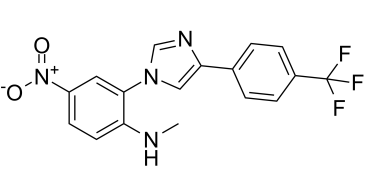
CU-T12-9 (CU T12-9; CU-T129) is a novel and potent TLR1/2 (Toll-like receptor) agonist with potential immunemodulatory and antitumor effects. Toll-like receptor (TLR) agonists activate both the innate and the adaptive immune systems. Thus, TLR agonists have been exploited as potent vaccine adjuvants and antitumor agents. CU-T12-9 activates TLR1/2 with an EC50 of 52.9 nM in HEK-Blue hTLR2 SEAP assay. CU-T12-9 signals through nuclear factor κB (NF-κB) and invokes an elevation of the downstream effectors tumor necrosis factor-α (TNF-α), interleukin-10 (IL-10), and inducible nitric oxide synthase (iNOS).
Physicochemical Properties
| Molecular Formula | C17H13F3N4O2 |
| Molecular Weight | 362.31 |
| Exact Mass | 362.099 |
| CAS # | 1821387-73-8 |
| PubChem CID | 91826088 |
| Appearance | Light yellow to yellow solid powder |
| Density | 1.4±0.1 g/cm3 |
| Boiling Point | 524.3±50.0 °C at 760 mmHg |
| Flash Point | 270.9±30.1 °C |
| Vapour Pressure | 0.0±1.4 mmHg at 25°C |
| Index of Refraction | 1.601 |
| LogP | 4.53 |
| Hydrogen Bond Donor Count | 1 |
| Hydrogen Bond Acceptor Count | 7 |
| Rotatable Bond Count | 3 |
| Heavy Atom Count | 26 |
| Complexity | 491 |
| Defined Atom Stereocenter Count | 0 |
| InChi Key | LITXVDAFEYLWQE-UHFFFAOYSA-N |
| InChi Code | InChI=1S/C17H13F3N4O2/c1-21-14-7-6-13(24(25)26)8-16(14)23-9-15(22-10-23)11-2-4-12(5-3-11)17(18,19)20/h2-10,21H,1H3 |
| Chemical Name | N-methyl-4-nitro-2-[4-[4-(trifluoromethyl)phenyl]imidazol-1-yl]aniline |
| Synonyms | CUT129 CU T12 9 CU-T12-9 |
| HS Tariff Code | 2934.99.9001 |
| Storage |
Powder-20°C 3 years 4°C 2 years In solvent -80°C 6 months -20°C 1 month |
| Shipping Condition | Room temperature (This product is stable at ambient temperature for a few days during ordinary shipping and time spent in Customs) |
Biological Activity
| ln Vitro | CU-T12-9 directly targets TLR1/2 to activate downstream signaling. By binding to TLR1 and TLR2, CU-T12-9 stimulates the development of the TLR1/2 heterodimer complex, thereby activating downstream signaling [1]. CU-T12-9 promotes downstream signaling, such as secretory embryonic alkaline phosphatase (SEAP), NO and TNF-α, via triggering NF-κB activation, thereby activating the TLR1/2 pathway [1]. CU-T12-9 (0.39-100 μM; 24 hours) does not generate toxicity up to 100 μM in HEK-Blue hTLR2 and Raw 264.7 cells [1]. CU-T12-9 upregulates the mRNA levels of TLR1, TLR2, TNF, IL-10, and iNOS. CU-T12-9 (0.1-10 μM) stimulates TLR1 mRNA and iNOS mRNA 24 hours after treatment of Raw 264.7 cells. CU-T12-9 (0.1-10 μM) activates TLR2 and IL-10 mRNA after 2 hours of stimulation of Raw 264.7 cells. CU-T12-9 (0.1-10 μM) activates TNF mRNA after 8 hours of treatment in Raw 264.7 cells [1]. |
| Cell Assay |
Cytotoxicity assay[1] Cell Types: HEK-Blue hTLR2 and Raw 264.7 Macrophage Tested Concentrations: 0.39, 0.78, 1.56, 3.125, 6.25, 12.5, 25, 50 and 100 μM Incubation Duration: 24 hrs (hours) Experimental Results: No toxicity observed Up to 100 μM. RT-PCR[1] Cell Types: Original 264.7 Cell Tested Concentrations: 0.1, 1, 10 μM Incubation Duration: TLR1 and iNOS mRNA assayed for 24 hrs (hours) TLR2 and IL-10 mRNA assayed for 2 hrs (hours) TNF mRNA assayed for 8 hrs (hours) Experimental Results: Triggered TLR1 mRNA and iNOS mRNA were dose-dependent at 24 hrs (hours). Dose-dependent activation of TLR2 mRNA and IL-10 mRNA at 2 hrs (hours). Dose-dependent activation of TNF mRNA was shown at 8 hrs (hours). |
| References |
[1]. Specific activation of the TLR1-TLR2 heterodimer by small-molecule agonists. Sci Adv. 2015;1(3). pii: e1400139. |
Solubility Data
| Solubility (In Vitro) | DMSO : ~250 mg/mL (~690.02 mM) |
| Solubility (In Vivo) |
Solubility in Formulation 1: ≥ 2.08 mg/mL (5.74 mM) (saturation unknown) in 10% DMSO + 40% PEG300 +5% Tween-80 + 45% Saline (add these co-solvents sequentially from left to right, and one by one), clear solution. For example, if 1 mL of working solution is to be prepared, you can add 100 μL of 20.8 mg/mL clear DMSO stock solution to 400 μL PEG300 and mix evenly; then add 50 μL Tween-80 + to the above solution and mix evenly; then add 450 μL normal saline to adjust the volume to 1 mL. Preparation of saline: Dissolve 0.9 g of sodium chloride in 100 mL ddH₂ O to obtain a clear solution. (Please use freshly prepared in vivo formulations for optimal results.) |
| Preparing Stock Solutions | 1 mg | 5 mg | 10 mg | |
| 1 mM | 2.7601 mL | 13.8003 mL | 27.6007 mL | |
| 5 mM | 0.5520 mL | 2.7601 mL | 5.5201 mL | |
| 10 mM | 0.2760 mL | 1.3800 mL | 2.7601 mL |