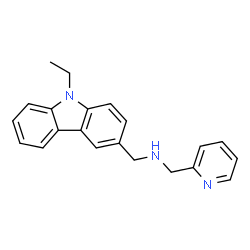
CMP-5 (PRMT5-IN-5) is a first-in-class and specific PRMT5 inhibitor with anticancer (B-cell lymphomas) and immunomodulatory activity. It displays no activity against other type I (PRMT1 and PRMT4) and type II (PRMT7) enzymes. CMP-5 blocks EBV-driven B-lymphocyte transformation and survival, without effect on normal B cells. Inhibition of PRMT5 leads to lost recruitment of a PRMT5/p65/HDAC3-repressive complex on the miR96 promoter, restored miR96 expression, and PRMT5 downregulation.
Physicochemical Properties
| Molecular Formula | C₂₁H₂₁N₃ |
| Molecular Weight | 315.41 |
| Exact Mass | 315.173 |
| CAS # | 880813-42-3 |
| Related CAS # | CMP-5 hydrochloride;1030021-40-9 |
| PubChem CID | 4722595 |
| Appearance | Light yellow to yellow ointment |
| Density | 1.1±0.1 g/cm3 |
| Boiling Point | 505.1±48.0 °C at 760 mmHg |
| Flash Point | 259.3±29.6 °C |
| Vapour Pressure | 0.0±1.3 mmHg at 25°C |
| Index of Refraction | 1.637 |
| LogP | 4.23 |
| Hydrogen Bond Donor Count | 1 |
| Hydrogen Bond Acceptor Count | 2 |
| Rotatable Bond Count | 5 |
| Heavy Atom Count | 24 |
| Complexity | 399 |
| Defined Atom Stereocenter Count | 0 |
| SMILES | N1C(CNCC2C=C3C4C(N(C3=CC=2)CC)=CC=CC=4)=CC=CC=1 |
| InChi Key | YPJMOVVQKBFRNH-UHFFFAOYSA-N |
| InChi Code | InChI=1S/C21H21N3/c1-2-24-20-9-4-3-8-18(20)19-13-16(10-11-21(19)24)14-22-15-17-7-5-6-12-23-17/h3-13,22H,2,14-15H2,1H3 |
| Chemical Name | 1-(9-ethylcarbazol-3-yl)-N-(pyridin-2-ylmethyl)methanamine |
| Synonyms | CMP5; cmp-5; 880813-42-3; 1-(9-ethyl-9H-carbazol-3-yl)-N-(pyridin-2-ylmethyl)methanamine; 1-(9-ethylcarbazol-3-yl)-N-(pyridin-2-ylmethyl)methanamine; CHEMBL4245087; SCHEMBL21308321; (9-Ethyl-9H-carbazol-3-ylmethyl)-pyridin-2-ylmethyl-amine; CMP 5 |
| HS Tariff Code | 2934.99.9001 |
| Storage |
Powder-20°C 3 years 4°C 2 years In solvent -80°C 6 months -20°C 1 month |
| Shipping Condition | Room temperature (This product is stable at ambient temperature for a few days during ordinary shipping and time spent in Customs) |
Biological Activity
| Targets | PRMT5 |
| ln Vitro | Although CMP-5 (0-100 μM; 24-72 hours) exerts effects, even after prolonged times, its toxicity to normal resting B is limited [1]. In comparison to the group treated with DMSO, CMP-5 (40 μM; 24 hours) decreased the expression of p-BTK and pY (416) SRC in 60A cells [1]. PRMT5 is preferentially transcribed in Th1 cells as opposed to Th2 cells when exposed to CMP-5 (0–40 μM; 24 hours); in human Th1 cells and Th2 cells, the IC50 values are 26.9 μM and 31.6 μM, respectively. CMP-5 (25 μM; 24 hours) decreased mouse Th1 cell proliferation by 91%. Different IL-2 dosages were applied, and the maximum degree of IL-2-enhanced proliferation was seen at 5 ng/mL [1]. |
| ln Vivo |
PRMT5 inhibition suppresses in vivo OVA-induced DTH inflammatory responses [2] The effectiveness of PRMT5 inhibitors at suppressing inflammatory memory T cell responses suggested that they may be beneficial in inflammatory or autoimmune disease. To test this, we used the OVA-induced DTH mouse model and HLCL65, a more potent and bioavailable derivative of CMP5 (Figs. 1H, 2H, Supplemental Fig. 2). First, we analyzed PRMT5 expression in the spleen of untreated mice after OVA immunization with CFA. We observed that, at 10 d after immunization, PRMT5 expression was upregulated significantly in the spleen (Fig. 6A), suggesting that PRMT5 expression is relevant to in vivo DTH immune responses. In the DTH model (outlined in Fig. 6B), OVA immunization with CFA induces an OVA-specific T cell response that causes footpad inflammation in mice upon subsequent exposure to adjuvant-free OVA and memory CD4+ T cell expansion. HLCL65 treatment during the rechallenge period reduced footpad swelling, a measure of inflammation, by 40% (p < 0.05, Fig. 6C). In addition, compared with vehicle, HLCL65 treatment reduced OVA-specific T cell proliferation by 36% (Fig. 6D) and IFN-γ production by 70% (Fig. 6E). These data indicate that our novel PRMT5 inhibitor HLCL65 suppresses T cell–mediated responses and inflammation in vivo. |
| Cell Assay |
Western Blot analysis [1] Cell Types: 60A Cell Tested Concentrations: 40 μM Incubation Duration: 24 hrs (hours) Experimental Results: Inhibition of p-BTK and pY(416)SRC protein levels. Cell viability assay [1] Cell Types: human Th1 cells and Th2 cells Tested Concentrations: 25 μM Incubation Duration: 24 hrs (hours) Experimental Results: Inhibited mouse Th1 cell proliferation, but adding IL-2 dose-dependently increased cell proliferation. |
| Animal Protocol |
OVA-induced DTH [2] CFA and OVA emulsion was prepared at a 1:1 v/v ratio for a final concentration of 1500 μg of OVA/1 ml of PBS. BALB/c mice were injected with 100 μl of emulsion in the dorsal proximal scruff and the base of the tail (150 μg of OVA per mouse). Control groups included nonimmunized mice and immunized mice that were not subsequently challenged with OVA. One week after immunization, aggregated OVA was prepared by suspending in PBS at a concentration of 10 mg/ml in a 15-ml tube. Solution was heated in an 80°C water bath for 60 min. Mice were challenged with 300 μg of aggregated OVA by injecting 30 μl of solution into the left footpad of immunized mice. After an additional week, mice were rechallenged in the same manner (nonimmunized mice were also challenged at this step). Twenty-four hours after the second challenge, mice were euthanized by CO2 asphyxiation and cervical dislocation. Each footpad was measured using calipers for swelling (pre-euthanasia) and weighed for changes in mass. Additionally, spleens were removed and processed for in vitro studies. Experimental autoimmune encephalomyelitis [2] For induced EAE, commercial Hooke Reagent or myelin oligodendrocyte glycoprotein and CFA emulsion were used. CFA/MOG emulsion was prepared in a 1:1 v/v ratio for a final concentration of 1000 μg MOG/1 ml of PBS. C57/B6 mice received 100 μl of emulsion s.c. in the dorsal proximal scruff and the base of the tail. About 2 h after immunization, mice were injected i.p. with 100 μl of 2 ng/μl pertussis toxin. Twenty-four hours later, mice were injected again with 100 μl of 2 ng/μl pertussis toxin. Mice were monitored for disease every day and treated with 25 mg/kg HLCL65 or DMSO vehicle control. At the indicated time points, mice were euthanized by injection with 20 mg/ml ketamine and 4 mg/ml xylazine (120 μl/20 g mouse) and perfused with PBS. Spleens, brains, and spinal cords were collected from representative mice and processed for in vitro studies. To isolate brain and spinal cord mononuclear cells, brains and spinal cords were processed through a 70-μm strainer and separated by a 70–30% isotonic Percoll gradient. [2] For spontaneous EAE, three MBPAc1–11 TCR-Tg mice that developed EAE spontaneously (scores = 1.5–2) were euthanized by CO2 asphyxiation and cervical dislocation. Splenocytes were isolated and activated with 2 μg/ml MBPAc1–11 for 48 h in the presence of PRMT5 inhibitors or vehicle control. T-bet, IL-17, and RORγt expression was analyzed by intracellular flow cytometry. |
| References |
[1]. Selective inhibition of protein arginine methyltransferase 5 blocks initiation and maintenance of B-cell transformation.Blood. 2015 Apr 16;125(16):2530-43. [2]. PRMT5-Selective Inhibitors Suppress Inflammatory T Cell Responses and Experimental Autoimmune Encephalomyelitis. J Immunol. 2017 Feb 15;198(4):1439-1451. |
| Additional Infomation |
Epigenetic events that are essential drivers of lymphocyte transformation remain incompletely characterized. We used models of Epstein-Barr virus (EBV)-induced B-cell transformation to document the relevance of protein arginine methyltransferase 5 (PRMT5) to regulation of epigenetic-repressive marks during lymphomagenesis. EBV(+) lymphomas and transformed cell lines exhibited abundant expression of PRMT5, a type II PRMT enzyme that promotes transcriptional silencing of target genes by methylating arginine residues on histone tails. PRMT5 expression was limited to EBV-transformed cells, not resting or activated B lymphocytes, validating it as an ideal therapeutic target. We developed a first-in-class, small-molecule PRMT5 inhibitor that blocked EBV-driven B-lymphocyte transformation and survival while leaving normal B cells unaffected. Inhibition of PRMT5 led to lost recruitment of a PRMT5/p65/HDAC3-repressive complex on the miR96 promoter, restored miR96 expression, and PRMT5 downregulation. RNA-sequencing and chromatin immunoprecipitation experiments identified several tumor suppressor genes, including the protein tyrosine phosphatase gene PTPROt, which became silenced during EBV-driven B-cell transformation. Enhanced PTPROt expression following PRMT5 inhibition led to dephosphorylation of kinases that regulate B-cell receptor signaling. We conclude that PRMT5 is critical to EBV-driven B-cell transformation and maintenance of the malignant phenotype, and that PRMT5 inhibition shows promise as a novel therapeutic approach for B-cell lymphomas.[1] In the autoimmune disease multiple sclerosis and its animal model, experimental autoimmune encephalomyelitis (EAE), expansion of pathogenic, myelin-specific Th1 cell populations drives active disease; selectively targeting this process may be the basis for a new therapeutic approach. Previous studies have hinted at a role for protein arginine methylation in immune responses, including T cell-mediated autoimmunity and EAE. However, a conclusive role for the protein arginine methyltransferase (PRMT) enzymes that catalyze these reactions has been lacking. PRMT5 is the main PRMT responsible for symmetric dimethylation of arginine residues of histones and other proteins. PRMT5 drives embryonic development and cancer, but its role in T cells, if any, has not been investigated. In this article, we show that PRMT5 is an important modulator of CD4+ T cell expansion. PRMT5 was transiently upregulated during maximal proliferation of mouse and human memory Th cells. PRMT5 expression was regulated upstream by the NF-κB pathway, and it promoted IL-2 production and proliferation. Blocking PRMT5 with novel, highly selective small molecule PRMT5 inhibitors severely blunted memory Th expansion, with preferential suppression of Th1 cells over Th2 cells. In vivo, PRMT5 blockade efficiently suppressed recall T cell responses and reduced inflammation in delayed-type hypersensitivity and clinical disease in EAE mouse models. These data implicate PRMT5 in the regulation of adaptive memory Th cell responses and suggest that PRMT5 inhibitors may be a novel therapeutic approach for T cell-mediated inflammatory disease.[2] |
Solubility Data
| Solubility (In Vitro) | DMSO : ~125 mg/mL (~396.31 mM) |
| Solubility (In Vivo) |
Solubility in Formulation 1: ≥ 6.25 mg/mL (19.82 mM) (saturation unknown) in 10% DMSO + 40% PEG300 + 5% Tween80 + 45% Saline (add these co-solvents sequentially from left to right, and one by one), clear solution. For example, if 1 mL of working solution is to be prepared, you can add 100 μL of 62.5 mg/mL clear DMSO stock solution to 400 μL PEG300 and mix evenly; then add 50 μL Tween-80 to the above solution and mix evenly; then add 450 μL normal saline to adjust the volume to 1 mL. Preparation of saline: Dissolve 0.9 g of sodium chloride in 100 mL ddH₂ O to obtain a clear solution. Solubility in Formulation 2: ≥ 6.25 mg/mL (19.82 mM) (saturation unknown) in 10% DMSO + 90% Corn Oil (add these co-solvents sequentially from left to right, and one by one), clear solution. For example, if 1 mL of working solution is to be prepared, you can add 100 μL of 62.5 mg/mL clear DMSO stock solution to 900 μL corn oil and mix evenly. (Please use freshly prepared in vivo formulations for optimal results.) |
| Preparing Stock Solutions | 1 mg | 5 mg | 10 mg | |
| 1 mM | 3.1705 mL | 15.8524 mL | 31.7048 mL | |
| 5 mM | 0.6341 mL | 3.1705 mL | 6.3410 mL | |
| 10 mM | 0.3170 mL | 1.5852 mL | 3.1705 mL |