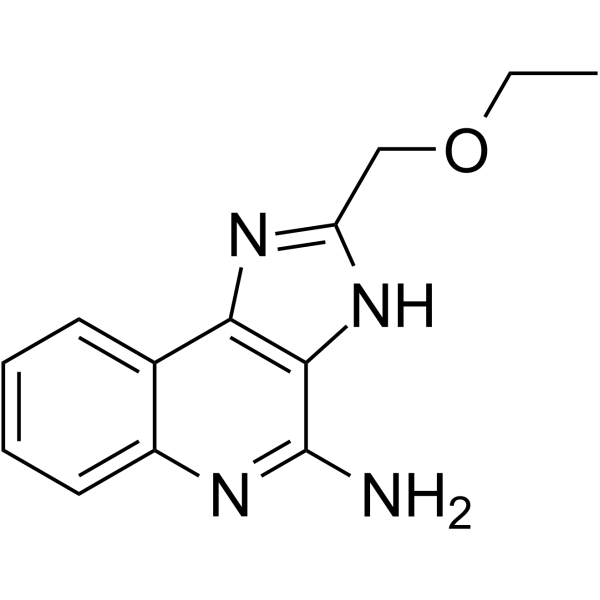
Physicochemical Properties
| Molecular Formula | C13H14N4O |
| Molecular Weight | 242.28 |
| Exact Mass | 242.116 |
| CAS # | 1026249-18-2 |
| Related CAS # | CL097 hydrochloride |
| PubChem CID | 11579618 |
| Appearance | White to off-white solid powder |
| LogP | 1.5 |
| Hydrogen Bond Donor Count | 2 |
| Hydrogen Bond Acceptor Count | 4 |
| Rotatable Bond Count | 3 |
| Heavy Atom Count | 18 |
| Complexity | 288 |
| Defined Atom Stereocenter Count | 0 |
| SMILES | N1C2C(=CC=CC=2)C2N=C(COCC)NC=2C=1N |
| InChi Key | DEVCLHVFELRPIU-UHFFFAOYSA-N |
| InChi Code | InChI=1S/C13H14N4O/c1-2-18-7-10-16-11-8-5-3-4-6-9(8)15-13(14)12(11)17-10/h3-6H,2,7H2,1H3,(H2,14,15)(H,16,17) |
| Chemical Name | 2-(ethoxymethyl)-3H-imidazo[4,5-c]quinolin-4-amine |
| HS Tariff Code | 2934.99.9001 |
| Storage |
Powder-20°C 3 years 4°C 2 years In solvent -80°C 6 months -20°C 1 month |
| Shipping Condition | Room temperature (This product is stable at ambient temperature for a few days during ordinary shipping and time spent in Customs) |
Biological Activity
| ln Vitro | CL097 activates NF-κB at 0.1 μM in TLR7-transfected HEK293 cells and at 4 μM in TLR8-transfected HEK293 cells [1]. By imitating the phosphorylation of p47phox in the human neutrophil signaling system, CL097 causes overactivation of NADPH oxidase, suggesting that p38 MAPK, ERK1/2, protein inhibitor C, and Pin1 regulate this process. CL097 increases fmlf-induced p47phox and causes phosphorylation of p47phox at particular locations. |
| ln Vivo | CL097 and CD40 agonists promote significant diabetogenic cytotoxic T pathway (CTL) activity in NOD mice. CL097 (5 mg/kg, sc) alone induced possible excess (~25%) of the target peptide. However, combination treatment with CL097 and a CD40 agonist (10 mg/kg, ip) resulted in an approximately twofold increase in the oscillation frequency of IGRP peptide-coated targets compared to treatment with CL097 alone [3]. |
| Cell Assay |
Western Blot analysis [2] Cell Types: Neutrophil Tested Concentrations: 0, 0.5, 2.5, 5 and 10 μg/mL Incubation Duration: 30 minutes of pretreatment Experimental Results: Induces phosphorylation of p47phox at specific sites at a certain concentration [2]. Dependence method. |
| Animal Protocol |
Animal/Disease Models: Female 8.3 NOD mice (5-6 weeks old) [3] Doses: 5 mg/kg Route of Administration: subcutaneous injection Experimental Results: Caused moderate specific cleavage of the target peptide (∼25%). |
| References |
[1]. Agonist and antagonist ligands of toll-like receptors 7 and 8: Ingenious tools for therapeutic purposes. Eur J Med Chem. 2020 May 1;193:112238. [2]. The TLR7/8 agonist CL097 primes N-formyl-methionyl-leucyl-phenylalanine-stimulated NADPH oxidase activation in human neutrophils: critical role of p47phox phosphorylation and the proline isomerase Pin1. J Immunol. 2012 Nov 1;189(9):4657-65. [3]. Toll-like receptor 7 stimulation promotes autoimmune diabetes in the NOD mouse. Diabetologia. 2011 Jun;54(6):1407-16. |
Solubility Data
| Solubility (In Vitro) | DMSO : ~100 mg/mL (~412.75 mM) |
| Solubility (In Vivo) |
Solubility in Formulation 1: ≥ 2.5 mg/mL (10.32 mM) (saturation unknown) in 10% DMSO + 40% PEG300 + 5% Tween80 + 45% Saline (add these co-solvents sequentially from left to right, and one by one), clear solution. For example, if 1 mL of working solution is to be prepared, you can add 100 μL of 25.0 mg/mL clear DMSO stock solution to 400 μL PEG300 and mix evenly; then add 50 μL Tween-80 to the above solution and mix evenly; then add 450 μL normal saline to adjust the volume to 1 mL. Preparation of saline: Dissolve 0.9 g of sodium chloride in 100 mL ddH₂ O to obtain a clear solution. Solubility in Formulation 2: ≥ 2.5 mg/mL (10.32 mM) (saturation unknown) in 10% DMSO + 90% (20% SBE-β-CD in Saline) (add these co-solvents sequentially from left to right, and one by one), clear solution. For example, if 1 mL of working solution is to be prepared, you can add 100 μL of 25.0 mg/mL clear DMSO stock solution to 900 μL of 20% SBE-β-CD physiological saline solution and mix evenly. Preparation of 20% SBE-β-CD in Saline (4°C,1 week): Dissolve 2 g SBE-β-CD in 10 mL saline to obtain a clear solution. Solubility in Formulation 3: ≥ 2.5 mg/mL (10.32 mM) (saturation unknown) in 10% DMSO + 90% Corn Oil (add these co-solvents sequentially from left to right, and one by one), clear solution. For example, if 1 mL of working solution is to be prepared, you can add 100 μL of 25.0 mg/mL clear DMSO stock solution to 900 μL of corn oil and mix evenly. (Please use freshly prepared in vivo formulations for optimal results.) |
| Preparing Stock Solutions | 1 mg | 5 mg | 10 mg | |
| 1 mM | 4.1275 mL | 20.6373 mL | 41.2746 mL | |
| 5 mM | 0.8255 mL | 4.1275 mL | 8.2549 mL | |
| 10 mM | 0.4127 mL | 2.0637 mL | 4.1275 mL |