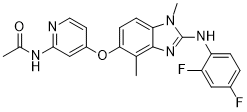
CHZ868 (CHZ-868) is a novel, potent and selective type II JAK2 inhibitor with an IC50 of 0.17 μM in EPOR JAK2 WT Ba/F3 cell. It stabilizes JAK2 in an inactive conformation. CHZ868 potently suppressed the growth of CRLF2-rearranged human B-ALL cells, abrogated JAK2 signaling, and improved survival in mice with human or murine B-ALL. CHZ868 and dexamethasone synergistically induced apoptosis in JAK2-dependent B-ALLs and further improved in vivo survival compared to CHZ868 alone. These data support the testing of type II JAK2 inhibition in patients with JAK2-dependent leukemias and other disorders.
Physicochemical Properties
| Molecular Formula | C22H19F2N5O2 |
| Molecular Weight | 423.415371179581 |
| Exact Mass | 423.15 |
| CAS # | 1895895-38-1 |
| PubChem CID | 91885989 |
| Appearance | White to gray solid powder |
| Density | 1.4±0.1 g/cm3 |
| Index of Refraction | 1.640 |
| LogP | 5.11 |
| Hydrogen Bond Donor Count | 2 |
| Hydrogen Bond Acceptor Count | 7 |
| Rotatable Bond Count | 5 |
| Heavy Atom Count | 31 |
| Complexity | 629 |
| Defined Atom Stereocenter Count | 0 |
| InChi Key | KQQLBXFPTDVFAJ-UHFFFAOYSA-N |
| InChi Code | InChI=1S/C22H19F2N5O2/c1-12-19(31-15-8-9-25-20(11-15)26-13(2)30)7-6-18-21(12)28-22(29(18)3)27-17-5-4-14(23)10-16(17)24/h4-11H,1-3H3,(H,27,28)(H,25,26,30) |
| Chemical Name | N-[4-[2-(2,4-difluoroanilino)-1,4-dimethylbenzimidazol-5-yl]oxypyridin-2-yl]acetamide |
| HS Tariff Code | 2934.99.9001 |
| Storage |
Powder-20°C 3 years 4°C 2 years In solvent -80°C 6 months -20°C 1 month |
| Shipping Condition | Room temperature (This product is stable at ambient temperature for a few days during ordinary shipping and time spent in Customs) |
Biological Activity
| ln Vitro | In JAK2V617F SET2 cells, CHZ868 potently suppresses constitutive phosphorylation of JAK2 and STAT5. CHZ868 exhibits a 6-fold reduced growth inhibitory efficacy on CMK cells (GI50=378nM) and efficiently suppresses the proliferation of SET2 cells (GI50=59nM) [1]. CHZ868 is active against 26 kinases, including TYK2 and JAK2, at 100 nM. It is believed that CHZ868 binds to the hinge region of JAK2 by way of two H bonds that are created between the backbone of L932 (NH/CO) and the amino group of CHZ868 (pyridine), which resides in the adenine pocket of the ATP binding site. JAK2 signaling is significantly inhibited and CRLF2-rearranged human B-ALL cell proliferation is effectively suppressed by CHZ868 [2]. |
| ln Vivo | CHZ868 is ideal for in vivo application due to its high passive permeability, strong metabolic stability, low water solubility, moderate blood clearance, and good oral bioavailability. The survival of mice with human or mouse B-ALL is improved by CHZ868,8. In comparison to CHZ868 alone, dexamethasone and CHZ868 together synergistically induce JAK2-dependent B-ALL cell death, substantially increasing the survival rate [2]. |
| References |
[1]. CHZ868, a Type II JAK2 Inhibitor, Reverses Type I JAK Inhibitor Persistence and Demonstrates Efficacy in Myeloproliferative Neoplasms. Cancer Cell. 2015 Jul 13;28(1):15-28. [2]. Activity of the Type II JAK2 Inhibitor CHZ868 in B Cell Acute Lymphoblastic Leukemia. Cancer Cell. 2015 Jul 13;28(1):29-41. |
| Additional Infomation | CHZ868 is a memger of the class of benzimidazoles that is benzimidazole that is substituted by methyl groups at positions 1 and 4, by a 2,4-difluoroanilino group at position 2, and by a (2-acetamidopyridin-4-yl)oxy group at position 5. It is a type II JAK2 inhibitor with antineoplastic activity. It has a role as an EC 2.7.10.2 (non-specific protein-tyrosine kinase) inhibitor and an antineoplastic agent. It is a member of benzimidazoles, a member of acetamides, a member of pyridines, a difluorobenzene, an aromatic ether, a secondary amino compound and an aromatic amine. |
Solubility Data
| Solubility (In Vitro) | DMSO : ~100 mg/mL (~236.17 mM) |
| Solubility (In Vivo) |
Solubility in Formulation 1: ≥ 2.5 mg/mL (5.90 mM) (saturation unknown) in 10% DMSO + 40% PEG300 + 5% Tween80 + 45% Saline (add these co-solvents sequentially from left to right, and one by one), clear solution. For example, if 1 mL of working solution is to be prepared, you can add 100 μL of 25.0 mg/mL clear DMSO stock solution to 400 μL PEG300 and mix evenly; then add 50 μL Tween-80 to the above solution and mix evenly; then add 450 μL normal saline to adjust the volume to 1 mL. Preparation of saline: Dissolve 0.9 g of sodium chloride in 100 mL ddH₂ O to obtain a clear solution. Solubility in Formulation 2: ≥ 2.5 mg/mL (5.90 mM) (saturation unknown) in 10% DMSO + 90% (20% SBE-β-CD in Saline) (add these co-solvents sequentially from left to right, and one by one), clear solution. For example, if 1 mL of working solution is to be prepared, you can add 100 μL of 25.0 mg/mL clear DMSO stock solution to 900 μL of 20% SBE-β-CD physiological saline solution and mix evenly. Preparation of 20% SBE-β-CD in Saline (4°C,1 week): Dissolve 2 g SBE-β-CD in 10 mL saline to obtain a clear solution. Solubility in Formulation 3: ≥ 2.5 mg/mL (5.90 mM) (saturation unknown) in 10% DMSO + 90% Corn Oil (add these co-solvents sequentially from left to right, and one by one), clear solution. For example, if 1 mL of working solution is to be prepared, you can add 100 μL of 25.0 mg/mL clear DMSO stock solution to 900 μL of corn oil and mix evenly. (Please use freshly prepared in vivo formulations for optimal results.) |
| Preparing Stock Solutions | 1 mg | 5 mg | 10 mg | |
| 1 mM | 2.3617 mL | 11.8086 mL | 23.6172 mL | |
| 5 mM | 0.4723 mL | 2.3617 mL | 4.7234 mL | |
| 10 mM | 0.2362 mL | 1.1809 mL | 2.3617 mL |